Story of Rice — How a white grain became a staple food
What does it take to put a plateful of rice on your table?
In this episode of “Story Of…”, Richa Govil examines the layered role of rice in Indian society and economy. Joining her is Manikandan V, faculty at Azim Premji University and an expert in food rights and social inclusion.
Details
Chāwal, Bhāt, Sādam… it is almost impossible to picture Indian cuisine without a steaming mound of rice. Accompanied by a ladleful of boiled lentils, a seasoning of roasted cumin seeds, a dollop of ghee or curd, cooked along with meat or vegetables, or served with a side of curried fish, it is the centrepiece of a square meal in many regions of India.
Did you know that the English word ‘rice’ may have its roots in व्रीहि (“vrìhí”), the Sanskrit word for grain? References to rice are plentiful in ancient Indian texts, notably in the Mahabharata. The legend of the Akshaya Patra, the inexhaustible bowl, recounts how Krishna satisfied the hunger of a sage and his disciples with a single grain of rice and a small portion of vegetable.
But what does it take to put a plateful of rice on your table?
In this episode of “Story Of…”, Richa Govil examines the layered role of rice in Indian society and economy. Joining her is Manikandan V, faculty at Azim Premji University and an expert in food rights and social inclusion.
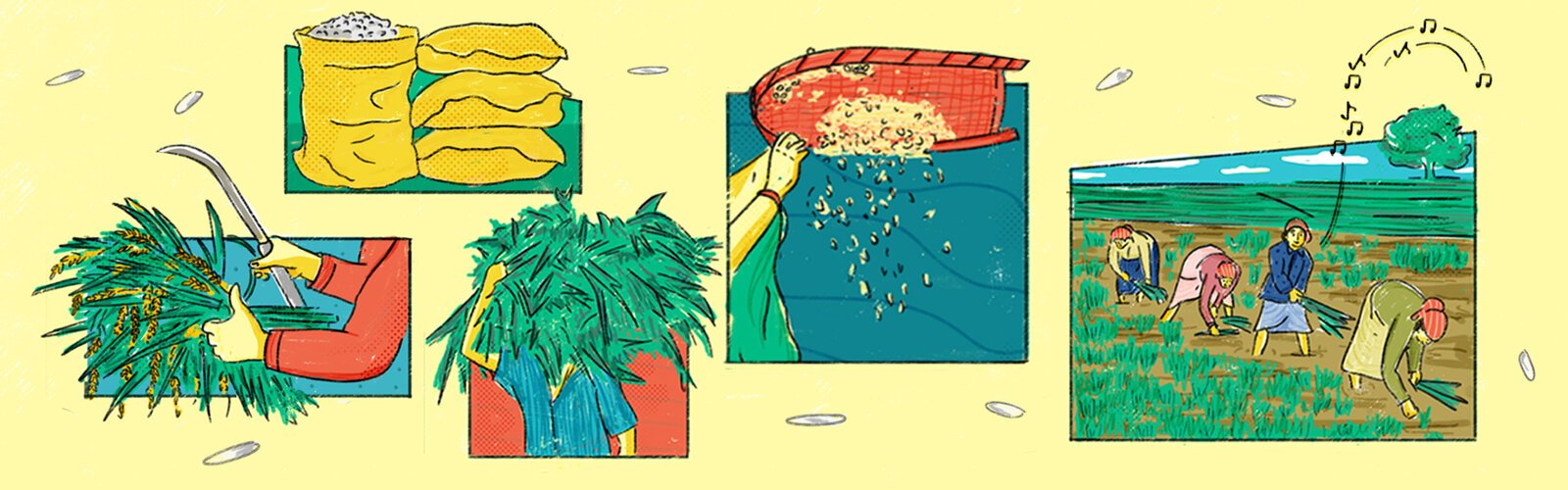
Originating in China 10,000 years ago, rice has become a global staple, especially in India, thanks to the mid-20th-century Green Revolution. While this government initiative boosted crop yields, it also led to environmental challenges like soil degradation and water depletion. Despite its benefits, the Green Revolution emphasised the need for sustainable agricultural practices. We delve into the complexities of sustainability in rice production, considering challenges like organic farming limitations, and the importance of holistic strategies such as sustainable water management and crop diversification.
Join Richa and Mani as they uncover how stakeholders are striving for a balance between economic viability, nutrition, and environmental sustainability in the journey from field to plate.
How about another serving?
Credits:
Akshay Ramuhalli, Bijoy Venugopal, Bruce Lee Mani, Harshit Hillol Gogoi, Narayan Krishnaswamy, Prashant Vasudevan, Sananda Dasgupta, Seema Seth, Shraddha Gautam, Supriya Joshi and Velu Shankar
Acknowledgements
YouTube | Traditional song while harvesting paddy crop in my farm
YouTube | Basmati Rice Se No Compromise — I love my Sasumaa!
YouTube | How Rice is Made : Step by Step Growing Rice Paddy Farming, South India
YouTube | Revolution Indian Agriculture
YouTube | For Hunger & Poverty Free World M S Swaminathan
Further Reading and Resources
Journal Articles and Research Papers:
- Restoring Rice Biodiversity, Debal Deb,Scientific American , Vol. 321, No. 4 (OCTOBER 2019), pp. 54 – 61 | JSTOR
- Folk Rice Varieties, Traditional Agricultural Knowledge and Food Security, Debal Deb| ResearchGate
- In book: Multicultural Knowledge and the University (pp.45 – 57), Chapter: 6, Publisher: Multiversity and Citizens International, Editors: Claude Alvarez, 2014
- Rice Production in India, Gulshan Mahajan, Vivek Kumar & Bhagirath S. Chauhan | Springer
- Growth and instability of rice production in India, Y. Manohar, S.M. Jainuddin, Dinesh TM P. Divakar Reddy, Indian Journal of Economics and Development 13(2a):338, 2017| Researchgate
- Growth Performance and Profitability of Rice Production in India: An Assertive Analysis, Singh, K.M. and Ahmad, Nasim and Pandey, Vagish Vandana and Kumari, Tulika and Singh, Ritambhara, Munich Personal RePEc Archive, 2021.
- Rice Production Systems, A.N. Rao, S.P. Wani, M.S. Ramesha, and J.K. Ladha, Springer International Publishing, 2017
Feature Articles and Interviews
- Ecologist Debal Deb on what’s wrong with the government programmes | Scroll
- Debal Deb, the man fighting to reintroduce India to indigenous rice farming | Telegraph India
- YouTube: Debal Deb, India’s ‘Rice Warrior’, on Climate-resilient Agriculture | The Wire Science
- India needs to usher in Green Revolution 2.0 to promote less water-intensive crops: GTRI
- How farmers in India are making rice cultivation sustainable | The National
Explore more episodes in this series
-

Crunch! Slurp! The Story of Pani Puri in India
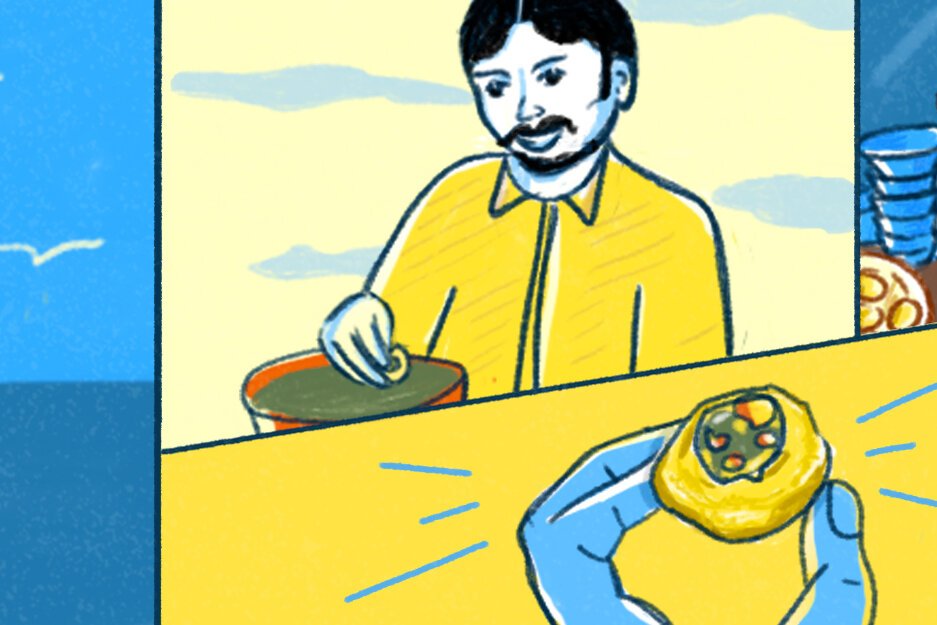
Pani Puri! Behind every morsel of the mouthwatering street snack is a human story of migration, entrepreneurship, labour, and the right to work. Listen to the first episode of “Story Of…” on Radio Azim Premji University.
-
Burp! Guess who had a husband for dinner?
Yes, they eat their mates, but spiders are perhaps the most misunderstood creatures. Hollywood films portraying them as hairy, ravenous monsters haven’t helped their cause. If spiders went extinct, earth’s ecosystem would collapse. Learn more about these fascinating creatures in this episode of Story Of…
-
Killer Jeans — Why Are Women Garment Workers Dying Young?
There’s a harrowing story of livelihood, labour, and premature death stitched into the fabric of your denim. The next time you buy a pair of jeans, remember the young women who crafted them, balancing dreams and hardships, somewhere on a shop floor in a Bengaluru industrial estate
-
Lantana — the unwelcome guest that refused to leave
In Story of Lantana, the third episode in our series “Story Of…”, Richa Govil and Madhuri Ramesh ponder the differences between alien and invasive species, mulling over the role that humans have played in altering biodiversity around the world. They reflect on the broader implications of introduced species and confront the complexities of categorising organisms as invasive or desirable.