
We Don’t Need No Education!
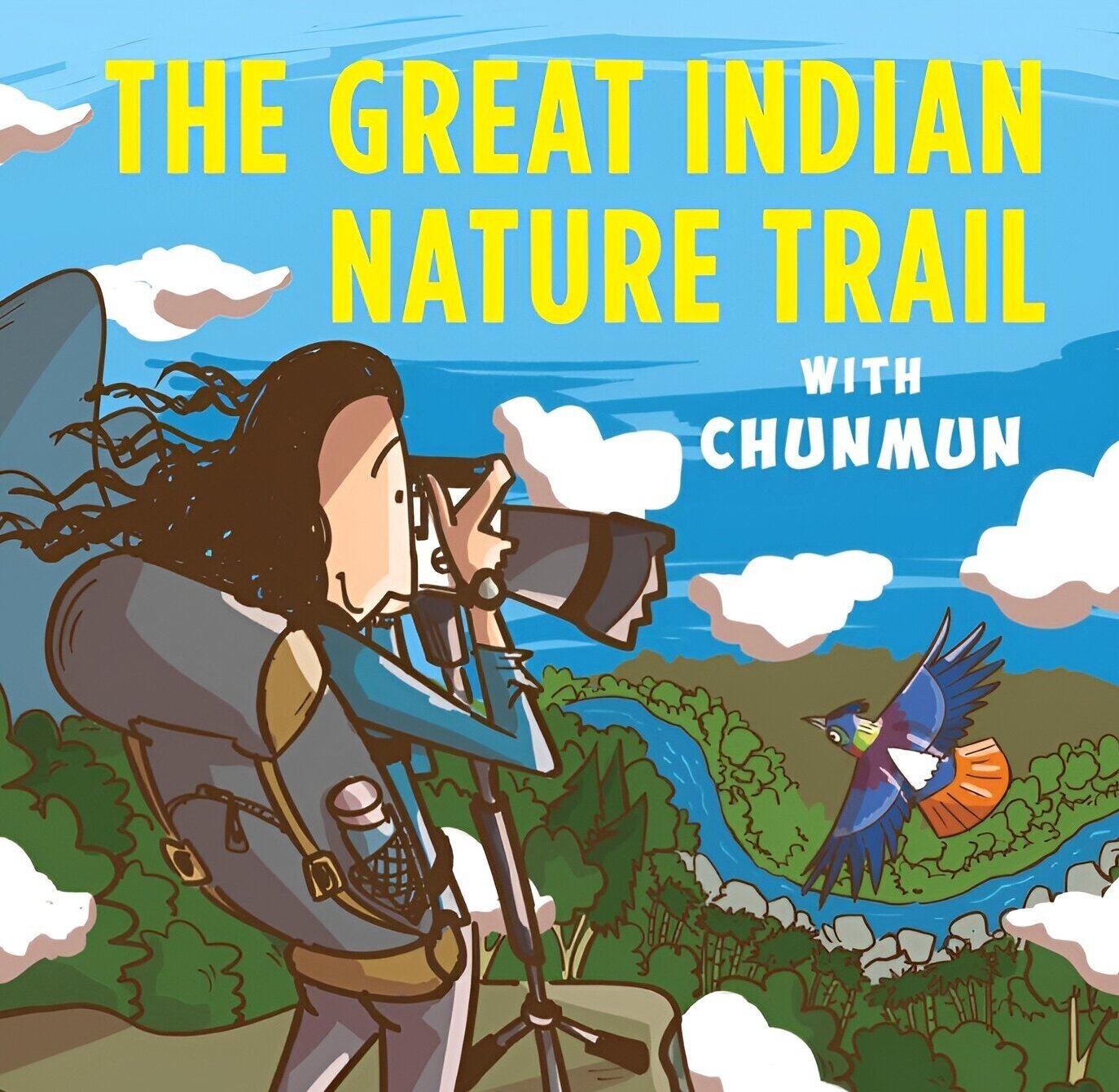
Book Title: The Great Indian Nature Trail with Chunmun
Author: Rohan Chakravarty and Bijal Vachharajani
Illustrator: Rohan Chakravarty
Publisher: India Pitta Kids/Juggernaut, 2025 (paperback, ₹499)
Reviewed by: Dakshayini Suresh
Details
In The Great Indian Nature Trail with Chunmun, acclaimed cartoonist Rohan Chakravarty and well-known children’s writer Bijal Vachharajani team up to bring young readers yet another journey through India’s diverse landscapes, showcasing its unique wildlife. Picking up on characters first introduced in The Great Indian Nature Trail with Uncle Bikky, the comics in this volume follow Chunmun — a fictional figure based on the wildlife photographer Munmun Dhalaria — as she traverses the sugarcane fields of Maharashtra, the waters of the Arabian sea, the foothills of Garhwal and many more terrains in search of wildlife for her photo essay. Drawing heavily from the world of wildlife and conservation research in India, the book frequently refers to real people working in the field such as Bano Haralu, Sejal Mehta and Arati Kumar-Rao among others. The comic strips are interspersed with fun facts and activities, positioning the book as an active learning experience for young readers.
About a double spread long, the comic strips are episodic in nature and represent short visits to specific locales where Chunmun meets a new wildlife expert who tells her and the reader about particular species of wildlife like the Hoolock Gibbon, the Humpback River Dolphin and the Gharial. The comics are animated in Chakravarty’s signature style with bold easy lines and vivid colours. Unlike his Green Humour panels where birds and animals exchange dialogues and deliver jokes, the creatures in The Great Indian Nature Trail are rendered realistically, sans speech bubbles, and in careful shaded detail, so that a young reader can potentially use the drawings to identify them in the wild.
Each comic spread is beautifully underpinned by a colour scheme: soft greens and blues, delicate peach and mauve, and sandy ochres and browns, which are deployed to stunning effect, evoking landscapes and times of day effectively, and drawing the reader further into the artist’s thoughtfully composed visual universe. The only downside is the choice of typeface, which is sometimes too bubbly and bold to be legible, while the white font sometimes blends in with the background in a manner that may bother some readers.
The comics are informative. They convey a few basic facts about an animal and its natural habitat and generally include a line or two about human-animal interactions, such as how the creature is viewed by the local people, and what strategies they use to avoid conflict. By visualising each section as a conversation between Chunmun and a different wildlife professional, the book also gives readers occasional insights into how wildlife research works — what different kinds of scientists specialise in, what a wildlife writer does and how a camera trap works. Many of the comics contain a bleak, realistic message about how climate change or human activity is endangering the lives of the creatures on the great Indian nature trail.
However, at a narrative level, one feels the comic strips could do more. Although the recurring figures of her ornithologist Uncle Bikky and Duggu the dog are used to bring some continuity to Chunmun’s story, the comics are really just quick educational bites, rather than real storytelling. This could well be what the expert comic artist was aiming for, but one wonders if he missed a trick by not making this a more immersive, adventure-style narrative with a veiled rather than overt pedagogical element.
Between the information-heavy comic spreads, one finds an array of facts about the featured animals or their habitats, generally followed by a language- or art-based activity. These activities, that seem to be pitched at a middle-school/adolescent age-group, range from the mundane and slightly silly to the involved and bordering-on-homework. In some cases, it feels like an editor could have helped cut down on activities that don’t add much fun to the proceedings. In these sections, Rohan Chakravarty’s drawings turn into school-textbook style perfunctory sketches, and the charm of the comic spreads is interrupted by asking the reader to “do” a task that can make their experience of the chapter educational.
The tone of the interludes is problematic, with jokes about real estate prices and Amitabh Bachchan, making the writer sound out of touch with how children think. Aside from the somewhat forced humour, the activity interludes make the book feel overfull, as if every page should “teach” the reader something. Some sections, such as the one towards the end of the book where readers are given dos and don’ts when trying to photograph animals, could have been given more space, especially since it highlights safety concerns.
If the book is treated purely as a classroom tool, it can be thought of as quite useful. Librarians and environmental science teachers might have fun passing this one around in class, or taking inspiration from some of the activities. The recommendations for follow-up reading given in the activity sections may also come in handy.
In the end, The Great Indian Nature Trail with Chunmun is jam-packed with info and yet slightly disappointing. With its inviting title and warm artwork, the comic-workbook promises an epic experience, but stops instead at delivering well-illustrated facts. It will be interesting to see if Rohan Chakravarty, whose best panels are his most detailed, can take on a more free-flowing narrative format in his next foray into the wild.
About the reviewer:
Dakshayini is a feminist educator. Her instructional experience spans age-groups and learning needs, and ranges across the areas of libraries, language, gender and social science. She is an external consultant with the practice team at IIHS, where she works on building narrative outputs for education-related projects.