
Ode to Rivers
Book Title: Submerged Worlds and Other Stories of India’s Mighty Rivers
Author: Vaishali Shroff
Publisher: Penguin (paperback, ₹299)
Reviewed by: Krupa Ge
Details
Back when I was in school, marking rivers and their tributaries on maps during geography class was a thrilling experience. In my own life, in urban Chennai however, rivers had played too little a part in those years. I didn’t even know where my city’s rivers were located and what stories they carried (and boy, do they carry stories!). I wish someone had introduced me to my city’s rivers the way Vaishali Shroff introduces, most admirably, so many rivers in her new book Submerged Worlds and Other Stories of India’s Mighty Rivers.
From the Siachen glacier and the Bhagirathi to the ‘mythical’ (not!) Saraswati; from the fascinating yet sad submerged worlds of Curdi in Goa to disappearing (seasonal) rivers like the Luni, the book is a deeply researched and well-put-together collection of narratives about India’s known and little-known rivers. Although written for young readers, the honesty of its tone and the depth of knowledge it conveys make it equally compelling for adults. I had visited Nubra Valley just a month before the devastating 2010 flood caused by a cloudburst that swept away entire villages; reading about the Valley in the book brought back bittersweet memories.
Concerning itself with more than just educating us about rivers, the book does a fantastic job of capturing the lives of people who live near these rivers, and their livelihoods which are often intricately linked to the ecology of the riverscape. After all, what else are we if not all belonging to one another, humanity and nature? In the chapter titled ‘Island of the Mising’, for instance, she writes about Majuli, ‘the world’s largest riverine island situated on the lap of the mighty Brahmaputra River — the boon and bane of Assam…’ and the art of making masks known as mukha-shilpa: These masks are made using clay, also known as kumar mitti, which is found in the riverbed of the Brahmaputra, bamboo, gobar or cow dung and cane. They are used for dance and theatre performances in Raas Utsav, one of the most prominent festivals celebrated in Assam, thus making Majuli a cultural hub.
The book does not shy away from inconvenient truths about the state of our rivers and the fates of those who live around them. I found the chapter titled ‘944mm, 24 hours’ about Mumbai’s rivers (now reduced to nullahs or khaadis) and the devastating 2005 floods, deeply moving. It reminded me of my own experience of the 2015 Chennai floods that led me to write the book Rivers Remember. Incidentally, it was Vikram Doctor’s piece on the 2005 Mumbai floods for The Times of India ‘Rivers that Remember and Cities that Forget’ that inspired the title of my book.
The fact that this book digs deeper into the problematic aspects of our river’s stories and emphasises on addressing pressing concerns, such as displacement from dams, the marginalisation of the ‘children of our rivers’ or forthcoming irreversible ecological damage, as in the case of the Great Nicobar Island Development Project, is proof enough of the fact that the writer is not patronising her readers. Instead, she is taking them into confidence while showing them an unfiltered narrative. In the chapter ‘Children of Rivers’, Shroff writes: In today’s world, it’s the majhis and mallahs or the boatmen of Varanasi who call themselves Gangaputra or ‘children of the Ganga’… While their chief occupation is to ferry people across the river, that livelihood is also snatched away from them thanks to the introduction of luxury liners by the government… They also work as gotakhors or divers. Whether the water is warm or chilly, the gotakhors dive deep inside the Ganga waters to retrieve coins thrown into the river by visitors who make a wish.
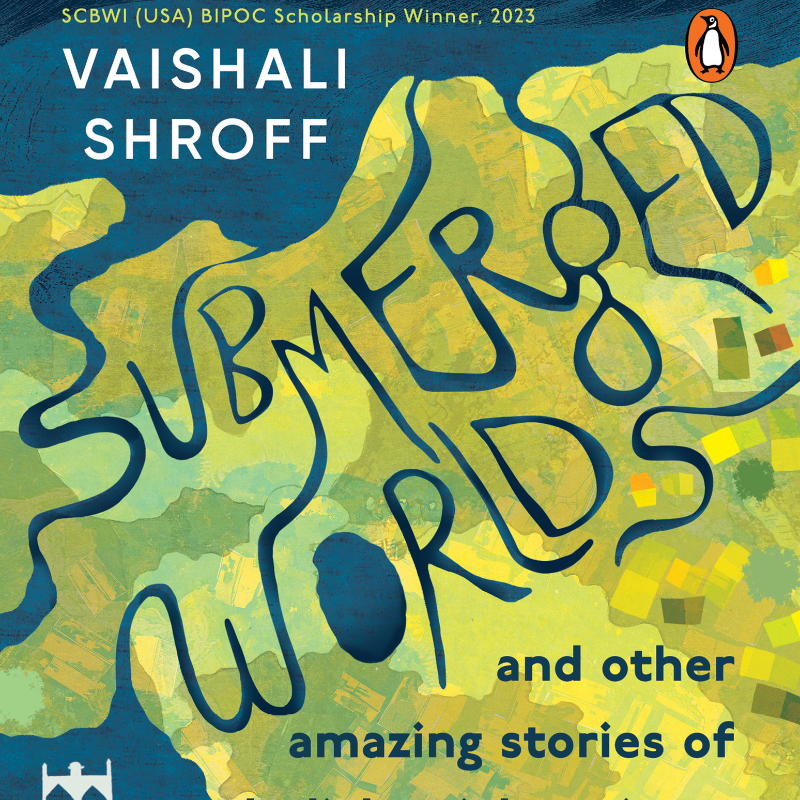
While the book’s cover by Antra K brings to mind a map of India’s rivers, it also showcases a submerged clocktower complementing the title. Meanwhile, Shroff’s own illustrations dot the book, lending it beauty and thoughtfulness. My personal favourites were the illustrations of the leopard looking out of a cliff, and the fisherwoman.
From history, mythology and science to geography and yes indeed our environment, whatever the curious young reader’s interest, Submerged Worlds has something to offer.
About the reviewer:
Krupa Ge lives and writes in Chennai.