
Tribal Tales
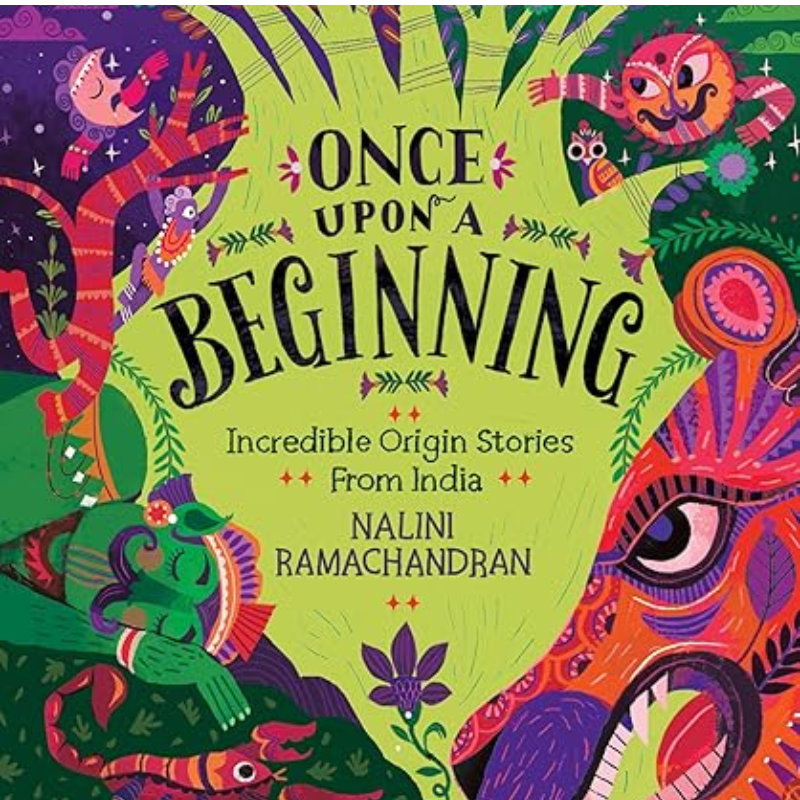
Book Title: Once Upon a Beginning: Incredible Origin Stories from India
Author: Nalini Ramachandran
Illustrator: Various
Publisher: Hachette India (hardback, ₹799)
Reviewed by: JoAnne Saldanha
Details
When I first began my journey as a storyteller, I was captivated by origin myths, creation stories, and the classic ‘how and why’ tales. I often imagined early humans gathered around a fire, wondering about the world around them. The elements, the weather, the creatures… everything must have seemed both wondrous and terrifying. In those moments of wonder, did they begin spinning stories to explain the mysteries of their world? This idea has always fascinated me. Yet, every collection of pourquoi tales I came across left me wanting. They were often too brief, poorly written or stripped of their magic, forcing me to spend time fleshing them out just to make them engaging. That’s why Nalini Ramachandran’s Once Upon a Beginning was such a pleasant surprise.
Ramachandran introduces the book with a story from the Khasi hills of Meghalaya, where U Pyrthat, the Thunder Giant, is captivated by the gleaming silver sword of U Kui, the Lynx. When U Kui refuses to share it, U Pyrthat snatches the sword and retreats to the sky. There, he begins beating a drum thunderously with one hand, while brandishing the shimmering sword with the other. Can you imagine the rumble of thunder and the flash of lightning you still witness today? It took me right back to my own childhood, curled up on my father’s lap as he tried to soothe my discomfort during a thunderstorm, by narrating a tale of my two late grandfathers playing football in heaven, the loudest sounds indicating when a goal was scored!
The tales in this collection are not your usual ones from Indian myths or popular Indian folklore. Rather, the collection brings together thirty origin stories from indigenous and tribal communities across India. The tales range widely, from the origins of the Earth, Sun and Moon, to explanations of geographical features, animal species, traditional professions (including witchcraft and sorcery), and the roots of the rituals and artistic traditions followed by different tribes.
More than folklore, these stories are coded lessons carrying ecological, cultural, and ethical significance. They offer readers an insight into why these communities hold the natural world in such reverence and, in doing so, invite the reader to see nature with renewed respect. In ‘The Wilder Brother’, a story from the Idu Mishmi community of Arunachal Pradesh, a human and a tiger are raised as brothers. Fearing the tiger’s wild nature, the human cheats in a race to win the right to live with their mother, and later kills his tiger brother out of suspicion that he might harm the human family. The mother is devastated, and warns her son that he has brought a curse upon himself and, in turn, the entire human race. “It is a sin to kill a tiger, your own brother!” she cries. Another tale, ‘Best Friends Forever’, from the Nicobarese people, speaks of a time when trees could walk until human greed rooted them to one place.
Each story is paired with a factual note that often sparks a quiet “aha!” as it unfolds the context and connects the magic of myths to science and history, reminding us that even the most fantastical tales often carry a kernel of truth. ‘The First Ancestor’, a tale from the A‑Pučikwar tribe from the Andaman islands (whose existence today is difficult to verify, given their dwindling numbers), narrates the story of an enchanted creek that transformed the first human family into a crocodile, a crab and a water monitor lizard. These creatures are endemic to the islands even today. Ramachandran shares that in other versions of the tale too, the creatures featured are those that are found on the islands. She draws connections between the evolution of the crocodile and the monitor lizard, tracing their lineage back to a common ancestor, the dinosaur. This insight adds a deeper layer to the myth, hinting at the tribe’s possible intuitive understanding of evolutionary concepts.
The writing is the book’s greatest strength. The stories flow easily unlike in many other folktale collections which tend to have short, stilted narratives, making this book a great read aloud. The author respects the oral origins of these tales while taking creative liberties to enhance readability. Her use of authentic names, references to region-specific flora and fauna, and faithfulness to cultural nuance ensure that the stories retain their rootedness even as they reach new audiences.
The production quality — binding, paper, colour palette and printing — is excellent, making this a book that is sure to attract readers of all ages. That said, the book would have reached a greater level of authenticity and impact if traditional artists from the featured communities had illustrated the stories. Additionally, a map showing where these communities live, either at the end of the book or alongside each factual note, would have enriched the reader’s understanding.
This is a book I would recommend as a must-have for school and home libraries because of its quiet yet powerful advocacy for indigenous knowledge systems. Its handsome production values also make it a delightful gift.
About the reviewer:
Joanne Saldanha is a library educator, consultant and children’s book enthusiast popularly known on social media as Myth Aunty. You can read about her work on https://www.mythaunty.com/