
The Mythical and the Magnificent
Book Title: Song of the Asunam
Author: CG Salamander
Illustrator: Rajiv Eipe
Publisher: HarperCollins India (hardback, ₹499)
Reviewed by: Saudamini Jain
Details
Sangam literature — ancient Tamil poetry comprising more than 2,000 poems — was rediscovered in the late nineteenth or early twentieth century. Until then the works survived on crumbling palm leaves and were transmitted orally as folk songs or lullabies. These poems deal with themes of love, war, death and community, and are rooted in biodiversity. Endangered species like the Nilgiri tahr feature here, as do extinct or mythical creatures like the Asunam.
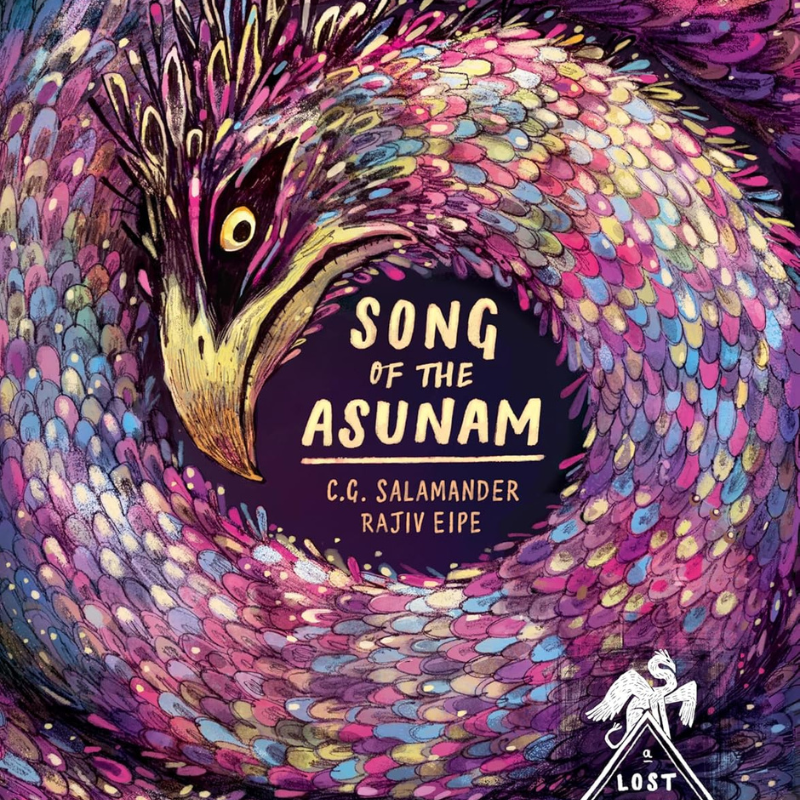
According to Sangam texts, the Asunam was a giant bird-like beast found in the Nilgiris thousands of years ago. It now comes to life in CG Salamander and Rajiv Eipe’s aesthetically stunning Song of the Asunam, the first of the new Lost Creatures series of picture books by HarperCollins India. An Asunam, its long serpentine neck coiled up and kaleidoscopic scales gleaming, makes for an inviting cover and the book opens with a panoramic, very cinematic, sepia-toned view of a Tamil village with coconut trees and temple architecture.
This is a book in which complex, sometimes conflicting, ideas are deftly woven into the narrative. For instance, sharing space while also being alone. Salamander sets the tone from the very first sentence: In a sleepy south Indian village where man and monster lived side-by-side / But mostly kept to themselves.
The story is built with new information introduced in every graphic panel, and Eipe rises splendidly to the task with illustrations that are even more intricate than usual. Clever little details are tucked in throughout, and the book can keep curious children engrossed for a long, long time and engaged through multiple reads. It’s definitely a keepsake.
The hero, Vetri, is an eight-year-old boy who wants to be a hunter even better than his grandmother whose journal on mythical monsters he studies religiously. He’s like a little Mowgli in a lungi who talks to grasshoppers and hangs upside-down with bats on trees. He is perhaps stranger than the strangest creatures of the wilderness. The villagers think him weird and smelly.
Eipe lays out a page with elaborate scribbles from Vetri’s grandmother’s notebook, which contains drawings of the beasts and how to hunt them. One day, an Asunam shows up in the village. It’s a magnificent multicoloured creature, something between a hippogriff and a phoenix with a long neck, but it is also the scariest, ugliest, most ferocious beast Vetri has ever seen. The villagers are terrified. But armed with his grandmother’s gyaan, Vetri is prepared. He plays his lyre and then makes a clamorous sound to first lure and then scare the creature. The Asunam is caged and Vetri briefly becomes a hero. But eventually everybody forgets and he is back to being the village weirdo again.
With the celebrations over, Vetri notices the now caged Asunam losing colour. In Sangam literature, the Asunam was a phonophobic creature — entranced by melody but sensitive to loud noises. Stories claimed that Asunams were driven to extinction by people hunting them by beating drums.
Vetri decides to befriend the Asunam. He names him Ilangovan, soothing him by playing his lyre. But Ilango’s depression continues to grow — he’s homesick for the forest and for his friends. So Vetri and Ilango make their way across the Great River/ beyond the enchanted woods/ over the valley of screams/ and along the sharpest cliffs. The rest of the book is their great adventure through wilderness. It is a most enjoyable journey as boy and beast encounter other creatures and difficulties along the way.
The writing, however, starts to dip and the difference between the first and second halves of the book is pretty stark. What had been clever, now feels lazy and the sentences seem to lose Salamander’s distinctive rhythm. In one scene, later in the book, the sky fills with other Asunams who revive a fading Ilango: They hummed and they whistled, carrolled, cooed, chirped, cheeped and crooned, Salamander writes. It’s cute, I suppose, the alliteration, the sounds and the synonyms. But it feels limp when compared to the precision and sharpness of the earlier writing, and the moving action of this section.
Still, Song of the Asunam is a fantastic book. It’s about adventure, friendship, healing and home. And it contains wisdom: friendship is not possessive. Vetri, the village weirdo, doesn’t try to hold on to Ilango, his only friend. Instead, he honours their love by making the same dangerous trek every year, to play his lyre and spot his friend shining brightly in the night sky. In the last panel, we see Ilango flying towards a grown Vetri. But we don’t know what happens when the friends meet. Friendship, after all, means being true to yourself while still holding space for the other.
About the reviewer:
Saudamini Jain is a writer and book critic based in New Delhi. She’s currently working on a book of narrative non-fiction, Lost Immigrants (HarperCollins India, 2026), set in northeast India and Israel.