
Of Tusks and Tears
Book Title: If Elephants Could Talk: A Novel in Verse
Author: Ranjeeta Raam
Illustrator: Damini Gupta
Publisher: Hachette India (paperback, ₹499)
Reviewed by: Venkataraghavan
Details
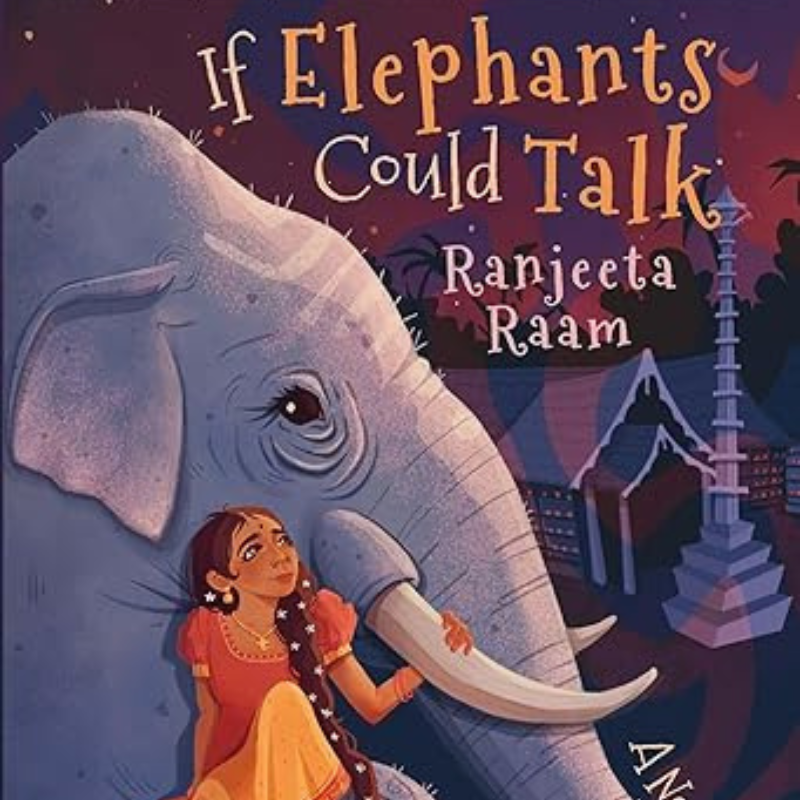
‘A Novel in Verse’ — this attention-grabbing phrase accompanies the poignant title of this book and Damini Gupta’s earthy cover illustration. What does it mean exactly, especially for readers aged ten and up, for whom the book is intended? Let’s dive in.
A novel in verse is a hybrid creation, combining the storytelling structure of the novel with the poetic form. They can be epic, like the Mahabharata; they can be in iambic tetrameter, like The Golden Gate by Vikram Seth; or they can be free verse, like Ranjeeta Raam’s debut work, If Elephants Could Talk.
The word ‘poetry’ can sometimes be off-putting, conjuring up centuries-old rhymes from school textbooks. Free verse can be an antidote to those disinclinations by not adhering to traditional rules of meter, rhyme or stanza structure.
The formatting of the text is an important element of If Elephants Could Talk. It is playful and experimental, with words like ‘s w a y’, ‘l o n g’ and ‘HEAVY’ imparting additional feels through font choices. A reader can, of course, choose to focus only on the text and zip through the book, but that would be like listening to a song’s lyrics and ignoring its music. In fact, I encourage readers to read this book out loud so they can hear the cadence of the lines and find their natural rhythm.
If Elephants Could Talk is a very sad song. Twelve-year-old Meenakshi, the daughter of a temple priest in a small town in Kerala, is dealing with monumental grief following her mother’s death from an unnamed illness. For six months, she has not spoken a word. She pulls herself through each day, distanced from her friends and joyless in her Bharatanatyam classes, until she comes across the temple elephant Ganeshan. A transformative meet-cute directs all her energies and attention on to the elephant, who is dealing with his own troubles. He has to participate in a physically punishing festival parade.
Meenakshi’s heart goes out to him, especially after Ganeshan gets injured, but she is still unable to break her silence. Guilt-ridden, she seeks new forms of expression. With the support of Anju Chechi, her fierce firebrand feminist cousin, Meenakshi writes protest signs and arranges sit-ins, even at great personal cost to her father, who, to his credit, never forsakes his daughter.
The author relies heavily on the greatest hits of India — elephants, Bharatanatyam, temples, festivals — as well as a generous dose of childhood nostalgia — coconut oil, kumkumam, sandalwood, raw mango. The Indian words are all italicised — puja, pallu, pottu, chechi, chandanam. This gives the book a feel of having been written for an audience primarily of NRIs and non-Indians.
This is a challenging book. The challenge in its form is its stylistic formatting, which can be so new and unfamiliar that it can take a few pages to figure out the ‘right’ way to read it. For instance, should you pause at every line break or read through? (Answer: You’re the reader, it’s up to you.) The challenge in the story is the large unbroken dark cloud that looms across much of the book’s 244 pages. Silver linings, if any, are rare. Navigating this block of grief and guilt that the protagonist wallows in takes some effort.
For a novel in verse, there aren’t many nuanced or poetic explorations of grief. The complex emotion is often flatly portrayed through the book as a large overhanging cloak of sadness. The grownup lens is evident — the text reads like an adult discussing grief, even though the protagonist is only twelve years old. This feels like an opportunity lost, especially since the novel is written in first person and the protagonist chooses to not speak verbally, which could have allowed for many moments of introspection, reflection and imagination beyond the surface-level articulation. Occasionally, however, a sentence or a paragraph shines through. For instance: who knew something as invisible as feelings could be so heavy? I wish there had been more such perspectives on grief.
The thirteen-page heartfelt epilogue, in which the author speaks candidly in first person, is a must-read. Her passion for the subject of animal rights and welfare shines through, as well as the copious amounts of research she has done on the topic.
It is heartening to see a middle grade novel attempt to embrace both its form and fable so wholly, even if messily. Depending on the proclivities of the reader, it could spark conversations around grief, loss of a loved one and animal rights. Those with a more literary bent may feel encouraged to experiment with their own poems and stories in verse.
About the reviewer:
Venkataraghavan is the author of the non-fiction book The Origin Story of India’s States (Penguin Random House India, 2021) and the children’s book Brachio (HarperCollins, forthcoming 2025). He was awarded the inaugural Neev Fellowship for Children’s Book Creators for 2024. He is also an actor for stage, screen and voice.