
Irula in the Shadows
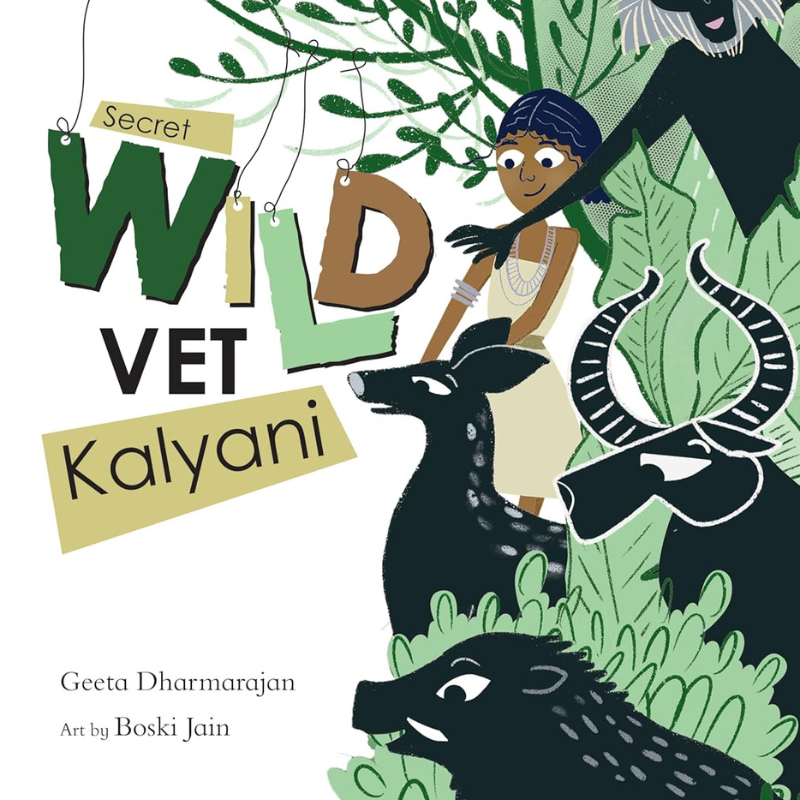
Book Title: Secret Wild Vet Kalyani
Author: Geeta Dharmarajan
Illustrator: Boski Jain
Publisher: Katha (paperback, ₹205)
Book Title: The Keepers of Darkness
Author: Mamta Nainy
Illustrator: Upasana Agarwal
Publisher: Katha (paperback, ₹205)
Reviewed by: Revathi Suresh
Details
Secret Wild Vet Kalyani by Geeta Dharmarajan/Boski Jain and The Keepers of Darkness by Mamta Nainy/Upasana Agarwal are two picture books (for children ages 5 upwards) about the Irula, a marginalised tribal community who live around forest peripheries in south India. They are hunter-gatherers whose livelihood has always been deeply connected with the forests, but many of them are now forced to find work as daily wagers. Older readers might know of their work with snakes – they are expert snake catchers and have done remarkable work in the extraction of anti-venom, the antidote to snakebite. Secret Wild Vet Kalyani and The Keepers of Darkness contain useful end notes that describe the community. These notes are probably the best part of both books.
We are told that Secret Wild Vet Kalyani is “inspired by a real N Kalyani, Tamil Nadu’s first woman veterinarian” and an Irula at that, about whom nothing is known besides that one fact. One of the suggested activities encourages the reader to find out more about N Kalyani. Well, if the book-makers couldn’t, we can’t either. A simple Google search has AI leading you right back to this book!
Anyway. Though Kalyani is supposedly a vet, she doesn’t treat any animal at all in this story. Instead, when called upon by the forest creatures to help thwart poachers, she leaps and bounds and swings from tree to tree like ‘Tarzana’ and, with the help of various animals, birds, reptiles, mice and spiders who actually do all the hard work, she shoos the villains off and they all live to see another day. What use is Kalyani’s degree, then.
Other than a passing reference to Mukurti River, there is little familiar about the landscape. Like an old-fashioned children’s book where all manner of animals dwell in one large treezone irrespective of habitat, here too they all thrive in happy harmony in an unnamed forest somewhere in the Nilgiris. Maybe I should call upon the lions, Kalyani thinks at one point, but then decides, nah, spiders will do. Just as well, because lions in those parts?
The illustrations by Boski Jain also feel old-fashioned, the style generic. Some animals are drawn really well while others are very ordinary. For some reason the fully grown Kalyani looks more like a child carrying some sort of lance. The poachers look suitably comical in their villainy, the animals turn up with ferocious faces – so much so that one wonders why they couldn’t have dealt with the intruders themselves. Why bother Kalyani who is roused into action in the middle of cooking herself a meal after a long day of not being a vet.
Mamta Nainy’s The Keepers of Darkness is about the near spiritual relationship between the Irula – the “last forest scientists of the world” – and the darkness. Nainy uses words sparingly and her writing is occasionally lyrical and evocative. Set against a black background to go with the night theme, Upasana Agarwal’s illustrations – full of bright blues, yellows, greens and browns – do justice to the text, and will surely catch a child’s eye.
The problem, however, lies in the way that Irula lives are made out to be simple, yet rich and full of blessings and gifts – they are “keepers of darkness” who “explore the colours of darkness” while foraging for “honey, tamarind, prawns and fish”; they sit around the fire singing about the “inky forests” and take care of the wild and allow it to take care of them. Sounds idyllic, but is this the reality of Irula lives? In romanticising them and maybe even borderline fetishising them this way, we do them an injustice. In an ideal world we would have left our tribes alone to lead their lives as they wish to, but that not being the case, perhaps we should just allow our children to see their reality. It is not merely the destruction of forests that has brought the Irula to their knees. It is unfair laws; it is the othering that all backward communities face. Like most tribes, the Irula are looked upon with suspicion, shunned and abused, harassed, discriminated against, and bear the brunt of systemic violence and injustice. Jai Bhim, anyone? It would be great if “we all embrace stewardship of our forests so we can protect them”, but we could also try for social justice, enabling backward castes to integrate into our societies by providing them livelihood and security. We don’t though. Not the policymakers/lawmakers, and certainly not people like us. So, who is the ‘we’ that we write about? Maybe ‘we’ should allow children to see our apathy.
Anyone who has ever written for children already knows how hard it is to address their audience in a meaningful way. Since we have forgotten what it is like to be that age, we target, very cautiously instead, their parents and teachers who decide if a book makes the cut and if the words are worth serving to the children in their care. Maybe writing boldly and with greater nuance for the actual audience, especially when writing on difficult issues, might get us better results.
About the reviewer:
Revathi Suresh is a Chennai-based writer. She is the author of two young adult novels, Jobless Clueless Reckless (Duckbill, 2013) and In Now and Then (1Inch Margin, 2021).