
Much to Crow About
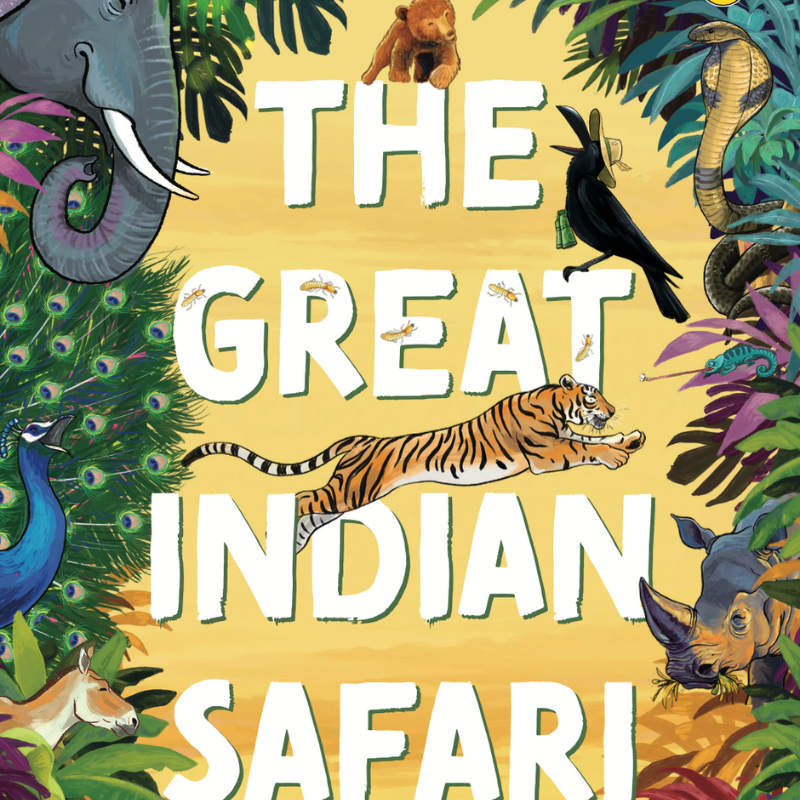
Book Title: The Great Indian Safari
Author: Arefa Tehsin
Illustrator: Mohit Suneja
Publisher: Penguin (paperback, ₹399)
Reviewed by: Aditi Patil
Details
Let me begin by saying: The Great Indian Safari is seriously funny. From the very first page, Arefa Tehsin’s choice of narrator, Charred the Bard, a jungle crow with attitude, ensures the journey is entertaining, irreverent, and habit-forming. You may well forget the author is behind the voice, because this crow feels entirely real: clever, cheeky, self-aware, and utterly unapologetic.
In fact, in the first chapter itself I found myself wanting to rap along with Charred’s introduction. He introduces himself with a flourish, and so you’re immediately on his wavelength: expect jokes, bits of swagger, and plenty of birdy sass. What follows is a safari across India’s wild landscapes, each chapter dedicated to a different creature, each full of surprising facts directly addressed to the reader, and playful commentary.
Take the tiger chapter, for instance. When the “most popular tiger poem” floats into Charred’s mind, he pipes up: “That’s already been written,” tossing it aside with breezy confidence to pen a fresh one. This cheeky move neatly illustrates how the book constantly keeps you off-balance — you’re learning, but you’re also laughing, and the writing feels alive rather than didactic.
One of the strengths of The Great Indian Safari lies in how much Tehsin packs into relatively short chapters. She speaks directly to us: “You are a mammal,” she writes, or “How big were you when you were born?” — gentle prompts that ground science in everyday wonder. In a few chapters, she even invokes readers’ mothers and grandmothers — a warm, familiar register that helps bridge the world of the wild and the world of home.
I love that she doesn’t shy away from “Go figure” moments, asking readers to think, dig deeper, wonder about how birds evolved from dinosaurs, or how species are named. As a conservationist, I was especially heartened to see that she defines who conservationists are (a surprisingly elusive concept for many adults, too), and slips in bits of insider humour. For example, she gently chides the laziness of naming a subspecies tigris tigris — a clever little dig at scientific naming conventions.
She also does not hatch a barrier between the joyous world of animals and the harsh realities they face. In every chapter, she flags human threats: habitat destruction, hunting, climate pressures. But she also balances that with nuance, acknowledging that there are Indian tribes and conservationists who do care, allowing young readers to see that some humans can be allies, too.
The physical book itself is a pleasure to hold. Printed by Thomson Press India, the pages are smooth, letting your fingers glide across illustrations that pop off the paper. Some of my favourite illustrations by Mohit Suneja: a chameleon flicking its tongue out from a page corner, Charred wearing his khaki safari hat and binoculars (then swapping into winter gear in the Himalayan chapter), and wide, dramatic spreads that pull you into the terrain.
I particularly appreciated how desi the book is. In the chapter on gharials, Charred muses about the chaos of naming dozens of siblings, and I caught myself laughing at the sibling-name Gadbad lal. In a book that could easily become generic, this rootedness in Indian life and vernacular voice gives it flavour and personality.
It’s also refreshing that among iconic beasts like tigers and elephants, Tehsin includes less glamorous species, like Indian white termites. That choice speaks to her belief that every creature matters, not just the headline animals. Her “Safari Rules” boxes in each chapter are fun and meaningful. I only wish there were a similar set of rules for adults venturing into the wilderness!
If I were to suggest any small improvements, I might hope for occasional map inserts (to help readers visualise where in India each creature appears). But these are minor quibbles in a book that succeeds on so many levels.
Overall, The Great Indian Safari is a witty, warm, and wise guide to India’s wildest citizens, delivered through the voice of a crow who knows his job. It sparks wonder and curiosity, while nudging readers gently toward caring for nature. Children aged 7 to 12 will devour this, but I suspect adults, especially those who visit forests, lead nature walks, or teach children, will find themselves smiling at every page turn.
In the world of children’s nature writing, it’s a delight to see a book that combines charm, accuracy, humour, and heart. I hope The Great Indian Safari encourages more young readers to explore wildlife conservation and inspires some adults to revisit how they tell stories of the wild.
About the reviewer:
Aditi Patil holds an MPhil from Cambridge and has co-founded the research organisation ‘Conservation indica’. She has a decade of conservation research experience in India and is the author of Patriarchy and the Pangolin.