
Lost in the Woods
Book Title: EYE TO I WITH MY FIRST TIGER
Author: Nirmal Kulkarni
Illustrator: Aanchal Lodhi
Publisher: Perky Parrot, 2024 (paperback, ₹295)
Reviewed by: Peeyush Sekhsaria
Details
I was excited to receive Eye to I with My First Tiger to review for two reasons: it has been written by Nirmal Kulkarni, one of India’s finest naturalists, and it has been brought out by Perky Parrot, the children’s imprint of Niyogi Books, who are known for their beautifully produced books on art.
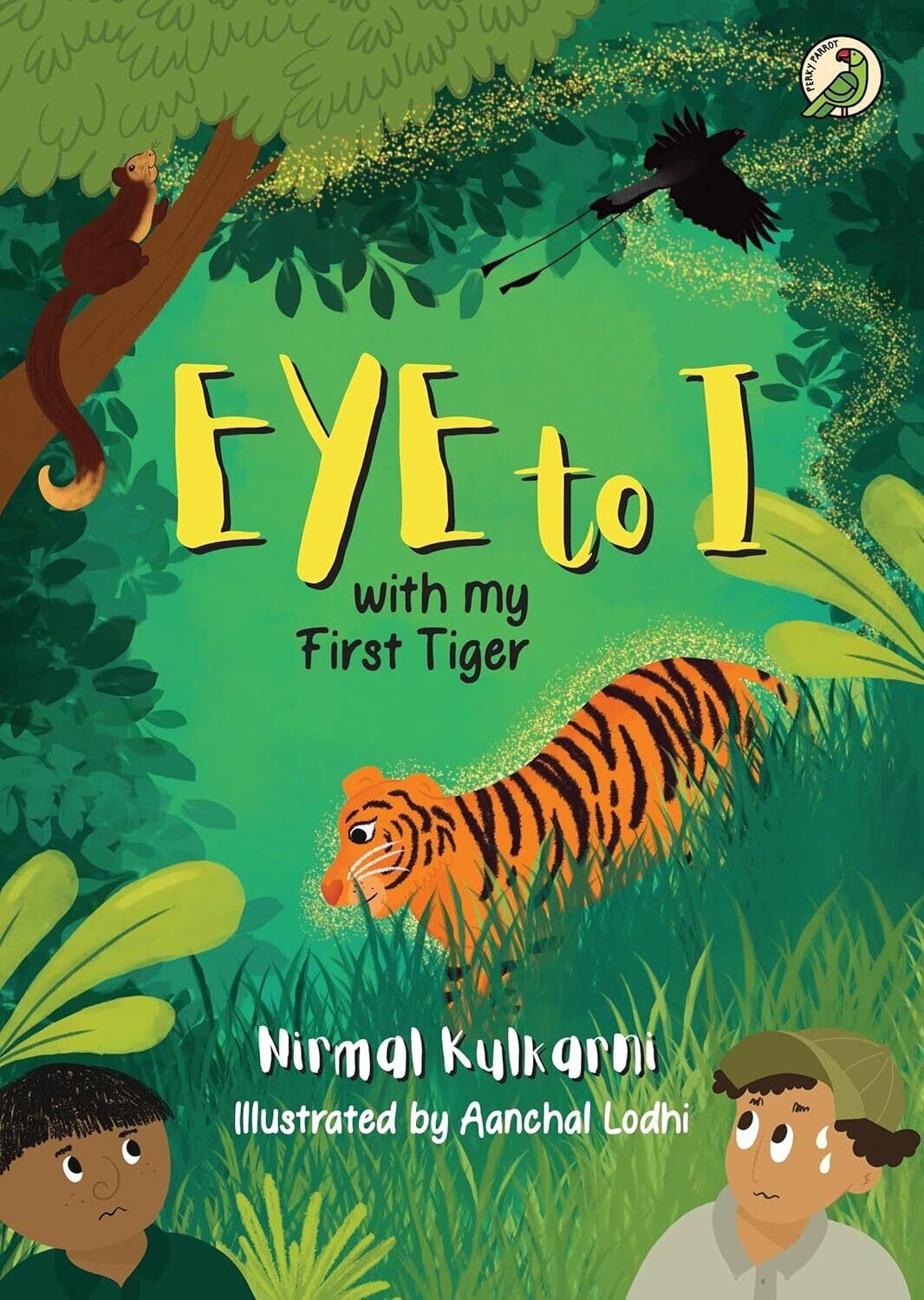
At first glance, the book did not disappoint — it has an attractive cover illustration by Aanchal Lodhi,
and the title ‘Eye to I’ is an interesting play of words. However, as I started leafing through the book,
some of its limitations became apparent. At A5 size, the page layouts were rather crowded. A slightly larger format would have benefitted this story set in a forested landscape. The book’s binding left a lot to be desired as well because its cover came off in the short time that I turned its pages to write my review.
Now coming to the story itself, which describes an encounter that wildlife enthusiasts Nandu and Salu have with a tigress while undertaking field surveys in the Nagarhole Tiger Reserve in Karnataka. The mood that the author sets for his story is quickly marred by the dense information he wants to impart to his readers. For example, right in the middle of the exciting eye-level encounter with the tigress, the author adds an entire paragraph explaining what tiger chuffing is. While this is well-intentioned and is meant to better explain tiger behaviour, it takes away from the pace of the narrative. The use of brackets to give additional information and explanations at various points in the book also hinders the reading experience.
The story suffers some other challenges, including that of flow. The author goes back and forth in time while describing an event that happens on the same day. The narrative starts at noon, goes back to the protagonists’ early morning wake-up routine, skips back to the previous night’s bonfire, jumps forward to lunch and then further to the same evening, which makes things somewhat disjointed for the reader. The problem with the flow gets compounded by the accompanying illustrations that do not match the narrative in some places. For example, while Nandu and Salu pause to marvel at the flora and fauna while heading for their afternoon break at the camp, the illustration shows them sitting down in the forest eating out of thalis. The double spread on the very next page where the author writes about their afternoon break followed by the evening transect has an illustration of night in the forest. In the subsequent double spread, the illustration goes back to a daytime setting. This happens again later as the encounter with the tigress reaches its final moments, making it confusing for the reader to visualise the episode properly.
The importance of consistency in illustrations in a children’s book cannot be overemphasised. While
Nandu and Salu are described as seventeen-year-olds, they come across as much younger characters in the visuals. On Page 6, it took me time to understand who the narrator was because the illustration has a speech bubble showing Salu talking of his Aai’s fish curry and rice while in the text it is Nandu who remembers his mother’s cooking. Similarly, right at the beginning of the story where the author writes of a crested serpent eagle circling above, the illustration is of some generic eagle-like bird. This makes me wonder whether the author was given the opportunity to review the illustrations.
There are other nigglers as well. For instance, the author builds an intriguing association between the smell of garlic chutney and the tiger in his narrative. However, this is left hanging and not explained anywhere in the book. At the beginning of the story, he writes: “A light drizzle at noon … Now we will have ticks AND leeches for company…” A little later in the book, he mentions that the protagonists’ line transects were happening in the month of April, which is not a time of the year when one is likely to come across leeches in a forest. A careful review of the story drafts by the editor and the author would have addressed such issues.
I was excited that this book recounts a real-life episode as it would have added to the limited body of non-fiction on natural history we have for children. However, a line on the copyright page states that this is a work of fiction. I’m not sure if this is a preferred protocol that children’s publishers follow but it left me confused and took away a bit from the charm of the book.
Eye to I with My First Tiger is the story of a rare hair-raising encounter in the wild, and I appreciate the effort taken to put the book together. That said, more attention paid to editing, illustration, design and production would have done better justice to this unusual tale.
About the reviewer:
Peeyush Sekhsaria is an architect and geographer by training, and a children’s writer by choice. His
books for young readers include Our Tigers Return: The Story of the Panna Tiger Reserve and Panch
Pairon Wali Hathi. He writes a column in The Hindu-Young World on the stories behind everyday
objects.