
Bungle in the Jungle
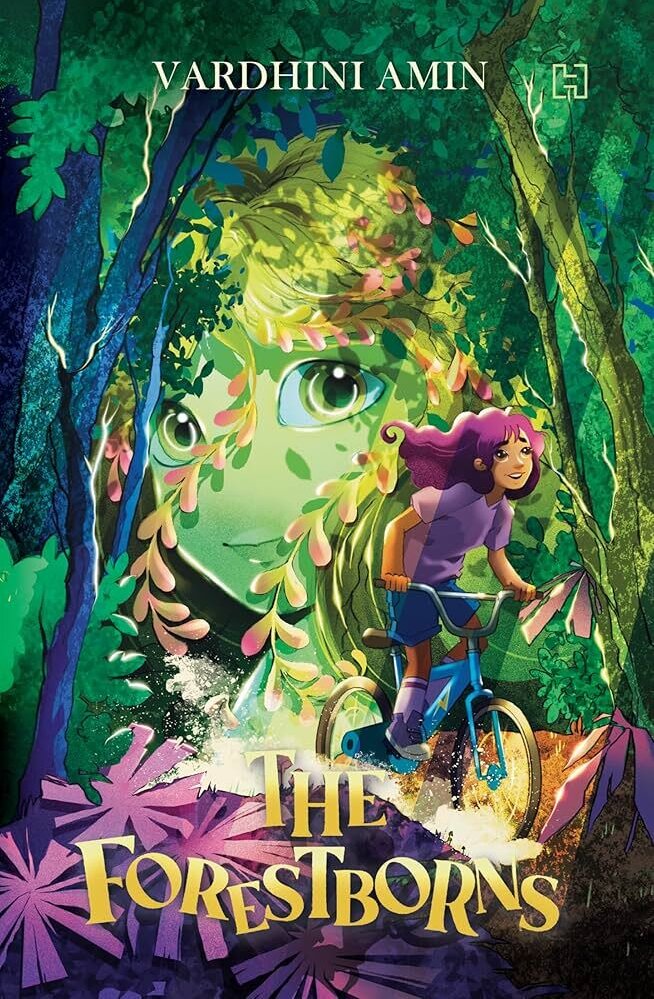
Book Title: The Forestborns
Author: Vardhini Amin
Illustrator: Pia Alize Hazarika
Publisher: Hachette, 2024 (paperback, ₹599)
Reviewed by: Mukta Patil
Details
Situated in the Western Ghats, the canopied world of The Forestborns is alive with the vrikshas
(or trees) and their vruhas (or spirits) that are undetectable to people but able to roam free under
the cover of darkness. They feel and soar, cooperate and have territorial battles, form clans and
friendships, and love and worry. The vrikshas live in harmony with the prani (or animals), but
are pitted against the manushya (or humans) and their worldview.
Human poachers are hatching a plan to cut down the old-growth sandalwood trees within this
forest, while the oblivious forest officials are busy with meetings. Siah, a young sandalwood
vruha, and Avni, a twelve-year-old human who lives with her grandmother at the edge of the
forest, must unite to thwart this threat. The journeys that Siah and Avni undertake to stop the
poachers and find each other lie at the heart of The Forestborns.
Our knowledge of how trees communicate has grown by leaps and bounds in the past decade:
they feel pain, warn each other of threats and share resources through vast fungal networks
underground and chemical signals above the ground. In her recent book The Light Eaters, for
example, writer Zoë Schlanger elaborates that plant language is made up of “wafting messages
on the air”. However, instead of relying on this rich body of contemporary research on how trees talk and how we hear them, The Forestborns takes the familiar path of assigning human
attributes to tree life. For instance, there are some sections in the book that show us the
friendships and antagonisms between tree species, but the anthropomorphism feels too human
and lacks imagination. Why not stretch the magic to be a little more radical — more tree-like and
less human?
The author wants the various human and non-human characters to inhabit each other’s dehas
(or bodies) and not just empathise with each other’s lived realities. Still, trying to balance the
human perspectives with the wild ones means that it’s hard to stay immersed in the vast and
vibrant world of the trees, which could have been so much more beautiful and detailed than it is
in the book. And sure, to save the forest, Siah and Avni’s worlds need to eventually collide, but
the lesson here should have been that we need to be able to sense these non-human spirits
without having to embody, see or talk to them. That’s where the magic truly lies.
The minor characters in the plot seem wasted. Taru, an old woman who lives in the forest and
talks to the vruhas, and Jambhu, an age-old tree spirit, both holders of infinite wisdom about the
ways of the forest world, are reduced to being a recluse and an amnesiac. Pia Alize Hazarika’s
illustrations are also a missed opportunity. Too far and few between, the black and white
illustrations are unable to bring alive this world full of animated spirits and magic.
The sandalwood grove that Avni loves holds a special place in her family’s life — one laced with
grief that resides deep in her heart. It channels the storyline and her eventual connection with
Siah. Unfortunately, this looming sense of grief — of losing family, losing forests and losing
humanity — is delivered more like a bludgeon, moving too quickly and shying away from letting
the reader feel it intently. Even though the pace of the plot is steady and you’re drawn into the
urgency of saving the sandalwood grove, the morality is too black and white. The world of the
vrikshas and their vruhas is ultimately not evocative enough to draw the child in me into the
inner lives of these flitting-floating souls.
About the reviewer:
Mukta Patil is a writer and editor. She lives on the outskirts of Goa with her cat, Pooki.