
Jungle Jamboree
Book Titles:
A LITTLE LOST ELEPHANT
HOW THE COBRA GOT HIS SPECTACLES
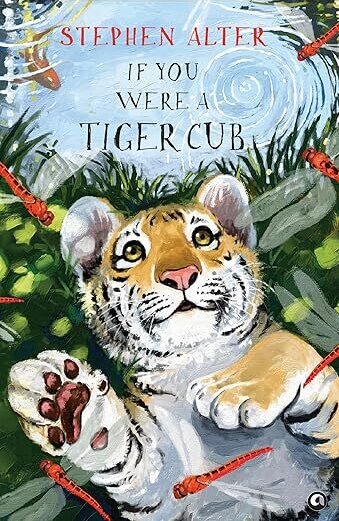
IF YOU WERE A TIGER CUB
Author: Stephen Alter
Illustrators: Mohit Suneja, Shruti Hemani
Publisher: Aleph Book Company, 2024 (hardback, ₹250 each)
Reviewed by: Zai Whitaker
Details
I’d been suffering from writer-reader block, waiting for something inspirational to happen that would repair both; and it did. Stephen Alter’s three wonderful animal stories fell into my lap, and I couldn’t get up until I’d read all of them (which led to envy and irritation about why I hadn’t written them.) They make a great series, but also stand alone, and as Father Xmas and Mother New Year approach, your money would be well spent on one or more of these as a gift.
A Little Lost Elephant is a perfect example of how a simple story can be so engaging. The easy but evocative language (the hardest to achieve) makes it a great read as well as read-aloud. For example: A dragonfly landed on his tail, and he tried to flick it off but the mynah quickly caught the insect in her beak. Further on, he saw what looked like a huge bush covered with shimmering blue and gold flowers. Its leafy green branches seemed to be waving in the breeze but when he got closer the little elephant recognized that it was a peacock, dancing with its tail feathers spread open.
The next, How the Cobra Got His Spectacles is, again, a fine melding of natural history and fiction. A cobra and a hermit-saint were neighbours in a riverbank jungle. The cobra had grey scales on his back and wider scales on his belly and pale bands on his throat. Every few months as he grew larger, the cobra shed his skin, revealing a fresh set of scales. Like most snakes, the naga had poor eyesight and no ears, so he relied on his forked tongue to taste and sniff the air around him. Stephen Alter engages his protagonists in a rollicking story about how the hermit loses his specs to a naughty monkey-thief, to be cleverly retrieved by the naga. And as to how the cobra got HIS specs… well you’ll have to find that out for yourself.
If You Were a Tiger Cub was, for me, the most fun of the three, because of the invitation to put yourself (the reader) in the shoes, I mean paws, of a she-tiger cub… sometimes at play with your “two dumb brothers” and at others on your own in the forest, dealing with fear, staying safe and quiet (sort of) while Mum’s out hunting, confronting a sloth bear, and so on. It’s a feminist tale, with the she-cub being braver, smarter and less selfish than her two brothers. And then comes her last challenge; she encounters a new species, with long braided hair, that’s standing on her hind legs and collecting sticks!
Their eyes meet… and Stephen Alter leaves us with the big question for readers/listeners to answer. If you were a tiger cub, what do you think you would do? Would you turn tail and run? Would you escape through the forest and never look back? Would you be so scared that you’d race to your cave and hide behind your big brothers, even if you know they would never protect you? It’s an enchanting journey into tiger lore and into ourselves, that puts our imaginations to work. I enjoyed being turned into a female tiger cub.
The get-up and covers of these books remind me of the attractive Christmas presents sent to us children in the 1960s, by parents’ friends, from England. None of the paperback, cost-cutting stuff, and the price would make the parents shudder, with their “Are-you-really-worth-this?” looks. Likewise, these three books are so good to hold and handle. Between Aleph and Alter, it’s been a great partnership.
I looked eagerly for a flaw in the writing, in order to “balance” this review but alas wasn’t successful. Indeed, one would do well to use this set of stories in workshops for aspiring (and perspiring) writers of children’s literature. I could certainly do with the reminder, for instance, not to bung in laboured vocabulary and metaphor, or pack in too much action. We try too hard to give it all we’ve got, which often doesn’t work. Hold back, and relax, seems to be the way Stephen Alter goes. We also need to have a truckload of information and experience, to write about a subject with this kind of confidence. If you know so much (arms wide apart), you can write this much (pinching two fingers together). Stephen Alter has obviously read about, and seen, tiger cubs at play, baby elephants reuniting with their herd, individual differences within a species, playtime as training to hunt, symbiotic relationships. I’m sure he hasn’t seen a cobra retrieving a hermit’s specs… but who knows? He might have seen that as well!
About the reviewer:
Zai Whitaker is presently managing trustee of the Madras Crocodile Bank Trust/Centre for Herpetology. She writes on the environment for children, and her books include Andamans Boy, Termite Fry, Cobra in My Kitchen and Scaling Up, which is her latest release.