
Into the Wild
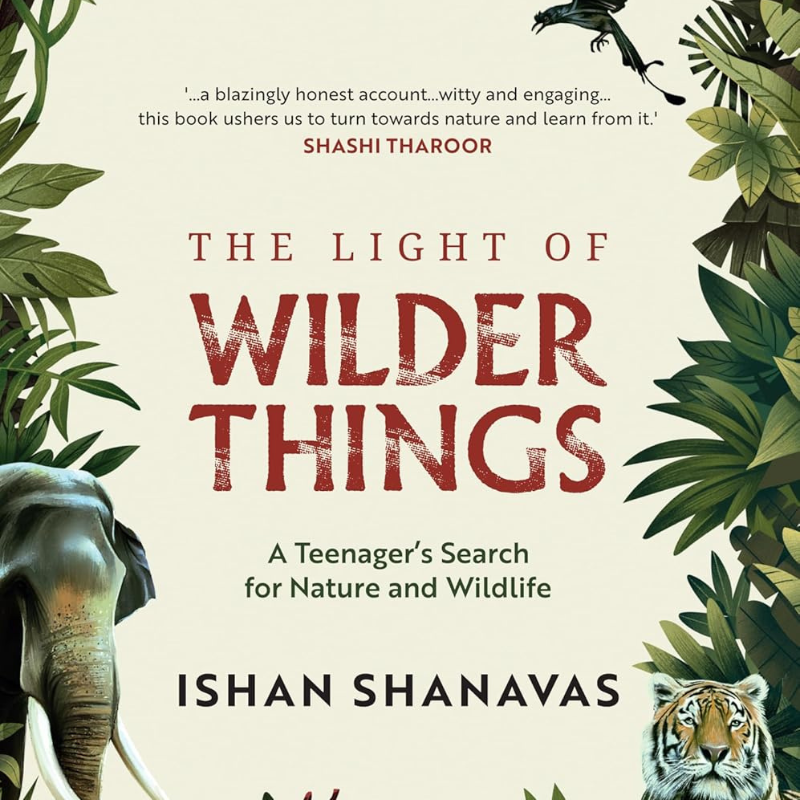
Title: The Light of Wilder Things: A Teenager’s Search for Nature and Wildlife
Author: Ishan Shanavas
Publisher: Stark World Publishing (paperback, INR 499)
Reviewer: Karthik Venkatesh
Details
A young person interested in the natural world is a delight to behold. And that is the promise of The Light of Wilder Things. It chronicles a teenager’s deep fascination with and eventual absorption in nature and wildlife.
As a boy, Ishan Shanavas finds himself drawn to the natural world. Perhaps, all children do. But not everyone gets the opportunity to cultivate it – Ishan does and how! He makes full use of the opportunities that his parents create and goes the extra mile in committing to the observation and study of trees, birds and animals of all sorts. The early chapters of the book give us a ringside view of his encounter with snakes, his bird-watching endeavours and his solo forays into the forest (in contravention of his boarding school rules). These are a treat to read.
Ishan beautifully chronicles the wonder and thrill of discovering various aspects of nature. It is not always milk and honey though. His experience of being at the receiving end of a (non-venomous) snake bite and his father’s close encounter with a wild pachyderm are sobering. It is one thing to be fascinated with animals. But when the animals turn on you for whatever reason, one’s limits are all too visible. This lesson is not lost on Ishan.
Then there is the matter of the mediated human-wildlife encounter which he writes about in a chapter entitled ‘The Despicable Safari’. This is something he feels strongly about. His less-than-complimentary experience of a touristy tiger safari at Tadoba wherein all that the tourists seem to do is wait in queue to gawk at a tiger, and a later safari at Bandipur when a woman tourist insists that she has seen a fox even as Ishan tries to tell her that it is a dhole (wild dog) are pointers for readers to think about such experiences. In the light of recent reports about the boorish behaviour of Indian tourists abroad, one could even conjecture that perhaps the seeds of that are sown at home, in safaris, like the ones Ishan describes.
Granted, a safari is not the best way to engage with the natural world. But living in a concrete jungle as we do, it is perhaps the only way to develop some love and respect for nature, even if it is in the crassest way imaginable. That is something perhaps the author could have thought about. True appreciation of nature demands immersion, an option not available to many. Could we imagine a more ‘benign’ safari therefore in contrast to the ‘despicable’ ones we have now? Who else can ideate about it if not a young nature-lover?
Where the author could have also done better is in being a little more mindful about certain descriptions. For instance, in one of chapters there is a photograph of a man simply captioned ‘Jenu Kuruba tribal’. This is clearly the city-dweller’s gaze at work here, which does not deem it necessary to state the man’s name, and give some more relevant details about him. Elsewhere, a photograph of a woman from Uttarakhand talks about her ‘weathered face’. It would have been good if Ishan had avoided a cliché like ‘weathered’ for the woman to describe her looks and instead given more pertinent information.
Then there is the claim that the pandemic made him an ‘artist, photographer and writer’. Yes, the pandemic did get him to write, click pictures and paint. The chapters that describe his immersion in these pursuits are wonderfully written. But ‘artist, photographer and writer’ is what one should claim to be when one has worked at these pursuits for some time and not after dabbling in it just for a few months. This claim stands out simply because in another instance when Ishan is volunteering in Agumbe with a researcher studying pit vipers, he spends time with two researchers who have spent some years going through the grind and sheepishly realises the chasm that separates an amateur like him and the professionals who have committed to deep study. Artistic pursuits are no different, surely. They too are the product of time, effort, feedback and improvement.
But its minor deficiencies apart, The Light of Wilder Things is a stunning debut. The book is masterfully written and wonderfully produced with sketches and photographs making the reading process even more enjoyable. Like I was saying, fascination with nature is wonderful. A more mature work is surely in the offing. One looks forward to that.
About the Reviewer:
Karthik Venkatesh is Executive Editor with Penguin Random House India. He is the author of two books for young adults: 10 Indian Languages and How They Came to Be and 10 Makers of the Indian Constitution and the editor of a volume entitled Where the Gods Dwell: Thirteen Temples and Their (Hi)stories.