
A Well-Steeped Mystery
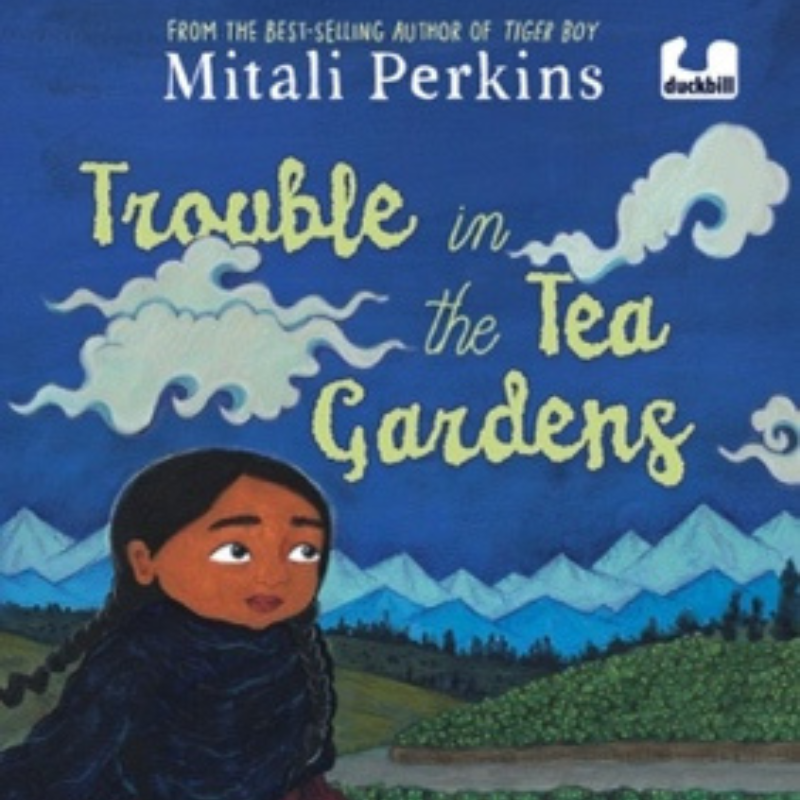
Book Title: Trouble in the Tea Gardens
Author: Mitali Perkins
Illustrator: Tanvi Bhat
Publisher: Duckbill (paperback, INR 250)
Reviewed By: Nadia Nooreyezdan
Details
Tourist brochures for the tea gardens of Darjeeling include stunning photographs of rolling emerald slopes, mist drifting across pine forests, and cups of amber tea held against mountain views. What these images fail to show is the labour that sustains this beauty. Generations of tea pluckers remain tied to estates through low wages, inherited work, and limited opportunities even as visitors arrive seeking rest and romance in the hill station. It’s against this backdrop of inequality that Mitali Perkins sets her latest book, Trouble in the Tea Gardens.
Twelve-year-old Sona lives on a tea plantation in Darjeeling with her mother and brother. While her mother and the other tea pluckers hike up the hills in the darkness before dawn, Sona is trying to study for an English exam that could secure her scholarship to a better school. But the daily struggle to collect water and anxiety over her older brother’s debts to the local loan shark are enough to distract her from her studies. As Sona wrestles with her concerns, her emotional state matches the terrain outside: landslides of worry poured into the slopes and crevices of Sona’s mind.
Although the book opens with weighty realities (the immense pressure on Sona to break free from the generational cycle of plantation labour, the sense that the tea estate is more of a prison than a home, the colonial legacies that shape their lives, and the fights over water sources), the writing remains buoyant, moving lightly even while quoting from Tagore and Edmund de Waal.
The narrative picks up speed as we’re introduced to the characters populating Sona’s world, from the tyrannical tea estate owner, ‘Banerjee babu’, his niece Tara who’s trapped in his house with her only other companion (her parrot, Tutu), her supportive teacher who believes in preserving Nepali language and culture, and her kind and ambitious brother, who was falsely accused of thievery and is now struggling to find work.
When Tara is on the verge of being married off to a man chosen by her uncle, who plans to divide the gold her parents left in her name as part of the arrangement, a robbery at the house almost seems like a stroke of luck. But Sona knows her brother was also at the house that day and must uncover the truth before suspicion inevitably turns toward him.
We follow the intrepid detective as she tracks down and questions her suspects, facing many ethical conflicts in the process. Clearing one suspect risks implicating her own family, and protecting her brother could harm other people she loves. Her dilemmas feel appropriately scaled to a twelve-year-old negotiating independence, loyalty to her friends, and aspirations for herself and her family.
Sona emerges as an engaging and likeable protagonist precisely because she’s neither saintly nor excessively virtuous. She lies to protect people, hesitates, and wrestles with doubt, even as she shows remarkable bravery and kindness. As a reader, you’re willing her to crack the case but you’re also able to empathise with the weight of expectation placed on her. This is especially true of the hopes that not only her mother but her whole community has for her to become a “Nepali leader”. When an elder urges her not to be reckless, she thinks: More pressure. Uff! Sometimes she wished she hadn’t won that scholarship.
Darjeeling emerges vividly in Perkins’s writing. Sunlight spills down the mountainsides and fog curls through pine trees, clinging to the tea bushes like tendrils of their neighbouring bojyu’s hair. Social inequalities are also visible through observation rather than exposition. Sona queues for drinking water while tourists splash in hotel pools. We see discrimination play out when a hotel employee uses a slur against Nepalis at her. And the generational cost of plantation labour is demonstrated through small domestic details: Sona’s grandmother’s doko that her mother now straps around her head everyday to collect tea leaves, and the old neighbour’s fingers, permanently bent from years of working in the tea fields. But as the narrative progresses we also see an undeniable solidarity between the female characters, cutting across generations. And those moments carry genuine warmth that runs through the book.
Perkins draws on research by Dr. Sarah Besky, author of The Darjeeling Distinction: Labour and Justice on Fair-Trade Tea Plantations in India as well as consulting with a Nepali family for insights, lending the story cultural texture without weighing it down with exposition.
There are minor blemishes in the book. A few copyediting slips, including a repeated paragraph near the end, are noticeable. And the opening takes some time to reach the sustained tension of the later chapters. Yet these do little to diminish the book’s emotional depth and the mystery is resolved in a surprisingly satisfying manner. Trouble in the Tea Gardens reminds readers that hope often begins with young people daring to imagine futures that are different from the ones handed to them.
About the Reviewer: