
Future Tense
Book Title: Where We Left Off
Author: Nikhil Kamath
Illustrator: Abhijeet Kini
Publisher: Abhijeet Kini Studios (paperback, ₹150)
Reviewed by: Smit Zaveri
Details
Where We Left Off is a comic book that sets itself up as a grave story of memory and silence if one were to read the blurb. We meet Ishaan, a teenage boy who has been sent out to buy milk and eggs for breakfast. It is an ordinary errand and that ordinariness is deliberate. This simple task becomes the story’s hinge. What lies outside is the question the book slowly builds towards, especially once we realise that the birds outside his window are not real.
I like that Where We Left Off is a short, cautionary tale about climate change. Data and statistics can often feel hollow when we can’t see how the world is changing in front of us. One of its most effective choices is the normalisation of the mask. It is a symbol we are now deeply familiar with. But that familiarity does not offer comfort. Instead, it highlights how unnatural this world is meant to be.
Because the book offers only a brief glimpse into this dystopian future, it needs to hit hard. At times, though, it feels hesitant, especially in its language. The line “the air outside is unfit for breathing” feels anti-climactic. The air is already unfit for breathing. We already live in sealed interiors with air purifiers and air conditioners to some extent. If this line is meant to bring us back to our present reality, it doesn’t quite work because it plays down the severity of what’s at stake instead of amplifying it. The writing could have been more unsettling/dystopic, rather than pulling back after telling us about the appalling lack of flora and fauna in the future — a future we could have changed.
The author’s choice to insert himself as a narrator also shapes how the story is received. By repeatedly signalling that this is a cautionary tale about climate change, the book becomes didactic. An omniscient narrator could have been used to introduce ambiguity or tension, trusting the reader to draw their own conclusions rather than being guided towards them.
This tension becomes clearer when the book addresses the reader directly. We are shown Ishaan’s world, a place already beyond repair. Yet we are reminded that we are not Ishaan and that it is not too late for us to change. The repeated use of “you” places responsibility on the present-day reader. We, the reader, are asked “what will we leave behind for the next generation” and shown the world from Ishaan’s perspective, who is living in a world beyond repair.
At the same time, the book does not fully decide who the reader is meant to be. Despite being positioned as suitable for 10+ readers, it remains unclear whether we are meant to read this as a child (who already has climate-anxiety these days) or read this as adults responsible for the problem. Clarifying this perspective could have strengthened the book.
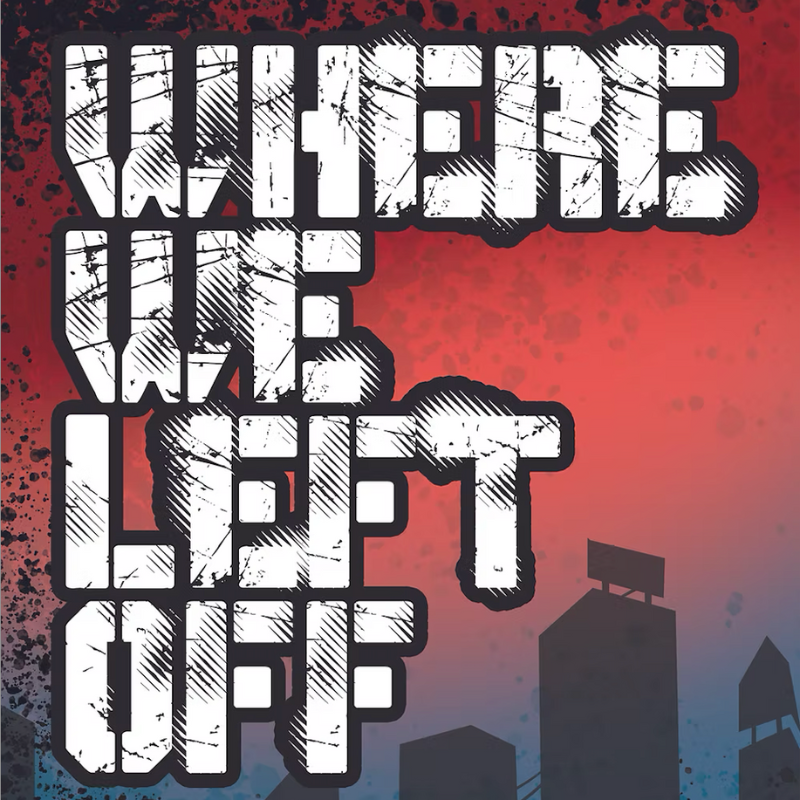
The fact that this was a short story that was adapted into a comic is evident, with the art often reiterating what the text is saying rather than complementing it. There is room here for the visuals to work harder, to introduce unease or contradiction, while letting the words pull back. This becomes especially apparent in the relationship between the cover, which makes it look like a generic thriller and the art inside, which uses a toon style. The mismatch sets up expectations the book did not meet for me as a reader.
The art itself is not ineffective. It has a cartoonish, nostalgic quality that recalls the books many of us grew up reading and seeing on TV, and that familiarity could have been used more deliberately. I kept thinking of WandaVision, an American miniseries, where comforting sitcom language and music slowly shatter to reveal grief underneath. Allowing the art to fracture as the story progresses might have deepened the sense of dystopia without changing the book’s tone.
Where We Left Off has strong ideas and a clear urgency behind it. But I wish it trusted its own world, images, or readers to sit with the consequences of that warning.
About the reviewer:
Smit Zaveri is a freelance children’s book editor and publishing consultant who has tried on many children’s publishing hats — editing, marketing and sales. She has been the editor on several award-winning books such as The Jungle Radio, Jamlo Walks, Afo and I, and Maithili and the Minotaur. She has collaborated with Azim Premji University on several editions of the Nature Writing for Children workshop.