
City City Dang Dang!
Book Title: Happiness City
Author: Bhawna Jaimini
Illustrator: Deepa Balsavar
Publisher: The People Place Project, 2024 (paperback, ₹500)
Reviewed by: Meghaa Gupta
Details
Mahatma Gandhi liked to say that India lived in her villages, but in the decades since independence, the urban sprawl has grown bigger. It is estimated that more children in the near future will be born in cities rather than villages.
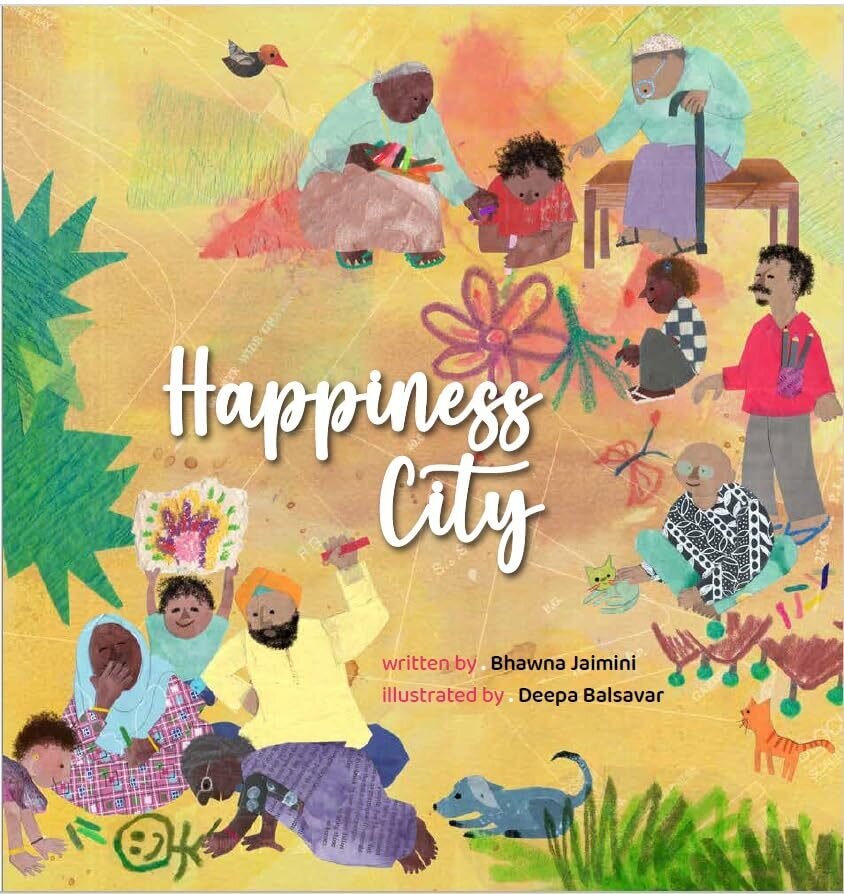
Happiness City is a joyously illustrated invitation to examine and reimagine the act of city-making with crayons! Divided into three parts — Resist, Renew and Replenish — the narrative offers a vision of how cities might look if they were designed by ‘ordinary citizens’ who work maximum hours and yet have minimum assets instead of ‘city-experts’, that is, the architects, the urban planners, the town planners, the transport specialists and anyone who thinks they know how cities are supposed to work. It’s a powerful idea and the author infuses it with sensory, childlike delight when she introduces the use of crayons to rethink urban spaces: …distribute crayons… Especially the green ones… Get the children and the elderly to draw parks first. Don’t stop them if they can’t keep the green between boundaries… There can never be enough parks in a city… Get people to draw homes for each other… for families of humans, animals and plants to flourish. How else will we achieve housing for all? Once everyone has a home to live, a street to walk and a park to play in, start drawing libraries, day-care centres and post-offices…
I found myself smiling at this vision of a city built on compassion, collaboration and cooperation instead of endless competition for resources — if only actual cities functioned this way! But the author, an urban practitioner no less, is adamant that this city isn’t utopian. Instead, it’s a right denied to us.
While I agree with the idea that our cities are poorly planned and lacking in happiness and comfort, I found myself thoroughly unconvinced by the viability of the ideas proposed in this book. To begin with, the problem of poor planning is not the fault of city experts alone. Most of India’s cities were not planned with the idea of accommodating the multitudes they have come to house. Lack of equitable development has meant that most opportunities for earning a regular income have come to be centred in cities, leading to migrations that have left metropolises heaving. Besides, city experts often work within a larger ecosystem that may not be supportive of sustainable solutions either because of a dearth of resources or of political will. I felt that the idea of sending away city-experts in order to make room for reimagining cities is deeply flawed. Community participation is essential in building inclusive cities, but belittling the work of planners is not the best way to begin the argument, even if it’s in a children’s picture book. After all, aren’t city experts part of the community too? Is it not better if people find ways of working together instead of excluding one group to highlight another?
Moreover, the idea of community-driven, sustainable living is not new. In a way, it has existed from the time the first humans walked on earth. They lived in groups and depended on each other and on nature for survival. With the advent of agriculture, humans began to settle down in one place instead of moving around. This paved the way for the creation of ever-growing human settlements — villages, towns, cities — and unleashed unprecedented urbanisation. The problems of urban development go back a long way. Research suggests that even early cities belonging to the Mayan and Mesopotamian civilizations bore signs of environmental decay that might have contributed to their collapse. Yet, eco-friendly modes of living, as proposed in this book, have by and large failed to take off in a significant way. City-experts have not been able to build cities that meet everyone’s needs — but why has such a situation come to pass? The book makes no attempt to probe and unravel the complex reasons behind this.
I also found myself perplexed by the author’s views on money. She believes that even though no one has tried it, perhaps kindness and love alone will make a city sustain itself: We will be asked, How will this city sustain itself? Where will the money come from? After all, kindness and love can’t run the fan on a hot day. Can they? Perhaps they can. No one has tried it. Money doesn’t get things done. People do. While I will never deny the importance of kindness and love, can earning fair wages for one’s work not be added into the mix? After all, don’t most people expect to earn a livelihood from their work? Also, money alone isn’t a problem — demons lie in the way money is spent. Wouldn’t it have been more realistic to envision a city where money is used to create resources for everyone instead of a fortunate few?
Perhaps I am far too hard-headed to visualise the kind of city the author imagines. But I believe even young readers might have questions about it, and I am not sure adults steeped in existing ways of life would be able to answer them persuasively.
Deepa Balsavar’s lively illustrations are a joy to behold. There is much to see and explore in them. But given the fundamental shortcomings in the main idea of this book, the illustrations too fall short. The pages are populated by an assortment of images — people drawing, sewing, farming, minding livestock, plucking mangoes, growing trees, cooking, filling water, repairing cars and bonding with each other — that don’t help to allay the bewilderment caused by the narrative. Is all this happening on the strength of love and kindness alone? Wasn’t there any money involved? Where did the locomotives and cars come from? How do they fit in with the idea of a self-sustaining society? Why not espouse bicycles, carts and plain old long-walks? The more I read and see, the more questions I have.
Perhaps the author wants readers to suspend disbelief and soak in a radically new way of looking at ‘city life’. But when it comes to exploring real-world problems, such an approach can appear incredulous and platitudinous — especially when it’s couched within an English picture book costing 500 rupees! If the idea is to inspire young readers to imagine alternate ways of city living, it might have been far more effective to dwell upon existing limitations and offer workable solutions.
About the reviewer:
Meghaa Gupta works in children’s publishing and co-edits the Nature Writing for Children newsletter.