
Koel’s Conundrum
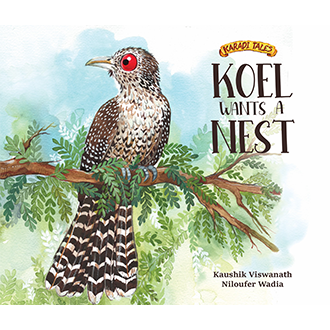
Book Title: Koel Wants a Nest
Author: Kaushik Viswanath
Illustrator: Niloufer Wadia
Publisher: Karadi Tales, 2024 (paperback, ₹399)
Reviewed by: Garima Bhatia
Details
The natural world is full of fascinating and incredible animal behaviours that sometimes play out in close proximity to humans. Brood parasitism is one of these. This is an evolutionary strategy where one species offloads its parental duties onto another, and is most easily observed in birds. One of our most common and everyday birds, the Asian Koel, is a brood parasite and Indian folklore abounds with stories of the interplay between koels and crows, which are its preferred hosts. Modern city dwellers though may be unaware of this drama unfolding in their backyards, and are amazed when they are familiarised with the details of the koel’s parenting style.
Koel Wants a Nest, a new picture book for young readers, attempts a retelling of this age-old tale by following a koel who wants to lay an egg but doesn’t know how to build a nest. She flies around meeting various types of birds that are all busy building their nests in their own unique ways, but she rejects each of these ways as unsuitable for her. Finally, she serendipitously chances upon a crow’s nest with eggs in it, and decides to make use of it to lay the egg that urgently needs laying.
It’s a simple story that tries to bring out several aspects of the natural history of birds – the need for a nest to protect the young and the nesting behaviour of different species of birds encountered by the koel (from cavity nests of hornbills to intricate nests of the weaverbirds and scruffy-looking nests of the pigeons). The birdwatcher in me cringed a bit to read about a ‘warbling swallow’ making a nest from ‘twigs’ (swallows make nests out of mud) but the other descriptions are generally accurate. The text of the story could have been more engaging for a read aloud session, and the use of somewhat complicated words, such as ‘retort’ and ‘budge’, seem out of place for the intended age-group. However, this book is worth picking up for the absolutely stunning watercolour illustrations that bring the koel’s predicament alive, and the empathetic telling of her story: Koel flies back to the rain tree and sulks. Where will she lay her egg? Why did she never learn to build a nest? Why didn’t her mother ever teach her? Koel couldn’t remember much about her mother. She had black feathers and a grey neck, sort of like Crow. Maybe Crow could help her with the nest?
Brood parasitism is a difficult topic to introduce to children of any age-group, and often the tendency, even among adults who hear about this for the first time, is to anthropomorphise and label the parasite as a lazy or negligent parent. In reality of course, there are no good or bad birds, just the race to survive in the natural world. Koel Wants a Nest steers clear of any judgement of the koel’s choice, and provides a child-friendly version of this fascinating aspect of natural history. The note (for parents) at the end of the book touches upon the evolutionary race between the koel and the crow, which helps to put the story in context and can be used to expand the knowledge of the interested child.
About the reviewer:
Garima Bhatia is a birdwatcher and nature educator who leads Early Bird, a non-profit initiative to introduce children to nature through birds. She is also the course director of Early Bird’s most recent offering – a free online course titled The Wonder of Birds.