
Between a Rock and a Hard Place
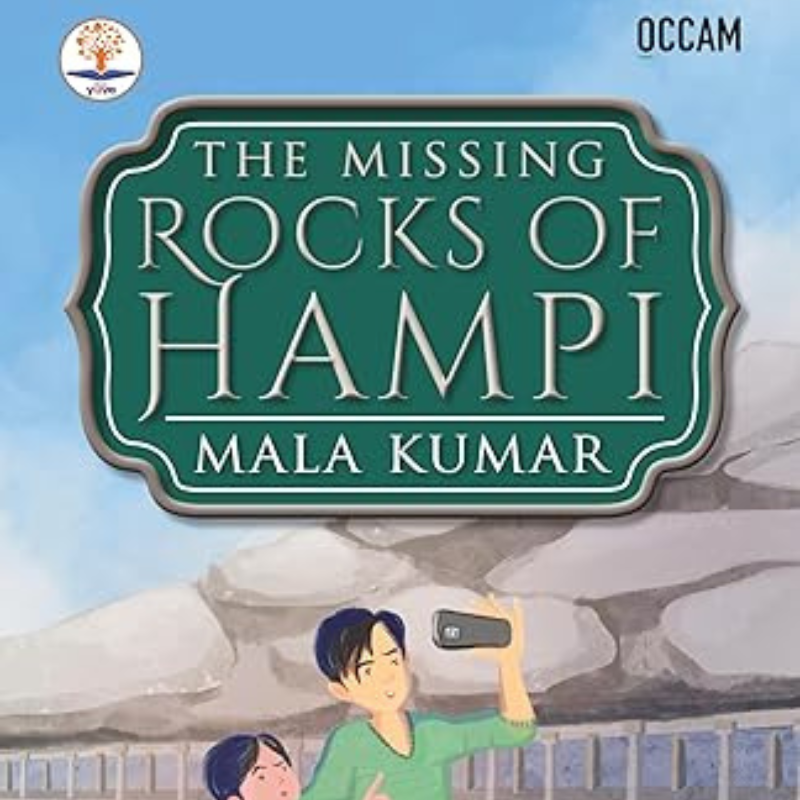
Book Title: The Missing Rocks of Hampi
Author: Mala Kumar
Illustrator: Megha Vishwanath
Publisher: BlueOne Ink (paperback, ₹350)
Reviewed by: Anagha Gopal
Details
The Missing Rocks of Hampi is a book made up of two worlds, present-day Bengaluru and early fifteenth-century Vijayanagara. By bringing these two worlds together in loosely alternating chapters, the book aims to address a pedagogical gap — how history is taught in school and which history is highlighted. As the note to readers at the beginning of the book states, the aim is to narrate histories classified as ‘regional’ as opposed to ‘national’ in an interesting way by combining storytelling with illustrations and maps. In such a framework, history veers away from being a mere accumulation of facts to actually contextualising the relevance of a historical period beyond its time.
The book is effective in contrasting modern-day Bengaluru where Manhattan Towers (the building temporarily housing the protagonist Devyani’s school) is built over a lake bed, and Hampi where a centuries-old water management system still works. Readers learn about the aqueducts, dams and tanks built under the rule of the Vijayanagara kings along with Devyani, her brother Sarang and her cousin Nakul as they tour Hampi with a local guide. We understand how the Vijayanagara kings focused on irrigation and invested in creating public access to water. Their openness to both local traditions and new ideas for irrigation, willingness to learn from older and contemporary civilisations, and their policy of observing nature carefully while building and expanding the city are emphasised. This is in marked contrast to the opening chapters of the book, where capitalist interests influencing water management in the present day are visible not only in the very existence of Manhattan Towers but also in a TV news debate sponsored by a drinking water company.
Much to its credit, the book does not present the past as perfect and the present as inevitably doomed. Powerful private parties plot to redirect the flow of water to their own homes at the cost of public access even in fifteenth-century Vijayanagara. And when Shubha, a sixteen-year-old girl, uncovers the plot, she needs her cousin’s help to convey the information to someone close to the king as she cannot access the spaces he does. Though she has a talent for architectural design, her plans are not likely to be taken seriously in a time that was more restrictive for women. Meanwhile, in the modern day, Devyani’s mother is a renowned water management consultant whose opinions are influential enough for her phone to be stolen so that her findings related to a new tourism development project in Hampi can be destroyed. The book also makes subtle references to long-term sustainability — the mix of fast food and local food that the characters order, volunteering at a local school for a knowledge exchange programme, attending local cultural performances and worrying over an old phone for its sentimental rather than monetary value.
However, the actual mystery in the book is loosely constructed, where readers have little to build on until an expositional chapter where an adult and not the child protagonist provides most of the explanations. Central to the mystery is Devyani’s mother whose work threatens the interests of a private construction firm that wants to start a tourism project in Hampi. The resolution of the mystery carries an important message — that development must go hand in hand with the knowledge and wisdom of local communities. While we are introduced to different members of the tourism ecosystem in Hampi, we do not hear their thoughts about the proposed tourism project. The mystery might have had a stronger base had their opinions, stakes and interests been peppered right through the narrative.
While the book succeeds in presenting history in an engaging way, it falls short when it comes to the plot. The title is particularly misleading. The ‘missing rocks’ in the title refer to a precious rock from Hampi that was gifted to Devyani’s father, which she has left at her now sealed-off school without his permission. Given the title, I expected that the story would be about the characters looking for a similar rock only to find themselves in an ecological mystery. Instead, the missing rock (there is only one, not many) comes up only in sparse moments of nervousness, often quickly suppressed by Devyani. In a story where water is the star, the missing rocks of Hampi are actually just missing from the plot!
About the reviewer:
Anagha Gopal is a PhD scholar at the Centre for English Studies, Jawaharlal Nehru University. She is currently working on the representation of readers in Indian children’s literature in English.