
Beasts on the Battlefield
Book Title: Mules that Fall from the Sky and Other Stories of Animals in War
Author: Nandini Nayar
Illustrator: Ira Nagar
Publisher: Scholastic, 2025 (paperback, ₹350)
Reviewed by: Aditi Patil
Details
There are certain books that you read as an adult and find yourself wishing you had encountered as a child. Mules that Fall from the Sky is one of those books for me.
War brings out the worst in humanity, forcing people to commit acts that defy forgiveness. It defines eras, shapes history and leaves behind dark lessons meant to guide future generations. But telling children stories about death, suffering and atrocities is neither simple nor comfortable. We often present war through the lens of heroism, filtering out its darker truths to shield children from its psychological toll. But Nayar does something different. She does not shy away from the harsh realities of war. Her stories are laced with courage and loyalty, but also with suffering and loss. The emotional weight of these narratives stems not only from the remarkable service these animals rendered, but also from the cruelty, confusion and, at times, indifference they encountered. In doing so, Nayar refuses to sanitise the truth: these were living beings caught in the chaos of wars they never chose to fight.
Through a series of powerful vignettes, she brings to life a diverse cast of creatures – mules, dogs, camels, horses, elephants, even glow worms – each forced to serve quietly, selflessly and often invisibly in the background of human conflict. Yet, Mules that Fall from the Sky is not a bleak book. There are moments of humour, of triumph, of deep connection between species.
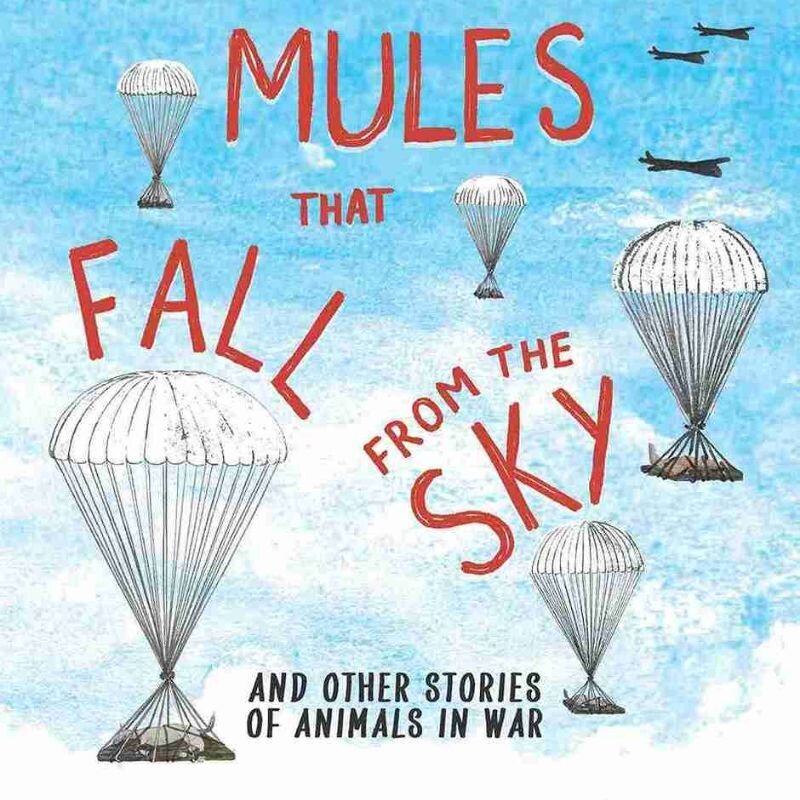
The titular story, about mules parachuted into remote battlegrounds, is both surreal and heartbreaking. Nayar writes with a gentle hand, noting how “blowing on each other” can soothe both humans and mules alike – but the violence is not veiled. One of my favourite discoveries from this story was learning that a book titled The Manual of Horsemastership, Equitation and Animal Transport exists!
The book includes just enough historical context to orient young readers – touching on World War I, World War II, the Vietnam War and more – without turning into a history lesson.
“The Narsapuram Way” offers a delightful glimpse into the everyday coexistence with wildlife that many in India instinctively understand. I especially enjoyed how Nayar weaves in fascinating historical details – like the establishment of the Madras Zoo inside the Madras Museum! Even more intriguing is how both museum artifacts and zoo animals were gathered through what we might now call community-led crowdfunding.
Even when all is desolate, glimmers of hope shine through – people like Lawrence Anthony, the conservationist who famously risked his life to protect zoo animals in Baghdad during the Iraq War.
“No Elephants in the Zoo!” is a beautifully told account of what may be a rare and extraordinary example of children’s advocacy during wartime.
Reading about the choices made by zoo authorities to euthanise certain animals during wartime in “The Many Secrets of a Zoo,” I was immediately reminded of George Orwell’s Animal Farm and its famous line: All animals are equal, but some animals are more equal than others that feels eerily relevant to the themes Nayar touches upon: the hidden costs of war and the lives caught in its crossfire.
The final story, “Ritwick’s Diary of the Ukraine War,” uses a refreshing storytelling format that brings back the charm of slam books and handwritten diaries — a nostalgic contrast to today’s world of mobile screens.
The stories carry a haunting relevance in present times. With war ongoing in Palestine and Ukraine, and economic tensions escalating globally, especially because of US-led tariff disputes, the themes of invisibility, displacement and the costs borne by voiceless animals feel more urgent than ever.
Nayar’s fresh perspective on history – celebrating the silent, brave companions who have stood alongside humans in times of war – becomes a quiet study in the political economy of conflict, revealing who reaps the benefits and who bears the burden.
More than a tribute, this book stands as a quiet warning. It reminds us that war, for all its grand strategies and headlines, is lived in the small and silent corners by those who cannot speak for themselves. Nayar’s collection offers a record that might otherwise be lost to history. Her’s is an account of war not told through generals and battles, but through children’s innocence, through hooves, paws and trunks. This narrative is beautifully complemented by Ira Nagar’s illustrations, which breathe life into the text and offer young readers a vivid, visual anchor for the stories. The cover is especially striking — it’s not often one imagines mules parachuting into tropical forests — and the playful detail of mule-shaped page numbers adds a unique charm that stays with you long after the book is closed.
Nayar’s writing is both simple and lyrical, making the book accessible to younger readers while offering layers of meaning for older audiences. Her research is evident, but it never overwhelms the storytelling. This is a book that expands our understanding of loyalty, sacrifice and the many forms courage can take.
In a world still at odds with itself, Mules that Fall from the Sky feels like an essential read – not just for children, but for anyone who believes in looking closely and remembering well.
About the reviewer:
Aditi holds an MPhil from Cambridge and has co-founded the research organisation ‘Conservation indica’. She has a decade of conservation research experience in India and is the author of Patriarchy and the Pangolin.