
Wander and Wonder
Book Title: Falling in Love
Author: Sujatha Padmanabhan
Illustrator: Sangeetha Kadur
Publisher: Kalpavriksh (paperback, INR 170)
Book Title: Rain Perfume
Author: Niveditha Reddy
Illustrator: Shubhshree Mathur
Publisher: Kalpavriksh (paperback, INR 170)
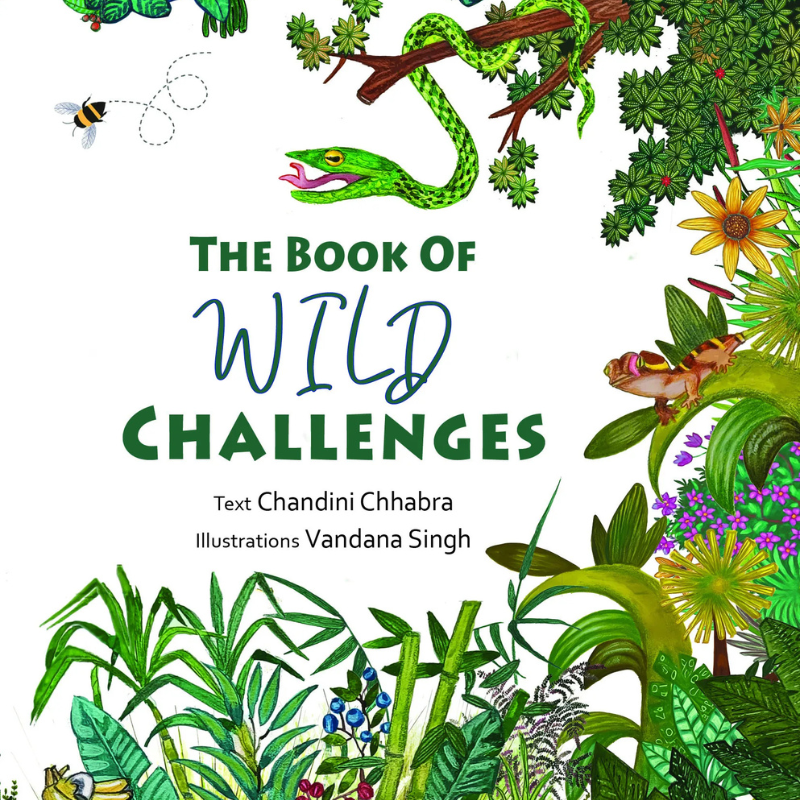
Book Title: The Book of Wild Challenges
Author: Chandini Chhabra
Illustrator: Vandana Singh
Publisher: Kalpavriksh (paperback, INR 170)
Reviewed by: Deeptha Vivekanand
Details
Every day, a bird knocks on my window with its beak. On some mornings it’s a sunbird, on some afternoons it’s a hoopoe, and on some evenings it’s a barbet. No, I do not live in a cottage in a forest. I’m simply lucky to live in a city that still has generous green cover and large open parks with old trees.
These small encounters remind me how thin the line can be between the human world and the wild one. Nature does not always require grand landscapes or distant safaris; sometimes it appears quietly, outside a window or under a patch of soil. I see this most clearly when my five-year-old daughter snaps pea pods out of our kitchen garden or spends her day playing with the stray cat who has adopted us. For her, the pleasure lies in the simple act of experiencing the fresh taste of a vegetable and observing how the cat slurps the milk from her bowl.
Perhaps that is where curiosity about the natural world begins: in these small, everyday moments of attention. Children’s books can nurture that curiosity in many different ways. Some invite readers to observe closely, some awaken the senses, and others encourage children to compare themselves with the remarkable creatures that share our planet. Three recent books—Falling in Love, Rain Perfume and The Book of Wild Challenges—offer young readers three distinct but equally engaging pathways to a relationship with nature.
In Falling in Love, Sujatha Padmanabhan traces the quiet beginnings of a lifelong fascination with the natural world. Each spread captures a rendezvous with nature. The book opens with the sighting of a stunningly illustrated paradise flycatcher, its long white tail ribbons trailing behind it as it glides through the canopy. The moment is fleeting, but powerful enough to ignite a sense of wonder.
From there, the narrative moves through a series of encounters that criss-cross different landscapes: a flying lizard gliding between trees in a forest in Kerala, a crimson tragopan appearing unexpectedly on a mountain trail, the swirling spectacle of a starling murmuration near a wetland, and the quiet thrill of spotting a Eurasian lynx in the high mountains of Ladakh. Marine life appears too, in the form of delicate Christmas tree worms nestled within coral reefs. Through each of these moments runs the recurring refrain: How can I not fall in love…?
What makes the book compelling is its ability to capture the emotional side of observation. These reflections are not presented as dry facts about wildlife, but as moments when curiosity deepens into affection and respect. Sangeetha Kadur’s spectacular illustrations mirror this sense of wonder, filling each page with richly textured landscapes and vividly rendered creatures.
At times, however, the paragraphs grow verbose for young readers, and the reflective narration may require adult mediation to hold their attention. At times, I found myself lingering over the illustrations more than the text. Yet the book’s real strength lies in evoking the thrill of discovery rather than simply listing facts about animals. It gently reminds readers that a love for nature often begins with a single moment of noticing.
Rain Perfume by Niveditha Reddy turns to a more sensorial experience: the smell of rain on dry earth. The story follows Boondi — aptly named in line with the book’s theme — a young girl who eagerly awaits the season’s first shower. When the rain finally arrives, she breathes in deeply and delights in the fresh scent that rises from the ground — that familiar smell of first rain, or petrichor, often named in that quiet moment when a child turns to an adult and asks, “What is that smell?” But, Boondi’s joy is tinged with concern. Her bedridden grandfather cannot step outside to experience it.
Determined to share the moment with him, Boondi sets off to capture the smell of rain in her water bottle. Her journey takes her through muddy paths, puddles and patches of wet earth where the rain has stirred up life. Along the way she notices the small creatures that appear after a shower — earthworms wriggling through the mud, snails inching along damp stones, butterflies fluttering through the moist air. What begins as a simple mission becomes an exploration of the many tiny lives awakened by rain.
Shubhshree Mathur’s illustrations give the story a warm, tactile quality. The brown-hued pages seem almost textured with mud, leaves and puddles, inviting readers to slow down and notice the details around Boondi. The doublespread that shows a dirt-covered Boondi through her grandfather’s glasses is particularly heartwarming.
While the story’s emotional core is tender and relatable, the narrative occasionally loses momentum. The various distractions Boondi encounters on her way home feel somewhat forced, as though inserted mainly to introduce small creatures rather than emerging organically from the story itself. Even so, the book’s quiet attention to the sensory world leaves a lasting impression.
The third book, The Book of Wild Challenges by Chandini Chhabra, approaches nature from an entirely different angle: play. Instead of asking children to observe quietly, the book invites them to test themselves against the remarkable abilities of animals. Each page presents a playful challenge, encouraging children to try the activity themselves before revealing the extraordinary abilities of animals — from chameleons that can move their eyes in different directions at the same time to cheetahs capable of breathtaking speed.
Conceptually, the book is not entirely new. Many animal fact books compare human abilities with those of animals. I was reminded of Eric Carle’s Head to Toe as I flipped through the pages that asked the reader to try and stand on one leg for thirty seconds like flamingos, and sit still like marsh crocodiles. But what sets this one apart is the playful framing of these comparisons as challenges, along with Vandana Singh’s lively illustrations that bring humour and movement to each spread. The result is a book that feels more interactive than informational.
Taken together, these three books offer three complementary ways of bringing children closer to the natural world. Falling in Love encourages attentive observation, reminding readers of the wonder that lies in simply watching and waiting. Rain Perfume celebrates the sensory pleasures of nature — smell, touch and sound. The Book of Wild Challenges transforms nature into a playful invitation, asking children to see how their own bodies compare with the astonishing abilities of other creatures.
In the end, perhaps that is how all relationships with nature begin. Not with grand gestures or distant journeys, but with small moments of attention.
About the Reviewer:
Deeptha Vivekanand is a Storytelling & Reading Consultant who works with teachers, children, and communities, exploring how stories — old and new — shape the way we imagine the world.