
A Jungle Jigsaw
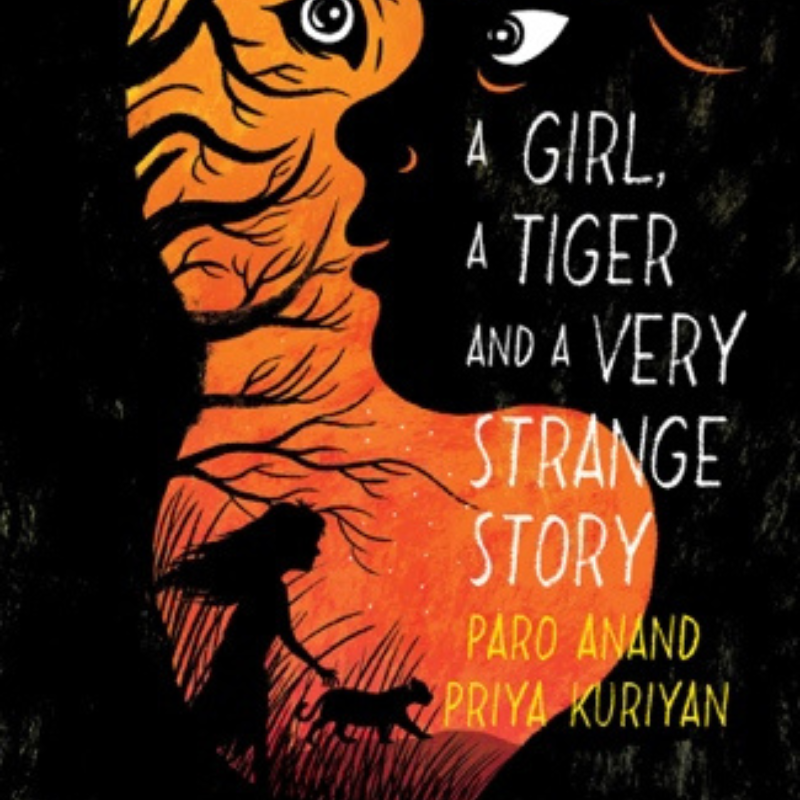
Book Title: A Girl, A Tiger and A Very Strange Story
Author: Paro Anand
Illustrator: Priya Kuriyan
Publisher: Penguin, 2025 (paperback, ₹399)
Reviewed by: Maithreyi M.R.
Details
In her stories for children, Paro Anand has repeatedly shown that, for her, talking about issues seen as ‘sensitive’ and ‘unsuitable’ for children is as important as spinning a fantasy. Reacting to two of her books being withdrawn from reading lists of schools, she wrote an opinion piece (“Something About the Book”) in The Indian Express where she stated that stories depicting difficult circumstances are needed for children to “navigate their world and become thinking, compassionate adults…”.
A Girl, A Tiger and A Very Strange Story surely does not fall in the category of ‘unsuitable’. It cannot be brushed away as ‘not positive’ content for a young reader. If anything, the wild child protagonist, Junglee, is likely to appeal to readers for the way she is, the way she thinks and the way she experiences her surroundings. She is the ‘other’, the exotic who will charm us with her worldly knowledge but not ruffle any feathers.
In a nutshell, the story is about an unlikely relationship that blossoms between Junglee and Raunaq, a young tiger cub (what a beautiful name!), as they find their way back to their parent/s, from whom they were separated one stormy night in the jungle. We are led into Junglee’s world of wild abandon. Several pages go by in establishing how Junglee and her people “were nomads, but never felt that they were homeless”, and unlike the city children who had clear relationship definitions, children of the nomadic world “were everything to each other — schoolmates, friends, cousins, and most of all, brothers and sisters”.
Anand’s readers are children whose world crosses that of Junglee’s on the city streets as they wave at her from their cars “stuck in helplessly long lines”. Standing on the footpath, analysing the cars, and in them the city children and their world, Junglee comes across as a precocious child. She may not have gone to school, but at eleven years, she’s worldly wise — knows the jungle like the back of her hand, is already learning her community livelihood of making medicines from wild herbs, and when push comes to shove, can make her own fire and cook the fish she has managed to snag with her bare hands.
The story picks up pace with Priya Kuriyan’s comics, which take over and breathe life into Raunaq through elegant, expressive strokes. The crisp text interspersed with comics enables a fast-paced and immersive reading experience as the duo navigate through the wild patches, learning to read, trust and even rely on each other. Junglee mostly becomes the ‘responsible elder’, feeding, teaching the cub to hunt and even protecting it. Occasionally, a hare, a fox, a quail, a racquet-tailed drongo, even a bluethroat and an Indian thick-knee walk into the pages, adding vigour as silent spectators.
When Junglee escapes the clutches of a crocodile and is badly hurt, Raunaq saves her by finding the leaf of the life-saving herb that she drew for him on the mud. The author seeks suspension of disbelief as she demonstrates how some relationships are beyond definition and comprehension. But this is harder to grant when she tells us that Junglee knew “birds don’t accept their chicks once they’ve been touched by human hands”. As someone who could “interpret most things of the forest”, surely Junglee should have known this was an unfounded belief.
Anand uses every opportunity to draw the reader’s attention to the nomadic community that Junglee belongs to. Unlike the other wandering communities, such as the nomadic pastoralists, who still receive some semblance of recognition (2026 is the International Year of Rangelands and Pastoralists), the Pardhis, deemed to be among the lowest rung, face not only a lack of opportunities but also historical stigma: …we are untouchables. No one wants us. No one trusts us. So, what can we do except continue doing what we do? Capturing and killing animals for parts and selling them illegally…
One can see why the author deems it important to highlight these issues of people largely invisible to her readers — they rarely figure in textbooks or fictional narratives for children, or make it to the newspapers for a positive reason. Yet, in her anxiety to pack in every injustice the Pardhis continue to face, the story slackens structurally.
The effect is far less moving than intended when the eleven-year-old protagonist declares: I know there are many who protect animals and forests, for them, we are nothing but dirty vermin — the worst kind of enemy. Yes, in some ways we are. We hunt them and, often, kill them. But as my parents were saying, what choice do we really have? Here, the author’s voice takes precedence over Junglee’s, and instead of prompting empathy, the narrative risks distancing itself from the reader.
About the reviewer:
Maithreyi M.R. is a Consulting Senior Editor with the Ashoka Trust for Research in Ecology and the Environment (ATREE).