An Introduction to Gravitational Waves
Basundhara Ghosh provides a pedagogical introduction to gravitational waves, one of the most fascinating phenomena in the Universe, which has been observationally confirmed in the past decade and is considered one of the strongest evidences for Einstein’s general theory of relativity.
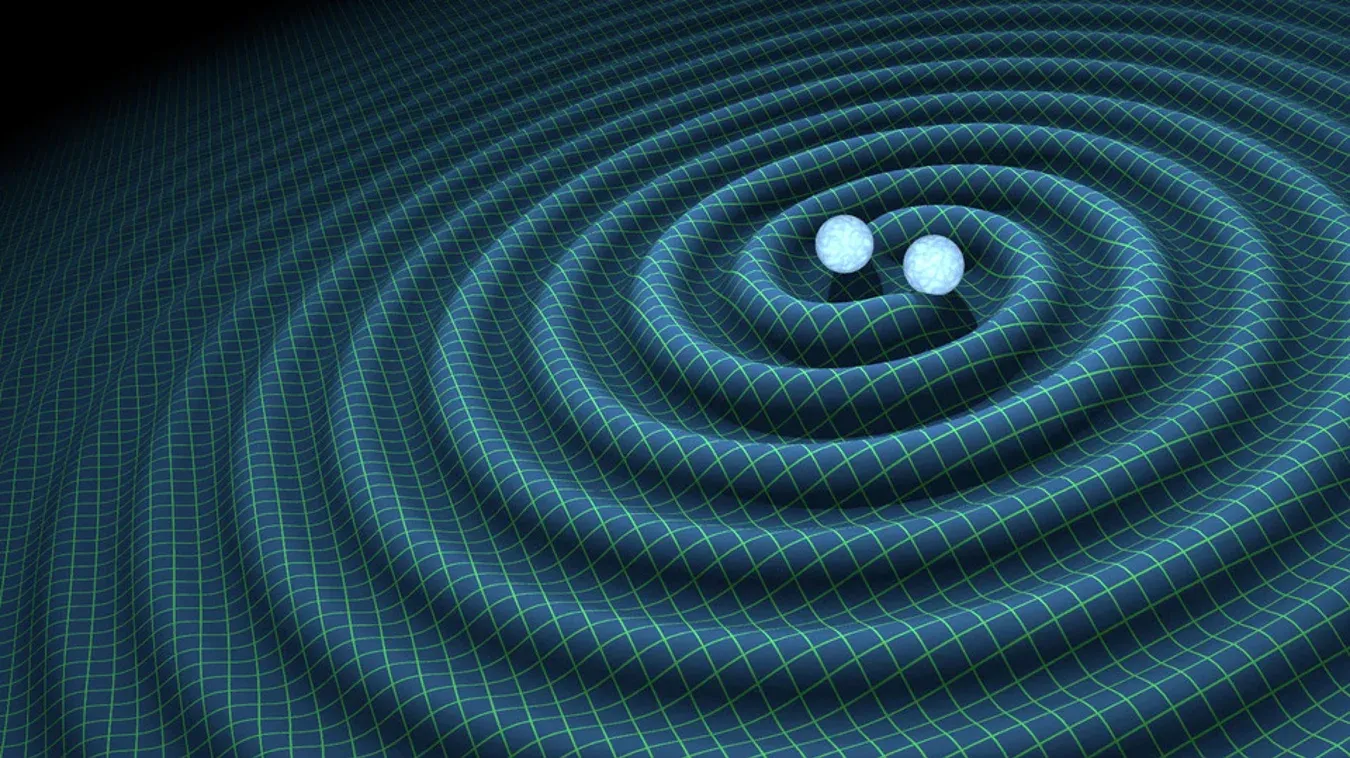
Details
Gravitational waves have gained significant interest in the scientific community in the past decade because of their first direct detection in September 2015 by the Laser Interferometer Gravitational-Wave Observatory (LIGO) collaboration, an international scientific collaboration with the primary objective of detecting gravitational waves. The interest has rightly spread among science enthusiasts all over the world, and a lot of initiatives have come up for popularising the topic among the public, apart from incorporating relevant workshops and classroom activities at all educational levels. This article aims to provide a simple pedagogical introduction to the topic of gravitational waves, henceforth written as GWs, along with links to some resources that can be helpful to anyone interested in exploring the subject further on their own.
The foundation of GWs lies in the general theory of relativity, which was developed by Albert Einstein over a period of a few years (1907−1915) to give a new understanding of the concept of gravity. Quite different from Isaac Newton’s picture of gravity, which depicted it as a force at a distance, Einstein’s theory portrayed it as a manifestation of the curvature of spacetime itself. While the Newtonian view postulated that space and time are rigid, unchanging backgrounds, Einstein said that space and time merge into a single four-dimensional fabric, which can be warped by mass and energy. GWs are, in fact, one of the many key predictions of general relativity, which include gravitational time dilation, perihelion precession of Mercury, and bending of light (also known as gravitational lensing in the large-scale context of cosmology). The predictions of perihelion precession 1 and bending of light have also been found to be true through various astronomical and astrophysical observations. The detection of GWs simply adds to the list of strong evidences in support of Einstein’s description of spacetime geometry.
One often uses the analogy of a heavy mass on a rubber sheet or trampoline to visualise the idea of the fabric of spacetime. Imagine a heavy ball to be placed at the centre of such a sheet, curving it in a way such that any smaller and lighter ball placed in its vicinity will tend to orbit the heavier ball. It is easy to understand that this is also a useful analogy to demonstrate the solar system, for example. Without the presence of a heavy mass warping the fabric, any mass left to itself will travel in a straight line across the fabric, which will be its shortest path, or its “geodesic”.
A geodesic can be understood as the shortest possible path from one point to another. In case of a flat surface, for example, it is a straight line joining the two points. Similarly, on a sphere, it is a great circle, the largest possible circle on the surface of the sphere. For the Earth, a great circle is formed by a plane passing through the centre of the Earth that divides the Earth into two halves. These would be the equator and all lines of longitude. In fact, the concept of geodesics is what enabled the invention of the Global Positioning System or the GPS.
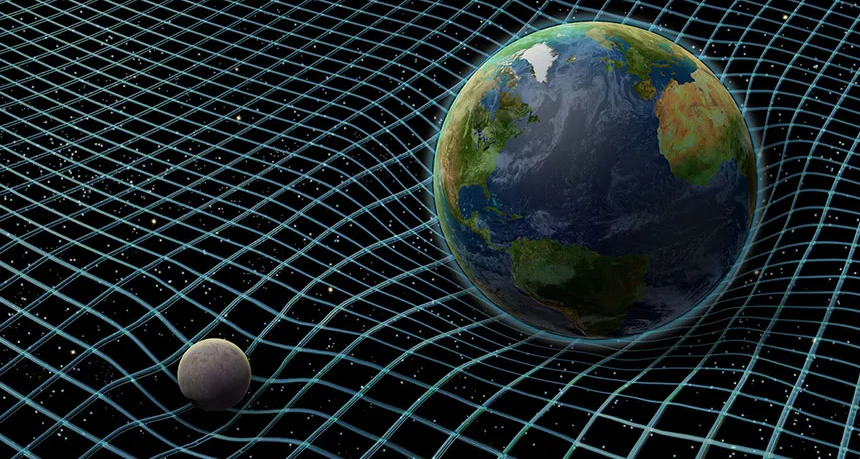
The fabric of spacetime. Image credits: Nicole Rager Fuller
General relativity provides us with a formalism where, in the words of John Wheeler (A Journey into Gravity and Spacetime, W H Freeman and Co., 1999), matter tells spacetime how to curve, and spacetime tells matter how to move. This seemingly simple yet conceptually complicated formalism is described by Einstein’s field equations 2, which relate the geometry of spacetime (curvature) with the content of spacetime (matter, energy, pressure, momentum). One of the simplest solutions to these equations describes a non-rotating and uncharged black hole, also known as the Schwarzschild black hole, named after Karl Schwarzschild, who provided the first exact solution to Einstein’s field equations. As we will soon learn, black holes are one of the integral components for the generation of GWs, which are nothing but ripples in the fabric of spacetime.
GWs are produced by violent cosmic events such as the merging of black holes (BH) and/or neutron stars (NS), and had evaded detection for more than a hundred years after Einstein theorised general relativity because of their extremely weak interaction with matter. While it is convenient to imagine spacetime as a rubber sheet with orbiting masses propagating waves across it, it is not actually as stretchy as a rubber sheet, and has an elastic modulus 3 trillions of times larger than the hardest known naturally occurring substance on earth, diamond. However, GWs do, in fact, stretch and compress spacetime as they propagate, perpendicular to their direction of travel. Hence, they are transverse waves akin to electromagnetic waves which constitute light, and their speed is the same as the speed of light. In contrast, longitudinal waves such as sound waves oscillate in the direction of propagation, and create regions of compression and rarefaction in the medium parallel to this direction.
Another point of distinction is that unlike electromagnetic waves which are described by vector fields, namely electric and magnetic fields, GW waves are described by rank‑2 tensor fields and exhibit two polarisation modes: the “+ mode” (compresses space in one direction while stretching it in the perpendicular direction) and the “x mode” (distorts spacetime along axes rotated 45 degrees relative to the “+ mode”).
Tensors are mathematical descriptions of physical quantities that remain unchanged regardless of an observer’s coordinate system, while their individual components may vary. You may be familiar with the concepts of scalars (quantities that have magnitude but no direction) and vectors (quantities that have both magnitude and direction). Tensors can be imagined as multidimensional arrays where scalars are rank‑0 tensors, vectors are rank‑1 tensors, and more complex quantities such as stress are said to be rank‑2. Here, the rank corresponds to the number of indices required to describe the components. Hence, tensors can be understood as generalised mathematical forms for physical quantities.
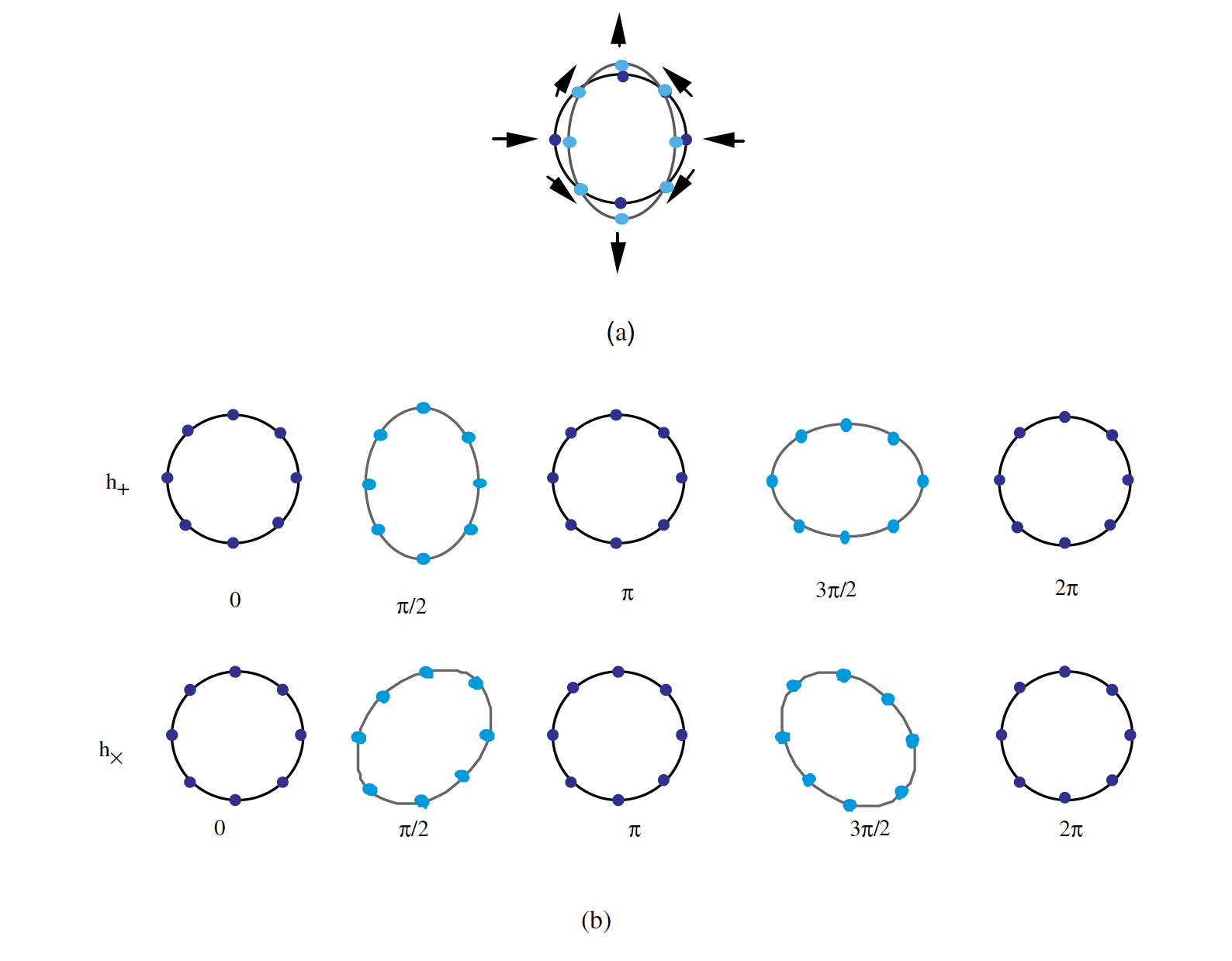
Polarisation modes of GWs. Image credits: J Lu et al, Rep. Prog. Phys. 63 (2000) 1317-142
As intriguing as all this may seem, unfortunately, our laboratories are not equipped to produce detectable gravitational waves. One needs huge astrophysical masses (tens and hundreds of times the mass of the Sun) moving at near-light speed to be able to achieve that, but even then, not all such masses can produce GWs. Similar to the idea that oscillating electric dipoles can produce electromagnetic waves 4, the primary requirement for a GW source is to have an asymmetric mass distribution that rapidly changes shape or orientation. It can be understood that this refers to the presence of an oscillating or accelerating quadrupole moment, since a gravitational monopole (which is simply the total amount of mass distribution) and a gravitational dipole (which describes the distribution of mass away from the centre of mass) are not sufficient to produce any gravitational radiation. A gravitational quadrupole, on the other hand, measures how stretched out the mass is along some axis, and one can find out that the GW strain or the fractional change in the length of spacetime due to GW propagation is proportional to the second time derivative of the mass quadrupole moment.
It is important to note that only certain kinds of mass asymmetries can give rise to gravitational waves. There needs to be a system where the shape of the mass distribution changes in a lopsided way, which is indeed the case for orbiting binary black holes or neutron stars. A simple visual analogy would be to consider a round ball of clay. If more clay is added to it or removed from it, so as to make it grow or shrink, but without compromising its spherical symmetry, it is like a monopole where only the total mass changes. If the ball of clay is just moved from one position to another, we can say that its centre of mass has shifted, but there has been no reshaping of its mass distribution. Both these situations are inadequate to produce any gravitational wave, however small in intensity. However, if we have two balls of clay connected like a dumbbell and spin the system rapidly, the shape is asymmetric, and at the same time, it causes alternate squeezing and stretching of the space around it as it spins. Using this analogy on astrophysical scales, we can imagine celestial objects spinning around each other, producing wavelike disturbances in spacetime.
The fact that a changing quadrupole moment, along with astrophysical masses, is necessary to generate GWs, automatically brings us to the point where we can talk about compact binaries to be the expected sources of GWs. Indeed, such binaries, which are basically systems of two dense objects like black holes and neutron stars, have been observed to be the source of all GWs that have been detected so far. The binaries spiral around each other, first slowly, over a period of millions of years, then extremely fast over a few seconds, and then eventually merge and form a new dense object. The orbital decay in the initial phase gives rise to a steady increase in frequency and amplitude of the GW signal, called the chirp signal (drawing inspiration from the sound of birds), and this particular stage is called the “inspiral stage”. This decay refers to the shrinking of the orbits of the spiralling black holes as they lose energy and angular momentum due to the emission of GWs. The “merger stage” follows as the binaries get closer and merge while their energies get emitted as GWs, and finally, the “ringdown stage” concludes the process with the waves getting dampened.
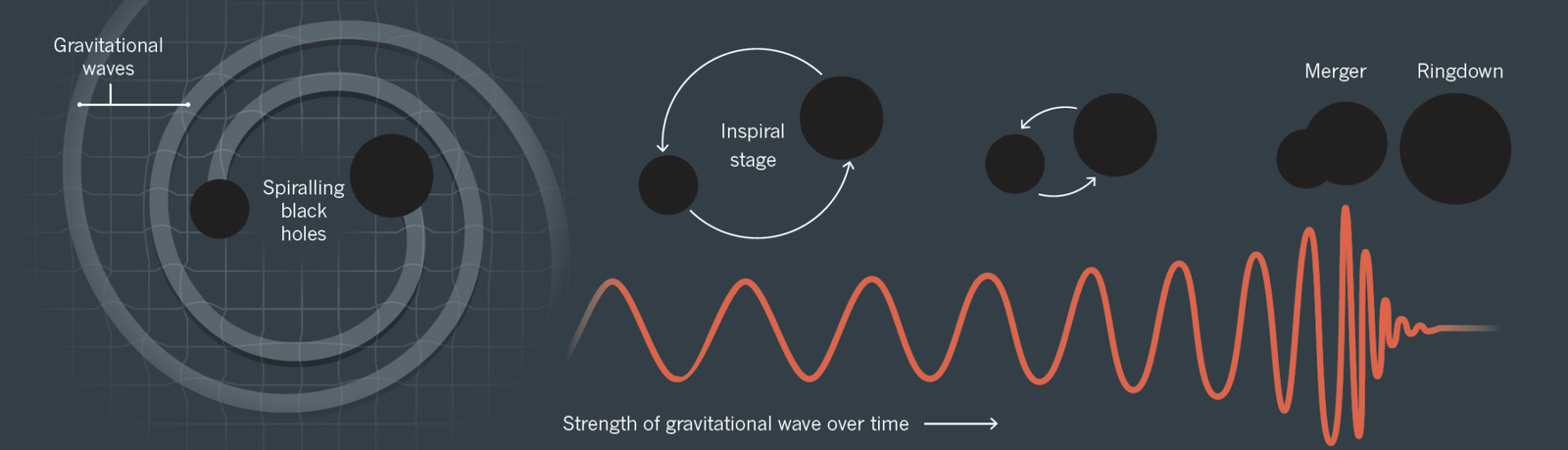
Different stages of a binary merger. Image credits: Mark Zastrow/Lucy Reading-Ikkanda, Nature
The first indirect evidence of binaries with decaying energy can be traced back to 1974, when Russel A. Hulse and Joseph H. Taylor at the University of Massachusetts Amherst discovered a binary pulsar (the PSR B1913+16) composed of a neutron star and a pulsar. This discovery was made when the pulsar (a rapidly rotating, highly magnetised neutron star) that Hulse and Taylor chanced upon, seemed to be emitting pulsed electromagnetic radiations at irregular intervals 5, making them conclude that it must be in a binary orbit with another neutron star. Over the years, the energy of this binary system was found to be decaying with a dependence on the square of the third time derivative of the mass quadrupole moment of the system, and Hulse and Taylor were awarded the 1993 Nobel Prize for their findings. One can calculate that the pulsar and the neutron star are expected to merge in roughly 300 million years.
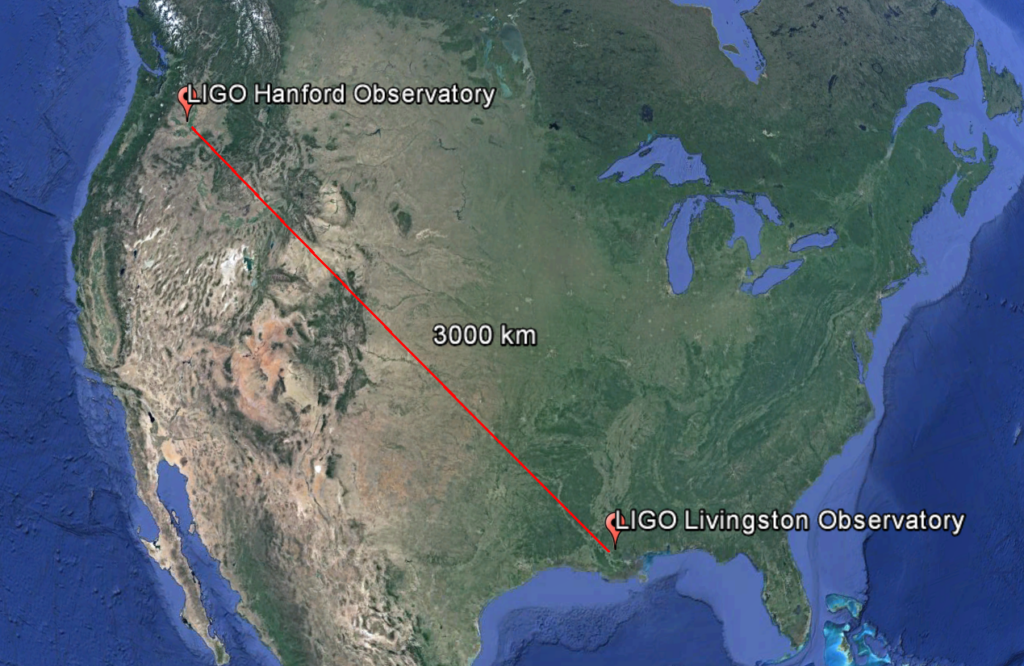
Map of LIGO in the US. Image credits: Google Earth
The first modern and intentional detection of GWs is attributed to LIGO, the Laser Interferometry Gravitational-Wave Observatory, which consists of two detectors, one at Hanford, Washington, and the other at Livingston, Louisiana, situated 3000 kilometres from each other in the United States of America. The basic principle is that of an interferometer, where interference patterns from various light sources are measured and analysed. Following this principle, which is also seen in a basic Michelson interferometer, LIGO employs a laser source whose light goes through a beam splitter and gets split into perpendicular directions. The light then gets, before getting reflected from two mirrors situated at the end of two 4 km tunnels and forming an interference pattern on a light detector 6.
It is to be noted that LIGO is designed in such a way that the reflected light waves recombine 180 degrees out of phase, causing a destructive interference that does not generate any pattern. Thus, in case there is a GW passing through, this arrangement is disturbed, and there is a resultant interference pattern to study. This disturbance, however, is extremely small, and LIGO possesses a sensitivity of detecting a change in length of the order of 1/10000th the size of a proton. Needless to say, one also needs to filter out the noise from seismic events and other terrestrial disturbances while analysing the signal.
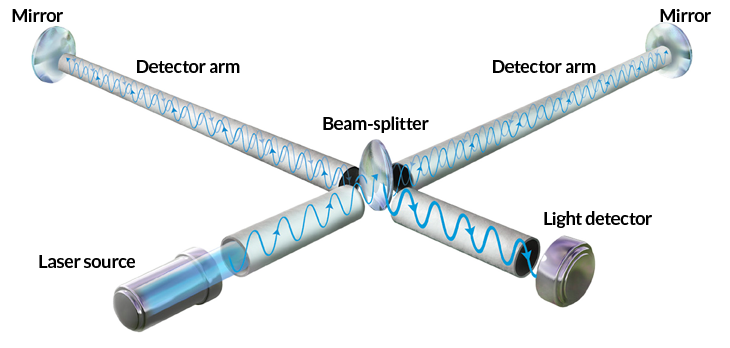
Image credits: Nicole Rager Fuller
The first GW detection by LIGO happened on September 14, 2015 (GW150914), which involved two black holes of 36 and 29 solar masses, and since then, there have been multiple detections over the years. Very recently, GW231123 was detected by the LIGO-Virgo-KAGRA collaboration, involving the most massive binary black hole merger so far, with black holes of 100 and 140 solar masses. There have also been cases of black hole-neutron star (BH-NS) mergers (GW200105 and GW200115, two events just 10 days apart) and neutron star-neutron star (NS-NS) mergers (GW170817), which are especially significant for multi-messenger astronomy, where electromagnetic waves such as optical and gamma rays are also observed. One might wonder how different kinds of mergers can be distinguished from each other, and the answer mostly lies in the mass gap between neutron stars and black holes, with the former being lighter than 3 solar masses, and the latter being heavier than 5 solar masses. Besides this, tidal effects on neutron stars and black holes are different, since the matter in neutron stars gets distorted due to the other member of the binary, which isn’t the case for black holes.
The global GW detection network consists of LIGO Hanford, LIGO Livingston, KAGRA in Japan, Virgo in Italy, GEO600 in Germany, along with an upcoming LIGO detector coming up in Hingoli, Maharashtra, India. There are also next-generation projects which have been planned. These include the Laser Interferometer Space Antenna (LISA), a space-based interferometer which will be shaped like a triangle with arm length of 2.5 million kilometres and will aim for low-frequency GWs, and the Einstein Telescope, which will be a ground-based underground interferometer with 10-kilometre arms, aiming for mid to high-frequency GWs. Together, these detectors aspire to unravel deeper mysteries of the Universe in the coming decades, such as the interior of neutron stars, merging supermassive black holes, and primordial black holes that are hailed as possible dark matter candidates.
Fortunately, there exists a plethora of resources to explore GW science in the comfort of homes, thanks to LIGO Educational Resources and GW Open Science Center. These include apps and websites to keep track of new detections, citizen science initiatives, and links to online workshops with varying levels of learning. Apart from this, I also encourage Physics students and teachers to have a look at the brilliant articles on GWs by the folks at Astrobites, try out the introductory data analysis exercise by L.M. Burko, and have a look at the LIGO Analogy Lab by Ugolini et al. One can also enjoy reading about the controversial history of GWs in the book, Travelling at the Speed of Thought, by Daniel Kennefick.
Acknowledgments
I am grateful to Kripa Gowrishankar, Anish Mokashi and M. Sivakumar, the coordinators of the Physics Teachers Training Programme (2025) at Azim Premji University, for giving me the opportunity to deliver a lecture on gravitational waves, which eventually led me to write this article. I also thank Anish for reviewing the article and providing valuable feedback prior to the publication.
Perihelion precession of a celestial body is the slow rotation of its elliptical orbit, that causes the point of closest approach to the Sun (known as perihelion) to change over time. Mercury, being closest to the Sun, undergoes perihelion precession since it gets subjected to the Sun’s immense gravitational field.↩︎
Perihelion precession of a celestial body is the slow rotation of its elliptical orbit, that causes the point of closest approach to the Sun (known as perihelion) to change over time. Mercury, being closest to the Sun, undergoes perihelion precession since it gets subjected to the Sun’s immense gravitational field.
Find a simple explanation of Einstein's equation for general relativity in this article.↩︎
Find a simple explanation of Einstein's equation for general relativity in this article.
Elastic modulus refers to the measure of the stiffness of a material understood in terms of its resistance to elastic deformation.↩︎
Elastic modulus refers to the measure of the stiffness of a material understood in terms of its resistance to elastic deformation.
Watch this video to learn more.↩︎
Watch this video to learn more.
It is interesting to note that pulsars are not exactly pulsating stars as they are often called. They do give off electromagnetic radiation (visible light, radio waves, X-rays and gamma rays), which is in the form of a continuous rotating beam, and appears to be “pulsating” at regular intervals only because they are observed when they are in the line of sight of a telescope on Earth. To understand this better, imagine a lighthouse that shines a continuous beam of light across the sky, but an observer will see it only when it points directly in their direction.↩︎
It is interesting to note that pulsars are not exactly pulsating stars as they are often called. They do give off electromagnetic radiation (visible light, radio waves, X-rays and gamma rays), which is in the form of a continuous rotating beam, and appears to be “pulsating” at regular intervals only because they are observed when they are in the line of sight of a telescope on Earth. To understand this better, imagine a lighthouse that shines a continuous beam of light across the sky, but an observer will see it only when it points directly in their direction.
A simple animation illustrating this can be seen here.↩︎
A simple animation illustrating this can be seen here.