
Education-Development Interlinkages (Part XIII)
Technology in Education: Potential and Limitations
Q&A with Santhakumar V | 11 July 2025
When technology is used in schools and classrooms, it can be an effective public investment for this purpose, and it can narrow the digital divide.
Details
Q. There seems to be an increase in the use of technology for education in countries like India.
A: Yes, there are indications of an intensifying dependence on technology in education currently in developing countries like India. Global investments in Edtech companies that have a base in India have increased substantially, with some of these also stepping into the elite billion-dollar club recently. Currently, more than 4,500 start-ups are operating in the EdTech space in India, an industry that is projected to grow to USD 30 billion in the next ten years from the current market size of around USD 800 million. A major part of the capital investments in Edtech is used for marketing and advertising, which creates additional demand.
Q: How do you see the use of IT in school education?
A: The use of IT in education is not new, even in schools. Desktop computers became widely available in India and other developing countries in the mid-1980s. During this time, a notable share of schools in the United States started using personal computers. If I look at the global situation during the last 35 years, the use of technology in education, in general (beyond technical education), has increased notably. Currently, teachers and students rely on online resources; there is enhanced use of technology to facilitate and organise teaching-learning processes, and a growing awareness of the possibility of tech-enabled education. There are several benefits due to the increased use of technology in education. It may enhance access to innovative learning materials (which may communicate ideas to learners in an effective manner). It may create pressure on all teachers to improve their performance, especially to be innovative and effective in terms of pedagogy.
Technological and socioeconomic changes are unavoidable, and these will inevitably impact all human and social processes, including education. The use of technology in education should not be resisted. The education space has to evolve organically to accept these changes. However, there has to be a reflection on the challenges in education and how technology may aggravate or how it can be used to overcome these. Then, technology can be used consciously for beneficial ends. That should be the appropriate approach towards technology.
Q: What are the limitations of using IT in education?
A: A major limitation is the digital divide. It is the poor and marginalised social groups and, in certain cases, girls who are mostly deprived of education due to the digital divide. We have evidence of such a divide and deprivation from different parts of the world during COVID-19. Though the use of mobile phones has become widespread (even as some sections of children/parents do not own mobile phones in countries like India), the functionality of mobile phones varies, and only a small section may have smartphones. Even when people have phones, connectivity can be a problem. When TV broadcasting is used for educational purposes, its reach can also be limited due to several factors, including the supply of electricity.
Some sections of students may do well with a technology-mediated education with their limited objective. This is again not only due to their access to digital technology. Their parents may be in a better position to provide complementary inputs to technology-mediated education. Well-educated parents can help children in many ways to assimilate the learning materials that Edtech companies offer.
Classroom discussions are important, and such discussions may take place only in a limited manner when each child is connected to the teacher with the help of technology. Those children who use online education may need additional academic support to clarify doubts, and such support is difficult through remote teaching. Some children may need personal persuasion to open up, and teachers may not be able to persuade them to do so on an online forum. As noted earlier, additional academic support may not be a serious issue when parents are well-educated and one or both of them can spare some substantial time for their children. This may be possible for those who are employed in stable jobs. Children from families with less-educated parents may not receive adequate academic support at home. Also, in the case of younger children, ensuring their attention during online learning requires the support of parents, which many parents may not be able to provide due to the nature of their employment, livelihood, or attitude. These factors may accelerate the inequality in education (and finally lifelong incomes) if online education is extended.
Educationists argue that maximum benefits occur when teachers are capable of using technology and understand how to integrate it into the curriculum. The data-set available on the use of ICT (Information and Communication Technology) as part of the PISA (Program for International Student Assessment) 2018, provides the following insights: ‘Who is using the technology matters – technology in the hands of teachers is associated with higher scores than technology in the hands of students’; and ‘a school system’s current performance level matters – in lower-performing school systems, technology is associated with worse results’. This shows the importance of strengthening the conventional education system with the use of technology, rather than the former being replaced by the latter.
Children from poor or lower-middle-class families may not have the resources to subscribe to the programmes of the Edtech companies. However, it may be possible that they may use Edtech if the cost of access comes down (and that may be possible due to the higher scale of operations). Just as poor parents use low-fee-paying private schools (rather than fully subsidised government schools), there can be an inclination towards the use of Edtech by poorer families. However, they may still be deprived of quality education for other reasons. As noted earlier, students from such families do not get academic support for all subjects at home. They may have to depend fully on technology-mediated learning materials. These factors may affect their academic achievements. Therefore, their disadvantages in terms of family background may persist in the long run. The school is an instrument to address the inequality in society, and the focus on Edtech may work against this function of schools.
Education, especially at the school level, has to be mainly through face-to-face interactions, in a group or as a social activity. This is necessary for achieving the multiple goals of education. There are many intangible outcomes of education which can be achieved only through such mode. Students learn not only from the teacher and books/articles but also from their peers. If we want to inculcate empathy, democratic behaviour, openness and an equitable attitude towards people belonging to other castes, religions, race, and gender and so on, through education, these cannot be achieved through a transaction in which the teacher and the student are linked only through technology. Children from all families (rich and poor) want to interact with others. They want to play, collaborate, compete, give and receive comfort, and learn from each other.
Certain skills can be learnt only through such peer interaction. Students from affluent families may have information on diverse subjects, and those from poorer families may get it from their peers. All these interactions are immensely useful in their adult lives. There are fewer opportunities for such interaction when there is excessive focus on individualised technology for education.
There are other functions of schools where face-to-face interaction of children and teachers takes place. When children study in their homes, some of them are pampered by their parents, which may encourage them to seek more attention, and they may become disturbed if there is no such pampering. In other families, children may not get enough attention or may face emotional deprivation. They may feel disenchanted. Neither of these behavioural traits nor impacts is desirable in their adult life. There is a need for moderation of their behavioural ups and downs. Desirable behavioural traits are best acquired at school, and this may not happen when the focus is on technology.
Children get exposure to a particular social identity, like one religion or caste, within their homes. They acquire cultural characteristics connected to this social identity. It is difficult for parents to give exposure to other cultures when they are rooted in one culture. This may sustain the ignorance of children about other cultures and reduce their ability to interact with people of other cultures. It can sustain or even widen the divides in society. The school is probably the only space where a child is likely to encounter people who belong to other religions, castes or ethnicities relatively closely. Undermining the advantages of school deprives them of this opportunity. Schools are needed for intercultural understanding, and this may be hampered because of an excessive focus on technology.
The expansion of Edtech may aggravate the fragmentation in education. A section of children may use it effectively and do well in terms of narrower education goals (but may fail in terms of socialisation). Others may use the conventional mode, and this may be seen as an outcome due to the lack of a better option. The differential socioeconomic background of these two sets of students is clear. This may have negative implications not only on the psychology of these children but can be detrimental to the social cohesion in the country. The already prevailing socio-economic fragmentations may be exacerbated due to this. This is not only going to accentuate the inequality in education, but would also create and sustain an inferior equilibrium in education. Once such an equilibrium comes into existence, it would be difficult to break it and create a better one. Path dependence and acquired habits may work against this transition. Technology would get its appropriate place in education only when it regains its importance as a social activity.
Q: Despite these limitations, there could be an increase in the use of technology in education. What could be the reasons?
A: Yes, there could be a danger of an over-dependence on technology in education in India and other developing countries. This would be similar to the over-dependence on private schools in developing countries, as we have noted in another Q&A Note (No.7). There can be ‘privatisation’ of public services in less developed countries, and this may be the case for education too. We have noted that such a privatisation can be part of an inferior equilibrium. Private investments in Edtech companies that we have noted in the beginning will strengthen the ‘inferior’ equilibrium that is marked by a higher level of demand and supply of private education, and it may even work against the evolution of a more desirable equilibrium, that is, a strengthened public education system to meet the education requirements of the society as a whole. It may be noted that the private provision of supplementary education is not that pronounced in most of the developed economies, which indicates the possibility of a dominant public education system as a desirable model.
Technology may help individualised and private provision of education. In which case, each student may deal with a private provider, and the service that they get is unaffected by the problems of collective action that are required for improving public education. Moreover, technology-based remote or online education can provide a higher level of flexibility, and it may become attractive to individuals with different requirements and endowments. It may encourage society to neglect or overlook some of the teething problems in public education. Technology may enable children to do most of the ‘learning’ with the help of lessons downloaded through apps, and they may go to school or college only to get a degree. The difficulty in improving the quality of face-to-face education due to the structural factors may encourage a section of society to use technology as a substitute for classroom education.
This may be somewhat similar to another trend that is noted in Africa – mobile-based money transfer. One estimate in 2018 notes that ‘two-thirds of total global mobile money transactions were driven by users in sub-Saharan Africa (SSA), with values exceeding US$25 billion’. The use of this technology has its benefits. However, we need to note that such a development has taken place in a particular context marked by a number of constraints. The development of financial organisations in a way to make these accessible to the majority of the population is somewhat slow in the continent. Such a development may require state intervention and economic development. These have not occurred in a number of African countries. However, there is an increasing demand for financial services. This is especially so among the migrants from these countries who need to transfer their remittances to members of their households. It is in this context that mobile-based transfer has become very popular there. It is good that new technology has enabled people to access a service that is in high demand. The cost of financial services may also have come down due to mobile transfers. However, it may work against the development of conventional financial organisations and the regulatory infrastructure, which may be necessary to provide a variety of financial products and services.
There is another example with respect to the drinking water supply. In most developed countries, the water is supplied through a centralised water supply and is potable directly. But that is not the case in countries like India, where the water that comes through taps needs to be treated. Conventionally, people boiled this for use. However, these days, most urban middle-class and richer families have a water purifying system installed in their homes. Poorer families cannot afford these, and they may boil tap water for use or may consume it directly, which may pose considerable health risks. This is an example of the use of technology-based private input of a public service and its unequal impact on access to a service (in this case, drinking water). A similar impact can be seen in the case of education, too, when technology is used.
Improving conventional education would mean addressing some major challenges. For example, despite the increase in access to schooling, the quality of education continues to be an issue in India and elsewhere. This could partly be due to the quality of teaching, which may, in turn, depend on the quality of teacher education. There is recognition of the fact that teacher education in countries like India is in a state of disorder and requires a major revamp. However, this may take a lot of time and resources and will require changes at the systemic level to yield positive results. Given these difficulties, people may focus on shortcut remedies. The use of education technology may be such a short-cut solution since parents/students can access learning materials which are prepared and delivered in a centralised manner, rather than depending on millions of school teachers whose proficiency is varied due to the problems in teacher education.
When public or collective action in education becomes difficult, those who can afford it go for the private provision of education services. The private provision can be either complementary to what is being provided by the government (which is considered inadequate by society) or a substitute for it. Private schools of different kinds, tuition and coaching centres, etc., are part of this private provision. Private tuitions are expected to bridge the quality deficit in public education. The use of technology can facilitate this dependence on private provision of education.
Q: How can technological developments be used in a socially beneficial manner in education?
A: It is important for teachers to be aware of and use the beneficial aspects of technology. They should not assume that they can continue with the conventional mode with a minimal use of technology, because it can destabilise their profession or threaten the continuance of their jobs. A sensible approach would be to use technology as a tool that facilitates/strengthens the conventional mode of education. Technology can be a useful tool in the hands of teachers and can help them access newer and more diverse teaching materials economically.
By using technology, teachers may be able to learn innovative practices to teach specific concepts or subjects. The innovation of a few teachers can be disseminated quickly, and others can adopt these easily. Students can access and acquire additional learning materials. The ability to use and work with newer technologies has to be part of education in general (and not just in specific domains of technical education). When technology is used in schools and classrooms, it can be an effective public investment for this purpose, and it can narrow the digital divide. Then, the teachers would be in a position to provide the additional attention that is required for those sections of students who may not get much academic support at home. Children can also learn to use technology from their peers.
However, an overemphasis on technology can be harmful. Education needs to continue as a face-to-face social exercise. However, the socio-economic circumstances in many developing countries are such that there would be a quicker acceptance of technology in education, which may reduce the societal need to make adequate investments in conventional school education. That would be harmful.
Santhakumar V is a former Professor, Azim Premji University, Bengaluru
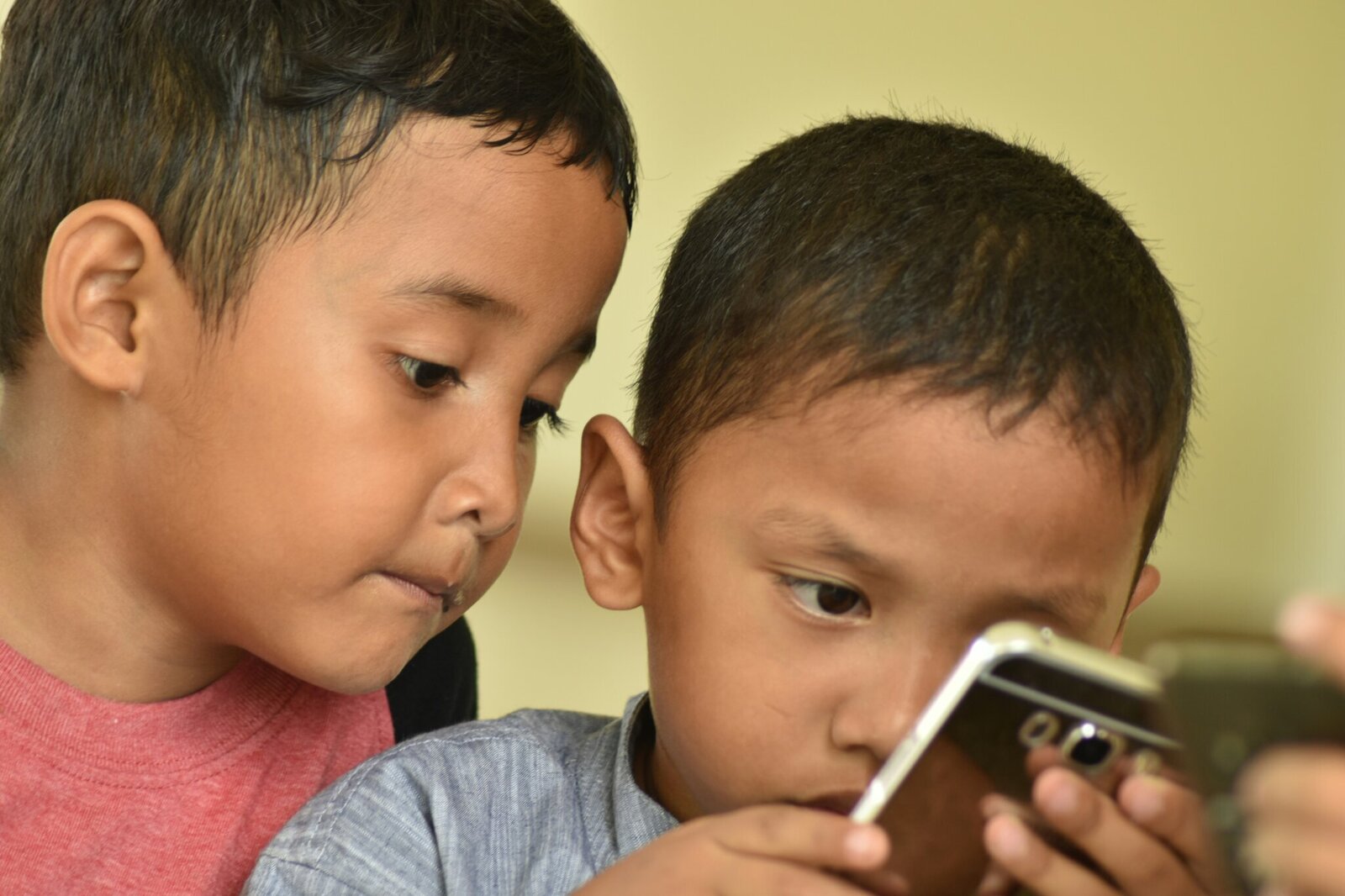
Featured photo by Budi Gustaman on Unsplash
Primary reading material
For a brief history of the use of computers in education:
Kuralnd, M. (1987). Computer Applications in Education: A Historical Overview. Annual Review of Computer Sciences, 2, 317 – 358
Santhakumar, V. Technology in Education and Social Equilibrium in Developing Societies. https://azimpremjiuniversity.edu.in/insights-from-social-context/technology-in-education-and-social-equilibrium-in-developing-societies