
A Child-Centred Model of Learning for the Early Years
Muktangan Education Trust, Mumbai
By Ira Joshi | Oct 4, 2024
Muktangan-run BMC preschools follow a child-centred, inclusive, and community-based education model to promote quality learning experiences for children from underserved communities. The schools are founded on the philosophy of ‘active constructivism’, a perspective that views children as competent and active beings.
Details
This is the second article on Muktangan Education Trust, Mumbai. It focuses on some classroom practices followed in their ECE programme. Read the previous article here to know more about the organisation’s work, philosophy and approach towards education.
It is morning time. At around 8:45 AM, a group of 5‑year-old children stand outside the class with their name tags, eagerly waiting for their turn to get inside. The teacher stands at the door and greets each child. She has kept a round hoop at the door and invites each child to enter the class by going through the hoop. It is an exciting moment as children smile and enter. Once inside, they go to a board with pegs and hang their name tags on it. This is how each child marks their attendance for the day.
This is the kindergarten (KG) morning ritual followed at a Muktangan-run BMC preschool in Mumbai. Muktangan is a not-for-profit organisation established in 2003 to provide quality and free education to children from underserved communities in Mumbai. It partnered with the Municipal Corporation of Greater Mumbai (MCGM) to set up its programme in seven primary schools. These mainstream government schools, with support from Muktangan, offer English-medium, quality education to children from KG up to class X. Muktangan engages with teachers, parents and community members, reflecting the community engagement model which is central to their work. The purpose of this two-day visit was to observe the teaching-learning processes followed in Muktangan-run BMC preschools.
A day in a kindergarten class
The KG classes in these schools begin at 9 AM. As children enter the class, they use their name tags to their mark attendance. Each child’s name tag has their name written by the teacher and a drawing made by the child, which supports young children to identify their tag even before they can identify their names in text.
The day’s schedule is written on a chart, which is available for children to ‘read’ several times in day. Young children thrive on consistency and classes in these schools follow a predictable routine, a practice that helps children to predict each day and to foresee changes. Familiar routines in the early years are important in building children’s sense of security in an unfamiliar environment.
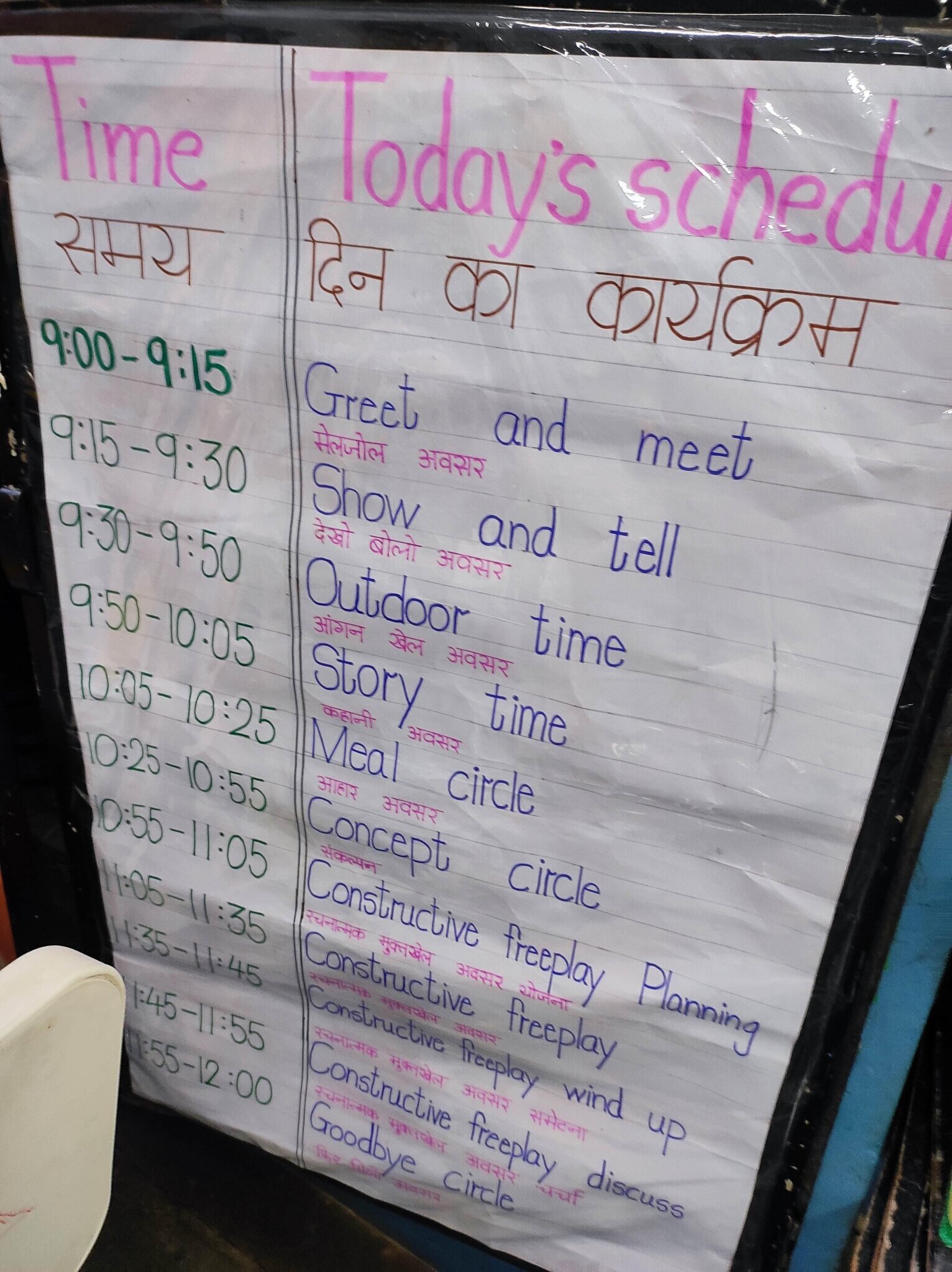
Figure 1: Daily routine chart
The day begins with large group activities which include action songs and rhymes. The classroom floor has a big circle painted on it, a visual prompt for young children to form a circle without the teacher’s direction. The names of action songs for the day are written on the board reflecting the teachers’ efforts to promote print awareness. Interestingly apart from English, the action songs are in Hindi and Marathi, the common languages spoken by the community. One can safely assume that children in Muktangan-run BMC preschools get opportunities to hear multiple languages in a non-threatening environment, an effort that promotes children’s sense of belonging.
After this, the children move into three small groups with their teacher for focused activities. This process is smooth as children can predict the transition, which is an outcome of the consistency in their routine. The physical environment is also designed to support children’s transitions. There are three smaller circles painted on the classroom floor to demarcate the area for each group. These guide children’s actions as they move into smaller groups. Even the group names are decided by the children reflecting the school’s belief that young children can make age-appropriate decisions. It was interesting to see that children name their groups after food items or things that are of interest to them.
Next is the ‘show and tell’ activity to promote oral communication, expression and self-confidence in children. Children talk about a personal object they bring from their homes. These objects usually have personal significance for them, like their favourite vegetable, a stationary item, a toy and so on. Often children use words in their local language to describe the object, and teachers do not discourage children’s attempts of using their mother tongue to explain their ideas. A summary of the conversation between the teacher and children in a KG class is given below.
The teacher asked a child what he got for the ‘show and tell’ activity. The boy held out the object and said ‘pyaaz’ (Hindi for onion). The teacher asked him to talk more about the object. He talked about its shape and size and that his mother uses ‘pyaaz’ in curries. Another child added that he calls it ‘kanda’ (Marathi for onion) and talked about the onion pakodas they eat during the rainy season. A few other children contributed to the discussion. All the responses were accepted, and the onion was circulated for other children to see, hold, and smell. The teacher asked them questions related to the texture, smell, and colour of the vegetable and extended their conversation as appropriate. Finally, she wrote the name of the object on a slate.
In the above example, the child describes the onion and associates it with his mother’s cooking at home. When children talk about things of personal significance, they bring their prior experiences, feelings, thoughts and ideas connected to it, which provides a good opportunity to help them construct new knowledge. This emphasis on meaningful oral communication also emphasised in the National Curriculum Framework for the Foundational Stage (NCF-FS, 2022), lays the foundation for literacy activities. Teachers write the name of the object on a slate which helps children make the association between the oral word and its written form, thus making writing a purposeful activity.
Play is an integral part of their daily schedule. This includes both outdoor and indoor play, usually on alternate days to manage space constraints.
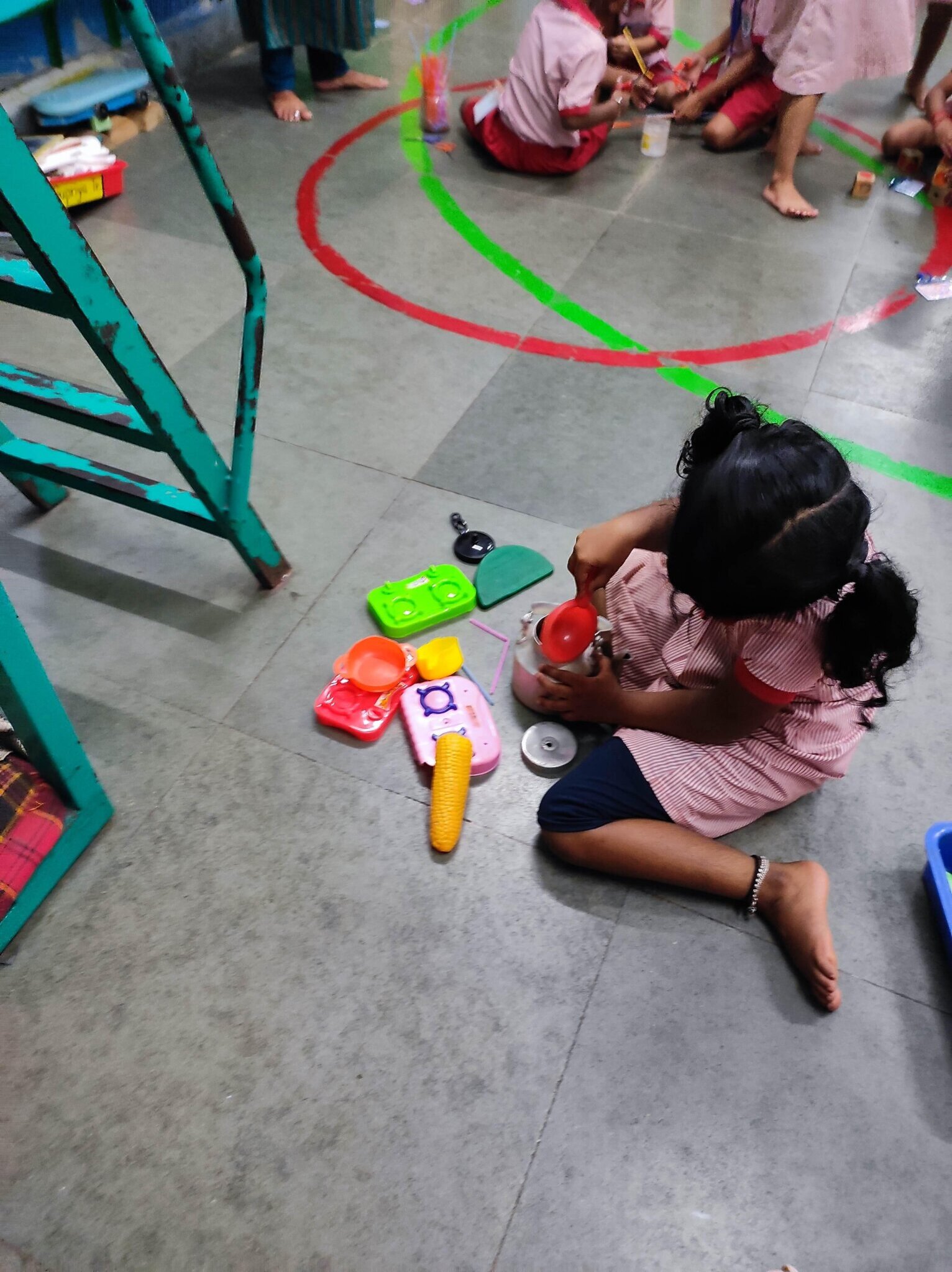
Figure 2: Free indoor play.
Next is the ‘story circle’ time which gives children focused time to listen to stories. After an energetic play session, children find it calming to listen to stories. Children in senior KG also volunteer to tell familiar stories, often in their language, a practice that is never discouraged.
This is followed by ‘constructive play’, a child-initiated session where children choose the materials. Teachers set up the environment and give children time to think about their plan. Children make ‘play choices’ based on their plan and engage in play for an extended time. It culminates with reflection time where teachers prompt children to discuss their ideas.
Cognitive concepts are taken up in the ‘concept circle’ using materials or worksheets. These are based on the outcomes mapped by Muktangan for their children. The school provides a healthy snack to children every day. Like many other activities, children take responsibility for distributing the snack to their peers. The last session is the ‘goodbye circle’ where children and teachers sit in a circle to talk about the activities done during the day.
Notable classroom practices
I could identify several noteworthy practices followed in Muktangan-run BMC preschools. They emerge from the organisation’s philosophy of ‘active constructivism’- a belief that children are active and capable beings who construct their knowledge by interacting with materials, teachers and peers. Muktangan supports teachers in integrating this philosophy into their teaching and learning practices. Next, I discuss some of these practices observed during the visit.
A welcoming space for all
The KG classrooms in these schools are warm and welcoming. The physical space and classroom layout encourage movement and exploration. Children were comfortably moving around, responding to teachers and interacting with each other. Clearly, there was a sense of belonging and comfort. Children were not weary of strangers, in fact, many came to us to show their drawings, toys or other materials. Teachers know children by their names and at times use children’s mother tongue to build relationships. The classrooms are inclusive spaces, and each classroom has a few children with special needs. Though the physical infrastructure of the government school is not necessarily barrier-free, teachers make efforts to include all children in their routines and activities.
Holistic curriculum
The organisation follows a holistic curriculum that focuses on all the domains of development. The daily schedule is carefully prepared to ensure a balance of teacher-directed and children-led activities, quiet and active exploration time, large-group and small-group activities, and indoor and outdoor time. Their assessment covers outcomes for all domains and aligns with the activities conducted in the class. The duration of most activities is 15 minutes except constructive play which is given 45 minutes in the schedule. This ensures that children get sufficient time to plan, explore the materials and reflect on their activities.
To effectively translate their philosophy of active constructivism in class, Muktangan ensures that the teacher-child ratio remains appropriate. The junior and senior KG classes have one teacher for 15 children which allows the teacher to meet the individual needs of children.
Autonomy and choices
Children in these schools are given enough autonomy to make decisions in matters that concern them. At the beginning of the school year, children decide a name for their group. Young children may be supported in this but are not directed. And so, it is not surprising to have groups called, ‘Balloon’, ‘Rose’, and ‘Ice-cream’. Every morning each child chooses a personalised greeting style — a handshake, hi-five, or a hug — to greet the teacher.
During constructive play time, children choose the materials, and the teacher supports children’s explorations by giving them time. Children also exercise their choices in the personal belongings they bring from home for the ‘show and tell’ activity. During the day, children are given several age-appropriate responsibilities, like distributing snacks to their peers during snack time, clearing toys and materials after play and ‘reading’ the daily schedule. The physical environment reflects several design elements that promote independence in children, like the painted circles on the floor for easy transitions, low shelves, materials at children’s height, learning corners and so on. These practices in the context of everyday activities promote children’s confidence and autonomy.
Play-based learning
Teachers use play- and activity-based pedagogy with children in KG classes. There is ample focus on interactions with materials, teachers and peers in the everyday routine. Teachers use hands-on activities to introduce concepts before giving worksheets. Emergent literacy is an integral part of the curriculum and children have several opportunities to engage with print in their environment. The Muktangan curriculum team had included experiences, like storytelling, conversations, constructive play and concept circles to promote learning through play.
Learning areas with materials
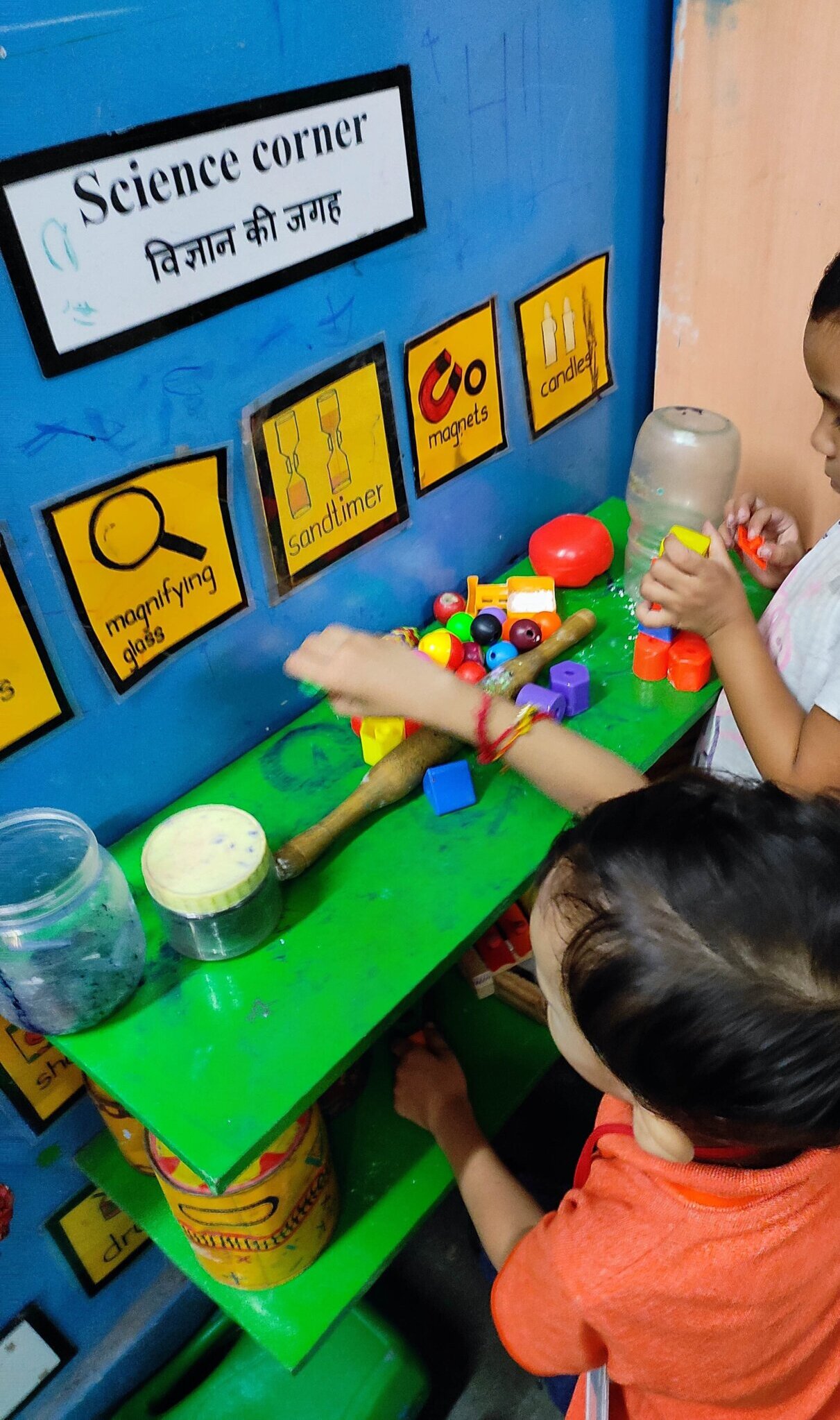
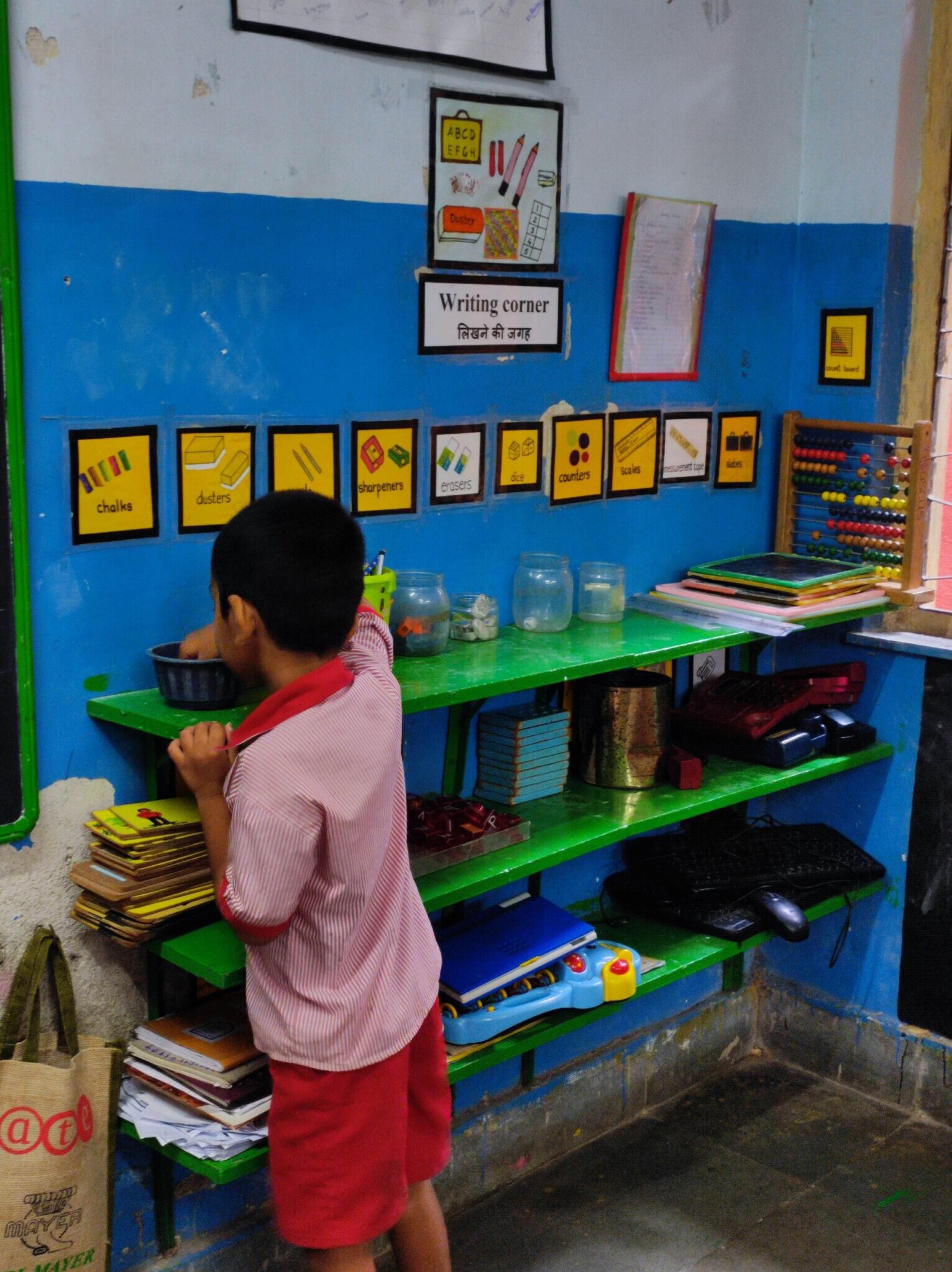
The classrooms are carefully designed with learning areas to support independent exploration. The materials are accessible, and the areas are labelled in English to promote emergent literacy. Some of the corners or areas in the class include the art and crafts corner, book and writing corner, music area, science corner, block area and home corner. There are ample manipulative materials including open-ended ones like blocks, clay, beads, an old telephone set, rubber bands, wool, and straws to promote creative expression and pretend play. The home corner is a well-set-up place in every KG classroom. It includes materials like utensils, clothes, household items, tools, play props, and soft toys commonly available in children’s homes. Children use these materials to enact cultural roles and situations. These provide authentic contexts for children’s learning.
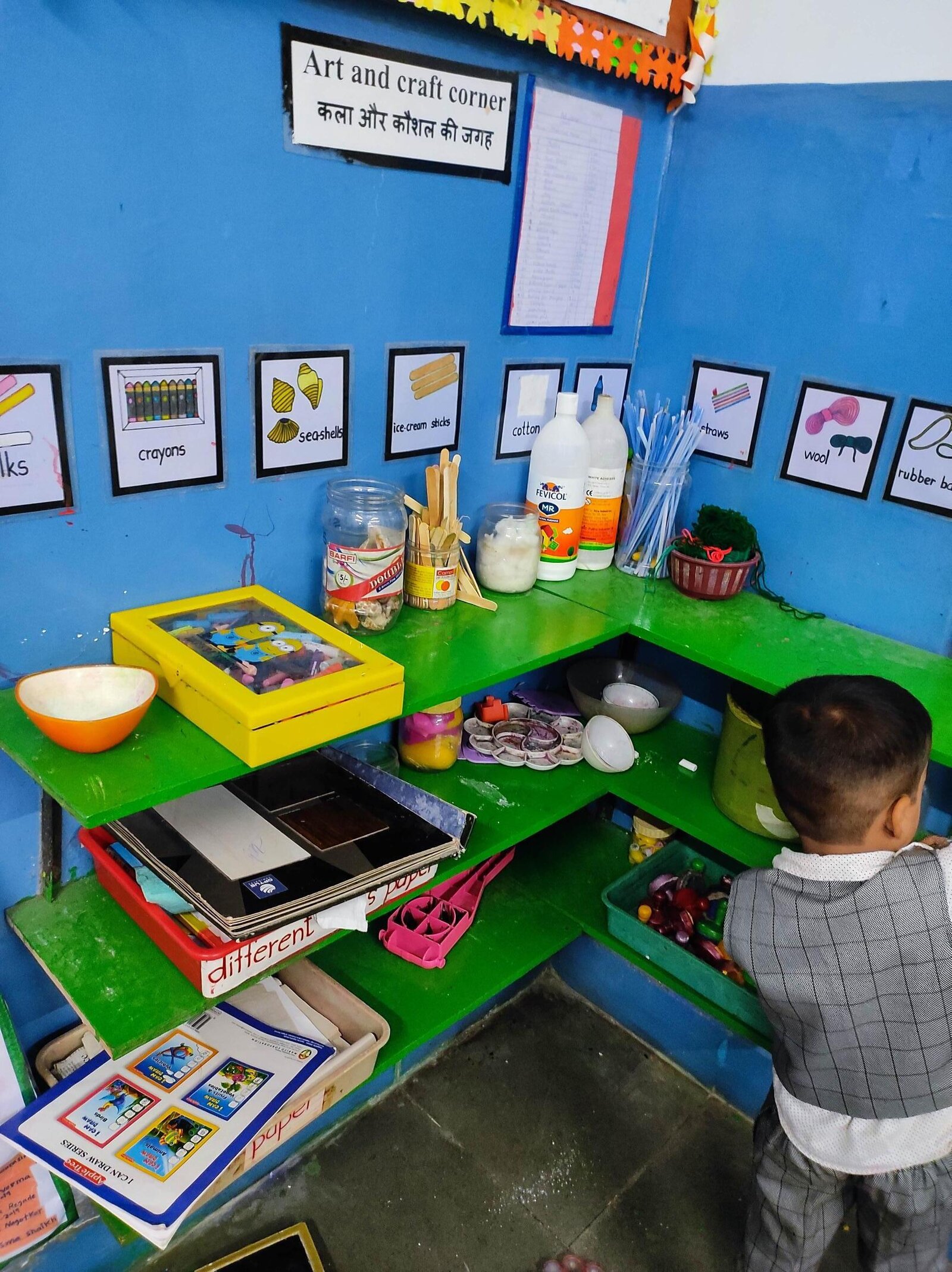
Figures 3: Different learning areas in the classroom.
During constructive play, children tell their play preferences to the teacher. They carry their name tag and hang it in the learning area, an interesting way to let others know about their plan. This also provides clues on the number of children who can comfortably play given the availability of space and materials. When the teachers signal the end of constructive play time, children put the materials back in their designated places. It was clear that children are supported in taking responsibilities from the beginning of the academic year.
Authentic observations and documentation
Teachers systematically make notes of children’s interactions and activities in their dairy. Each day Muktangan teachers systematically observe one or two children from their group. These observations inform the assessment. Muktangan has developed an assessment card which aligns with the outcomes of the NCERT Preschool Curriculum. Teachers note down each child’s progress in all the domains of development. This is shared with parents during the parent-teacher meeting. The assessments are continuous, and children do not have exams or tests before class I.
Reflections
Muktangan-run BMC preschools follow a child-centred, inclusive, and community-based education model to promote quality learning experiences for children from underserved communities. The schools are founded on the philosophy of ‘active constructivism’, a perspective that views children as competent and active beings. They believe all children have the potential to learn in an environment which is built on the foundation of positive relationships, interactions and exploration. One can see glimpses of this philosophy in the physical and social environment of the school: adequately sized classrooms with learning areas, teaching-learning materials, warm and amicable teachers and opportunities for children to interact. The curriculum is holistic and addresses all the domains of development: physical, cognitive, language and early literacy, socio-emotional and creative. Among other elements, the daily schedule includes planned experiences like ‘constructive play’ to encourage children’s decision-making.
Constructive play, as a pedagogical approach in Muktangan-run schools, is meant to support children’s exploration of any material of their choice, followed by teacher-guided reflection. Based on the two days of observations, one can reasonably assume that the purpose of this activity is to encourage children to plan, make decisions about their play and reflect on this process with an adult. It will be useful to explore this further and get a deeper understanding of how constructive play was conceptualised by the founders and their vision of introducing it in Muktangan-run schools. One can draw some parallels between ‘constructive play’ followed in Muktangan-run schools and the HighScope model’s Plan-Do-Review approach where teachers give children time to plan their play, implement and then reflect on it. One can find several elements in their curriculum which seem to be inspired by the HighScope model. For example, all preschool classrooms have accessible learning areas with appropriate materials, a consistent daily schedule, choice time and active learning experiences, positive adult-child interactions, daily planning and teacher reflection sessions. Perhaps it will be interesting to do an in-depth study of how an international curriculum model, like HighScope, can be adapted for the Indian context.
The teachers are drawn and capacitated by Muktangan from the same community, reflecting the organisation’s belief that women from under-resourced communities can be empowered to become qualified teachers. The recruitment process primarily includes teacher interviews to gauge their attitudes and openness towards learning and their interest in young children. Knowledge of child development, though desirable, is not integral. The founders believe that teachers need to experience ‘active constructivism’ in their own learning so that they can adopt it in their own teaching. Therefore, their in-service teacher training integrates an understanding of the theoretical concepts of ECE using the key tenets of constructivism. In future, it will be useful to observe teacher training sessions to get a nuanced understanding of their training approach and its implementation.
Teachers are supported through ongoing mentoring by an ECE Resource Person, also known as ‘Preschool Faculty’. In general, the interactions with teachers and preschool faculty indicate that the pre-service teacher training covers many important elements of the Muktangan approach and pedagogy. Nonetheless, one can observe individual differences in the way teachers engage with children, often a reflection of their own understanding of the organisation’s philosophy. Typically, all the teachers give ample opportunities for children to make choices, however, there are differences in the extent to which they encourage children’s co-construction of knowledge. In one instance, observed in a senior KG class, a child looked at the picture of a ‘bat’ (animal) and called it ‘superman ka pakshi’ (superman’s bird). The teacher gave the correct name (“bat”), which one may assume, was the curricular objective of the activity. Without disregarding the teachers’ intent, we feel that this was also an opportunity to draw connections with the child’s prior experiences. Possibly the child could have been asked to elaborate on what he said, draw similarities and differences, identify other animals that may look similar and so on. Such moments may offer teachers the possibility to know more about the children’s current thinking and prompt them to build new knowledge by linking it with their prior experiences. Having said this, it is important to recognise that most teachers in that school had less than 3 years of experience in Muktangan pedagogy. Observing children or extending their ideas requires specific skills which are gradually developed with practice, support and constant reflection.
Children need to experience a curriculum which is a little more challenging than their current level of understanding. Though two days of observations are insufficient to make reasonably sound claims, we were unsure how individual children’s curricular needs were met in the classroom. Like any group, some children were ahead of others and could easily do concepts related to number sense like one-to-one correspondence, cardinality (1−20), count on etc. However, during that day, there were few opportunities for them to be challenged by the current activities, resulting in them getting bored or distracted. This calls for more classroom observations focusing on the curricular aspects to understand how the curriculum is translated in the classrooms and to identify any challenges faced by the teachers in implementing this approach.
There was a fair amount of noise and movement in the classrooms, clearly an indication of children’s active involvement in the activities. The teachers were supportive of children’s interactions throughout the day. There were no instances of physical or verbal punishment even though children were still learning to regulate their behaviours; a reflection of the core values of the organisation and the teachers’ effort to translate them in the classroom practices. There were, however, some differences in the way individual teachers supported or regulated children’s actions, indicating teachers’ own capacities in addressing children’s needs. We recognise that working with young children is a challenging task and teachers need a lot of energy and patience. Perhaps some more focus on classroom management during the on-site support for the new teachers may help them feel more empowered in guiding children.
The success of the Muktangan model, to an extent, can be attributed to the community-based education model and their overall approach to building teachers’ capacity through sustained supportive interactions. The training is followed by weekly on-site support and mentoring. Several teachers shared examples of how the Muktangan training and mentoring had improved their confidence and enabled them to work more effectively with young children. Another commendable feature worth mentioning is the organisation’s detailed attention to processes and systems. The organisation has developed research-based documents and checklists for planning, classroom transactions, and assessment. These are essential for managing programmes at the classroom and organisation levels. And yet within this structure, teachers have the autonomy and flexibility to plan based on the interests and needs of their children.
One can witness several good quality ECE practices in Muktangan-run schools: learning areas, well-conceptualised daily schedules, holistic curriculum, play-based learning, accessibility of materials, freedom and choices, continuous assessment and documentation of children’s interactions. These practices are grounded within the larger community-based education model developed by them. Future studies may need to focus on these classroom practices in a more systematic way to gain deeper insights into the principles that govern them and how they reflect the overall philosophy of the organisation. Muktangan’s approach presents a unique model of public-private partnership to promote access and availability of quality ECE. Undoubtedly, the organisation’s work within the public education system to address the educational needs of children from low-resource communities is quite significant.
Author
Ira Joshi is faculty at Azim Premji University, Bengaluru
References
https://Muktanganedu.org/
Howmann, M and Weikart, D.P. (2002). Educating Young Children: Active learning practices for preschool and childcare programs (pp 3 – 10). High/Scope Press. Ypsilanti, Michigan.
NCERT (2022). National Curriculum Framework for the Foundational Stage. Retrieved https://ncert.nic.in/pdf/NCF_for_Foundational_Stage_20_October_2022.pdf