
Dadabhai Naoroji
Early Nationalist Economist
By Dinyar Patel
Details
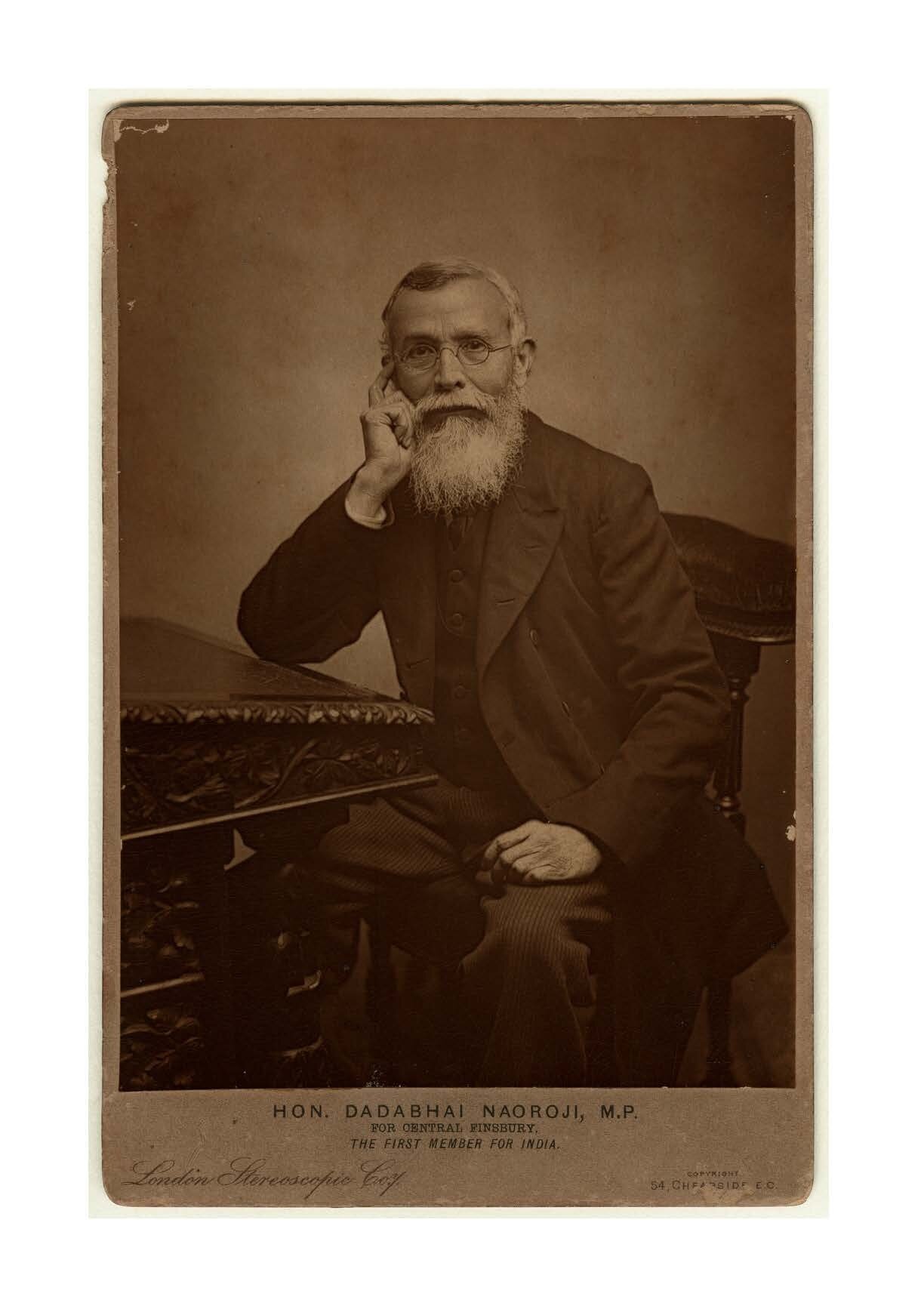
Dadabhai Naoroji (1825−1917) was one of the most important early Indian nationalist leaders: he helped found the Indian National Congress; served as the Congress’ president on three occasions; and, between 1892 and 1895, championed the Congress’ agenda while serving as an MP in the British Parliament. In terms of economic thought, Naoroji is perhaps best associated with the theory of the drain of wealth, which held that British rule directly led to stark impoverishment in India. Throughout his career, Naoroji strove to connect political and economic grievances, ultimately arguing that only swaraj (self-government) could stop the drain of wealth and generate prosperity in the subcontinent.
Naoroji was born into a poor Parsi family in Bombay on 4 September 1825. As a youth, he received a hybrid education, studying in a traditional pathshala before joining an English-medium school administered by the Bombay Native Education Society. He attended Elphinstone College between 1840 and 1845. At Elphinstone, western India’s premier institute for higher education, he distinguished himself as a polymath, excelling in chemistry, natural philosophy (a precursor to modern physics), history, and — appropriately enough — political economy. He joined Elphinstone’s faculty after completing his education, rising to the level of full professor of mathematics and natural philosophy in 1854 (he was the first Indian to attain the rank of full professor at a government college). It was during Naoroji’s time in Elphinstone that he developed his particular interest in Indian poverty. He was influenced by older Maharashtrian classmates, including Bhaskar Pandurang (author of “Letters of a Hindoo”), who had formed a “secret society” to discuss India’s steady impoverishment. During his maiden political speech, before the Bombay Association in 1852, he spoke on the impoverishment of the kunbis or peasants.
It was only after Naoroji left India — in 1855, when he joined a group of Parsis establishing a trading company in London and Manchester — that he undertook sustained research on Indian poverty. He was struck by the prosperity of Britain and France in comparison to India, and his involvement in the Indian cotton trade probably provided salutary lessons in the inherent inequalities of the colonial economy. At the same time, he was horrified by news of mass famine in India, such as the Orissa Famine of 1866. Naoroji referenced this famine in his first speech on economic matters, “England’s Duties to India,” delivered in London in 1867. In this speech, Naoroji established his trademark statistical approaches for quantifying Indian poverty, based on copious research at the India Office’s library and elsewhere. He also made his first estimates of the drain of wealth from India, arguing that it amounted to £33 million annually, or one-fourth of total tax revenue (Naoroji, it is important to note, was far from being the first individual to observe a drain of wealth: in his speeches and writings, he referenced Indians and Britons who had earlier made similar claims). At a subsequent speech in London, “Wants and Means of India,” delivered in 1870, he made the first-ever estimates of India’s gross income per capita, a shockingly low 27 shillings (in comparison to £33 per head in the United Kingdom).
In speeches and papers delivered between 1870 and 1880, the tenor of Naoroji’s economic thought became more radical. Earlier, Naoroji acknowledged the benefits of British rule and claimed that some of the drain of wealth was justified due to supposed improvements introduced through colonial administration, especially public works investment. Such references were gone by the mid-1870s. By then, Naoroji developed the art of statistical comparison to illustrate India’s impoverishment, amassing statistics on other countries like the United States. At the same time, Naoroji began thoroughly interrogating British statistics and economic data, pointing out glaring calculation errors which overestimated everything from agricultural production to commodity prices. While assailing British data, he incorporated data which he collected from correspondents across India as well as his own travels in places like Gujarat. “Condition of India,” produced in 1880, offers perhaps the best illustration of Naoroji’s finesse with statistics: drawing on his own data and interrogating British figures, he analysed production in the province of Punjab through various agricultural commodities and manufactured goods, ultimately concluding that total income per head could be no more than 40 shillings. These investigations prompted the finance member of the British Indian government, Evelyn Baring (the future Lord Cromer), to make his own estimates of Indian income per head: he concluded it could be no higher than 54 shillings. All of these estimates laid bare the stark poverty of the average Indian and helped shatter notions of development and material improvement under the British Raj. They also offered explanations for the mass famine devastating India in the late nineteenth century: Naoroji’s calculations demonstrated that most Indians were living at the cusp of starvation.
Naoroji’s economic writings generated ripples of controversy in both Britain and India. A parliamentary committee refused to publish testimony Naoroji delivered in 1873 where he unfavourably compared the condition of an average Indian with convicts in an Indian jail being kept on subsistence diets (the testimony was later published as “Poverty of India”). As he abandoned notions of the benefits of British rule, he developed the idea of a “moral drain” — that British colonialism, through its extensive employment of Europeans, denied Indians particular professional, educational, and leadership opportunities. Naoroji’s drain theory focused more and more on the deleterious effects of employing European officials rather than Indians, particularly the cost of their salaries, pensions, and remittances to Great Britain. In this sense, he began developing a political corollary to the drain theory, arguing that substituting European with Indian officials would help stanch the drain. This was a revelatory argument, offering us significant evidence that Naoroji’s drain theory was politically motivated: it was meant to advance a political agenda, which in time became self-government. As early as 1884, Naoroji publicly discussed India’s future as “a self-governing and prosperous nation” within the British Empire, claiming that foreign rule was “a curse.” Underlying this vision of Indian autonomy was an Indianised civil service: Naoroji believed that, once the civil service was staffed mostly by Indians, it would champion India’s economic and political interests rather than those of Great Britain.
Between the 1860s and 1890s, Naoroji, like many early Indian nationalists, was drawn into the affairs of princely states. In large, relatively progressive states like Baroda and Mysore, Naoroji saw laboratories for experiments in Indian self-government, arguing that princely states were better shielded from the drain of wealth and the moral drain, and that they were reservoirs of Indian capital. He briefly served as diwan or chief minister of Baroda in 1873 – 4, bringing with him a number of reformist-minded ministers. Despite fierce clashes with both Malharrao Gaikwad and the British resident, Naoroji achieved a modicum of reform and later established close relations with Sayajirao Gaikwad III.
Naoroji’s economic writings drew upon a wealth of testimony of British officials: he had a knack for discovering reports and correspondence that corroborated his views of Indian poverty. On occasion, he referenced the work of economists such as John Stuart Mill, but he always provided his own unique perspectives. For example, he cited Mill to argue that the drain of wealth produced a continually worsening spiral of impoverishment, robbing India of capital and diminishing labor. At the same time, Naoroji’s work exercised a broad influence on the thought of various Indian and British political figures. In India, M.G. Ranade was an early convert to Naoroji’s drain theory, although he later expressed skepticism. The drain of wealth remained a totemic idea in Indian nationalism, but there was no consensus on the theory within the Indian nationalist camp. Figures like R.C. Dutt argued with Naoroji that excessive land taxation was a bigger cause of impoverishment, although he acknowledged the existence of the drain. In Britain, Naoroji’s greatest convert to the drain theory was the socialist politician Henry Hyndman. Hyndman adopted the idea of a drain of wealth with gusto and used it to advocate a form of politics in India oftentimes far more radical than Naoroji’s approach. It was through Hyndman that Karl Marx might have been introduced to the drain theory: Hyndman tried to arrange a meeting between Naoroji and Marx in 1881.
“Condition of India” represented Naoroji’s last major work of economic scholarship. His most famous publication, Poverty and UnBritish Rule in India, produced in 1901, is a compilation of his writings through 1880, including papers like “Condition of India” and “Poverty of India.” These papers are complemented by later testimony to a parliamentary commission (the Welby Commission) and addresses in and out of Parliament. By the early 1880s, Naoroji was devoting increasing time to political organisation, including founding the Congress and standing for election to the British Parliament. As a parliamentary candidate, Naoroji moderated his language on Indian poverty (and completely avoided any references to Indian self-government). Yet, there were many times when Indian poverty crept back into his agenda. It probably influenced his interest in socialism and the labour movement in Great Britain — as well as his long standing alliances with Irish nationalists such as Michael Davitt. In London, Naoroji was associated with Hyndman’s Social Democratic Federation and Sidney Webb’s Fabian Society; while standing for Parliament, he endorsed ideas like the eight-hour workday and spoke about the widening socioeconomic gap between the rich and poor in Great Britain. In 1890, he issued a pamphlet, “The Rights of Labour,” which endorsed the Lockean concept of property in labour. Indian poverty provided a backdrop to all of these endeavours: he reminded British audiences that poverty in India was far worse and even argued, on occasion, that Britain suffered from its own drain of wealth due to the persistence of poverty and attendant social problems.
Naoroji, standing as a member of the Liberal Party, narrowly won election to Parliament from the London constituency of Central Finsbury in 1892. After a failed attempt at Indian civil service reform, he grew disillusioned with the prospects of Indian political reform in Parliament and the stance of his own Liberal Party towards Indian affairs. Consequently, beginning in 1894, he resumed speaking forcefully about Indian poverty. From the floor of the House of Commons, Naoroji claimed that India was the poorest country in the world and compared Indian subjects to slaves — statements that did not go down well with many of his fellow MPs. He became more radical after losing his reelection bid in 1895. Naoroji joined Hyndman, Davitt, and others in protesting the British government’s lackluster response to famine and plague in western India. Additionally, he deepened his ties with Irish nationalists; and established contacts with American anti-imperialists. It was through these American contacts that Naoroji and Hyndman’s ideas of the drain of wealth reached the Progressive politician William Jennings Bryan, who cited the impoverishing effects of British rule in India as a warning against American imperialism in places like the Philippines. Naoroji’s ideas, therefore, had begun to circulate globally.
In speeches and correspondence around the turn of the century, Naoroji made his link between the drain of wealth and swaraj more explicit, first arguing that self-government under “British Paramountcy” was India’s immediate need. Such ideas put Naoroji in an anomalous position: increasingly, he was viewed as too radical by moderate nationalists in the Congress, while an emergent crop of radical leaders — like Bal Gangadhar Tilak, Bipin Chandra Pal, and Aurobindo Ghose — found him too moderate. In 1906, in his eighty-first year, Naoroji was elected as president of the Congress in order to paper over differences between moderates and radicals. His presidential speech broke new ground: he called for “‘Self-Government’ or Swaraj like that of the United Kingdom or the Colonies,” deploying the vernacular term popularised by Tilak while signaling that India could evolve into a truly autonomous nation like Great Britain. He endorsed the Swadeshi Movement but held back his support for tactics like boycott; he also urged the continuation of constitutionalist tactics like petitioning, fast falling out of favour amongst more advanced sections of the Congress. While such pronouncements caused consternation to individuals such as Tilak, Naoroji’s speech helped push the Congress in a more radical direction and firmly established the goal of self-government within the Congress platform.
Naoroji passed away in Bombay on 30 June 1917. Towards the end of his life, he was hailed as the “Grand Old Man of India,” an Indian equivalent to William Gladstone. He had a commanding influence on generations of Indian nationalists, both radicals and moderates. Gandhi was deeply affected by Naoroji’s writings on poverty and defended Naoroji’s brand of politics — then under assault by radical critics — in the opening pages of his Hind Swaraj. The drain theory remained a powerful idea in Indian nationalism and even influenced the economic tenor of other anticolonial movements: we can see echoes of the drain theory in the thought of figures like Eric Williams in Trinidad and Tobago, Sukarno in Indonesia, and Kwame Nkrumah in Ghana. Although his particular political methods — and his stubborn faith in “British justice” — quickly lost favour within the Congress by the time of Gandhi’s rise to power, Naoroji’s ideas, particularly his overriding concern for Indian poverty and its eradication, continued to exercise a major influence on Indian political and economic thought in the years both before and after independence.
Naoroji, D. (1862a). The manners and customs of the Parsees. Pearson & Son.
Naoroji, D. (1862b). The Parsee religion. Pearson & Son.
Naoroji, D. (1887). Essays, speeches, addresses and writings (on Indian politics) of the Hon’ble Dadabhai Naoroji (C. L. Parekh, ed.). Caxton Printing Works.
Naoroji, D. (1901). Poverty and Un-British Rule in India. Swan Sonnenschein & Co.
Naoroji, D. (1917). Speeches and Writings of Dadabhai Naoroji (G. A. Natesan, ed.; second edition). G. A. Natesan & Co.
Masani, R. P. (1939). Dadabhai Naoroji: The grand old man of India. G. Allen & Unwin, Ltd.
Mehrotra, S. R., & Patel, D. (Eds.). (2016). Dadabhai Naoroji: Selected Private Papers. Oxford University Press.
Patel, D. (2020). Naoroji: Pioneer of Indian Nationalism. Harvard University Press.
Patwardhan, R. P. (Ed.). (1977a). Dadabhai Naoroji correspondence (Vol. 2, part 1). Allied.
Patwardhan, R. P. (Ed.). (1977b). Dadabhai Naoroji correspondence (Vol. 2, part 2). Allied.
Visana, V. (2022). Uncivil Liberalism: Labour, Capital and Commercial Society in Dadabhai Naoroji’s Political Thought. Cambridge University Press
About the author
Dinyar Patel is Associate Professor of History at the SP Jain Institute of Management and Research (SPJIMR) in Mumbai. He received his PhD in History from Harvard University. He is the author of Naoroji: Pioneer of Indian Nationalism. [Full profile]