
M.L. Dantwala
Father of agricultural economics in India
By Ritu Dewan
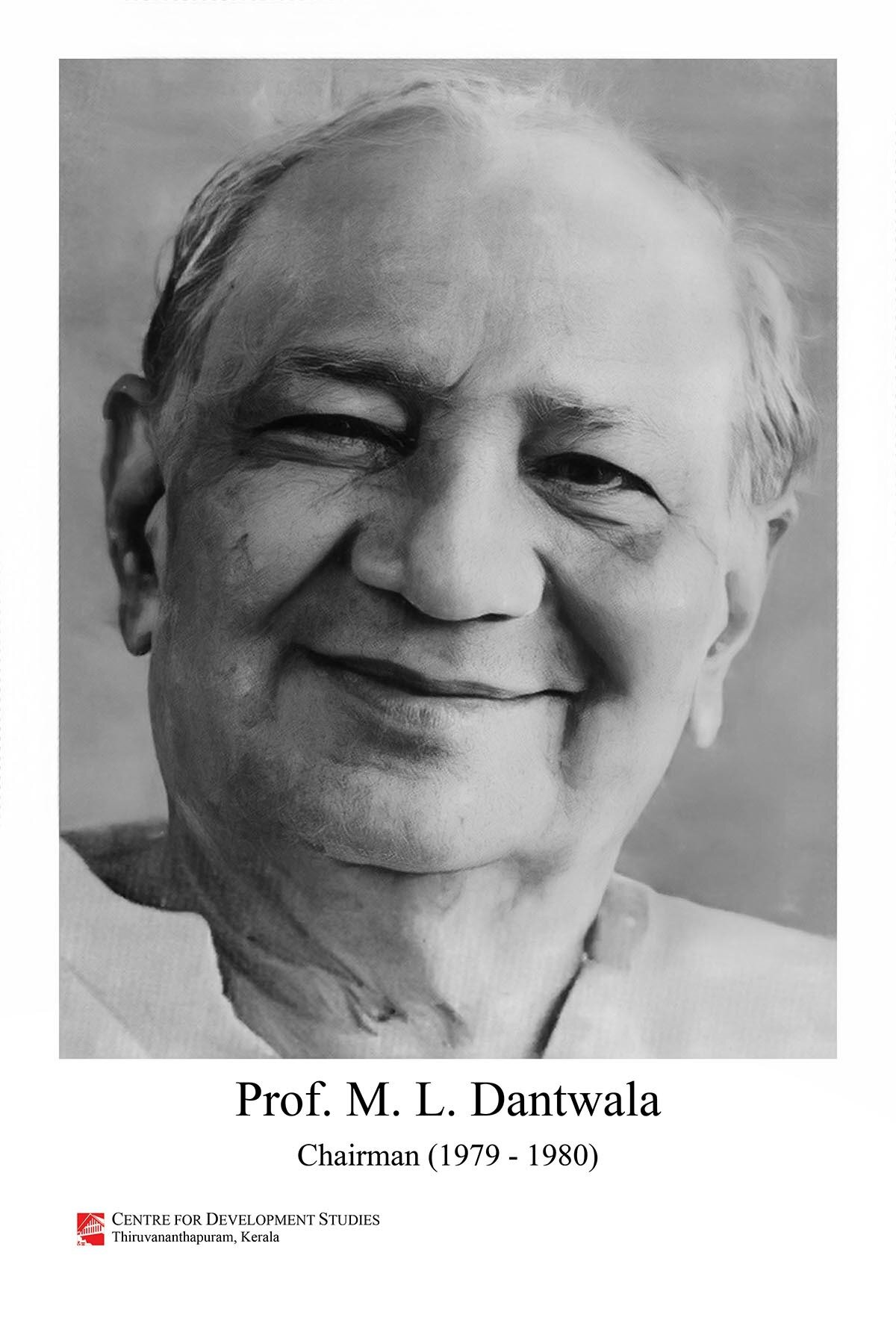
M.L. Dantwala (1909−1998) is generally referred to as an agricultural economist, the ‘father’ of agricultural economics in India. This term is somewhat reductionist in the context of his immense contribution not only as an economist but also, if not more importantly, as a scholar-philosopher, as a creative and pioneering policy maker, and as an activist. His research, the life he lived and his way of being and doing integrated the three essentials that are fundamental for a thinker to be and to remain relevant – academics, advocacy and action. Each feeding into each other, thereby each getting strengthened and reinforced.
The strongest and most long-lasting influence on him and his work was deep involvement in the struggle for India’s independence from his teenage years onwards: the consistent and continuing connection to movements define all his writings and also policymaking. Dantwala graduated from Wilson College in Mumbai in 1930, after topping the BA examinations, for which he was awarded the prestigious James Taylor Prize. Thereafter, he joined the Bombay School of Economics and Sociology (now the Mumbai School of Economics and Public Policy) as a Dakshina Fellow for an MA by thesis.
It was during this time that Mahatma Gandhi began the salt satyagraha and officially started the non-cooperation struggle. The resumption of the civil disobedience movement in 1932 and the arrest of Mahatma Gandhi resulted in massive popular support extended by people from all walks of life, including students. The 23-year-old Mohanlal Lallubhai Dantwala was one of them. He was immediately arrested and jailed. This however did not deter him from completing his MA, writing the last chapter of his thesis in the Arthur Road prison in Mumbai. He was awarded the MA degree from the University of Bombay (now Uiversity of Mumbai) in 1933 with a First Class. After his release from prison, Dantwala participated in trade union activities around Dhule, a town in northern Maharashtra, where he had done his schooling. In 1936, he joined the H.L. College of Commerce in Ahmedabad as Professor of Cotton Trade and Industry, after being motivated by his guide C.N. Vakil, the founder of the Bombay School of Economics and Sociology.
Four years later, Dantwala resigned from his teaching post in response to Mahatma Gandhi’s call for individual civil disobedience, and joined the freedom movement even more actively. His participation in the All India Congress Committee session in Mumbai in August 1942, where the Quit India movement was launched, resulted in him being arrested yet again. He was sentenced to rigorous imprisonment for two and a half years in the Nasik Road Central Jail. However, being granted the status of a political prisoner, he was able to read and also interact with fellow thinkers and intellectuals. Upon his release, he joined as Lecturer in Agricultural Economics at the Department of Economics, University of Bombay in 1945, from where he retired in 1973 as the Director.
Although Dantwala was now a full-time faculty, and focused on teaching and research, he continued to be part of what was informally called the Wednesday Club.
Started in the late 1930s, continuing uninterrupted for over four decades, this gathering was primarily a sharing-debating group, initiated by those who had bonded over their opposition to the repressive Anarchical and Revolutionary Crimes Act of 1919 (known as the Rowlatt Act), merging seamlessly to be part of the non-cooperation movement, with all members having been direct participants.
He published his first book in 1937, during the years of his incarceration, in collaboration with C.N. Vakil: Marketing of Raw Cotton in India. A few years later, he published the still widely quoted book titled Gandhism Reconsidered. This was followed in 1948 by the book commissioned by the East India Cotton Association titled Hundred Years of Indian Cotton, whose foreword was written by the first Prime Minister of independent India, Jawaharlal Nehru. Collaborating closely with Mahatma Gandhi, he drafted the document on Practical Trusteeship, considered to be the only authentic version of this core Gandhian idea.
What followed was a large number of articles and research projects, too numerous to be mentioned in detail. The massive field-based survey he conducted on land rights resulted in the famous report on Evaluation of Land Reforms in 1971, the recommendations of which influenced several policies. This was also his first crucial foray into linking academic research with the lived reality of those affected. Thereafter his writings combined even more strongly the fundamental interlinkages between aggregate macro data from national censuses and sample surveys, and insights from field investigations and case studies.
Dantwala’s writings were not only pioneering both conceptually and empirically, but much of what he wrote resonates even today. Central to almost all his chosen themes was the necessity of reconciling growth with social justice, an issue in much debate today given the prevailing process of the increased delinking of growth from the fundamentals of development, incorporating not only economic issues of employment but additionally and importantly egalitarianism. He was also perhaps the first mainstream economist to raise the issue of women’s participation in particularly agricultural economic activity, a much researched theme these days. Heterogeneity of labour supply was flagged by the Committee of Experts on Unemployment Estimates (1970) of which he was the Chair, leading to a new discussion on variations in labour structures via analysis of categories, especially those self-employed, taking into account supply-based and demand-determined constraints, as well as alternatives. Also interlinked was the prevalence of unemployment coexisting with poverty. These connects and also disconnects have been analysed in much detail in several of his works, as for example in his 1973 book Poverty in India: Then and Now, 1870 – 1970 and also in Dilemmas of Growth: The Indian Experience which he co-edited with Pravin Visaria, N.A. Mujumdar and T.R. Sundaram.
As with much of his work, academic analysis was not conducted in an empirical vacuum, but in the context of practical policy suggestions and actionable programmes: public works schemes for casual wage labour; asset strengthening; enhancement of agricultural productivity; increasing viability of marginal and small farmers; skill training, etc. It must be recalled that this was the period when the ‘green revolution’ and technology enhancement was being implemented in Indian agriculture. He entered national and international debates on the possible effects on resultant inequalities increasing: eviction of tenants as a consequence of rising profitability; introduction of labour-saving technology impacting especially women’s work in agriculture; increasing dependence of poorer farmers on the market for purchase of high-yielding seeds, fertilisers and pesticides; the environmental impact of tube well irrigation; the lack of credit facilities; etc.
Dantwala also made significant and lasting contributions to the advancement of learning by placing social science research and advocacy at the national level. He was the first Member Secretary of the Research Programmes Committee of the Planning Commission, and was entrusted to determine and monitor the flow of official funds to universities and research institutions. His deep and abiding commitment to the Indian Society of Agricultural Economics and the Indian Journal of Agricultural Economics is well-known and well-recognised both nationally and internationally.
It is not possible to discuss the many contributions of Dantwala without including his two special traits. One, the sudden insertion of aphorisms in the midst of serious academic analysis. One such illustration is ‘The times are such that one feels more comfortable with dreams, past and future than with the suffocating reality’, a statement that resonates so strongly in these current times. Two, a level of ethical honesty not seen often enough. He was consistently critical of government policies, openly publishing his disapproval in the public domain without a care of reprisal.
The ethics of his uncompromising values are evident in his lifelong refusal to disassociate from his commitment to linking academics, advocacy and action. Intensely disturbed at the declaration of the Emergency in 1975, he resigned from official bodies and committees including the Central Board of Directors of the Reserve Bank of India. Subsequently he reposed his faith in civil society and voluntary community action, and called upon the government to provide necessary financial, administrative and technical support without impinging upon and constraining their autonomy. The last book he wrote, Social Change through Voluntary Action, was released on his last birthday, just three weeks before his passing away in 1998.
Dantwala, M.L., and Vakil, C.N. (1937). Marketing of Raw Cotton in India. Longmans-Green.
Dantwala, M.L. (1945). Gandhism Reconsidered. Padma Publications.
Dantwala, M.L. (1948). A Hundred Years of Indian Cotton. East India Cotton Association.
Dantwala, M.L., & Shah, C.H. (1971). Evaluation of Land Reforms. Department of Economics, University of Mumbai (mimeograph).
Dantwala, M.L. (1973). Poverty in India, Then and Now, 1870 – 1970. Macmillan India.
Dantwala, M.L. (1986). Indian Agricultural Development since Independence. Oxford and IBH Publishing Company.
Dantwala, M.L., Visaria, P., Mujumdar, N.A., and Sundaram, T.R. (eds.) (1996). Dilemmas of Growth: The Indian Experience. Sage Publications.
Dantwala, M.L., Sethi, H. and Visaria, P. (eds.) (1998). Social Change through Voluntary Action. Sage Publications.
Dantwala, M.L. (2001). Dynamics of Agricultural Development. Concept Publishing Company.
About the author
Ritu Dewan is Visiting Professor at Institute of Human Development, New Delhi. She is founder-member of the first Center for Gender Economics in Asia. Her research focus – which interlinks academics, advocacy and action – is the result of issues related to the marginalised.