
Walking the Talk
Sujatha Padmanabhan at the Kalpavriksh Environmental Action Group narrates her experience of publishing children’s literature on nature, environment and community conservation.
Details
At the time of writing this piece, Kalpavriksh Publications for children is twenty-four books old. I like to describe it this way, since this area of our work is still at a fairly nascent stage. Our first children’s book, The Ghost of the Mountains, was published in 2008 in collaboration with the Snow Leopard Conservancy-India Trust. It was part of our localised environment education programme in Ladakh and gave us the experience of publishing for children. Soon, we published some illustrated storybooks as part of the learning resources we were creating for other areas: Circle of Life for children of honey harvesters in Bheemashankar Wildlife Sanctuary, Khari Journeys through Kachchh and Shero to the Rescue for children in Kachchh.
In 2017, we launched a publishing unit dedicated to children’s literature on nature, environment and community conservation, to reach out to more children than our environment education programmes allowed us to do. Our early books showed us the power stories have to raise awareness and sensitise children about environmental issues, giving them the agency to bring about change.
With over four decades of work in the environment, we had developed expertise in certain thematic areas such as community conservation, biodiversity and environmental and social impacts of large dams and mining. We felt that this was an asset we could tap into, to create books for children. For example, we published People & Wildlife, an anthology of ten stories that explores different kinds of relationships local communities across the country have with wildlife. Saving the Dalai Lama’s Cranes, a fictional story inspired by true events from Arunachal Pradesh, deals with local resistance to a proposed dam and introduces young readers to concepts like Environmental Impact Assessments. Pedru and the Big Boom, a fictional story set in Goa, highlights the negative impacts of mining on local communities.
In our books, we have also tried to highlight nuances of complex environmental issues. For example, in A New Home for Ajiri, a pastoralist family in Kachchh looks after an injured chinkara till it is reunited with its family. While working on this book, we realised that besides portraying the reality of local communities who often look after injured or abandoned wild animals, we also needed to inform readers about the legal aspects of caring for a species protected by law.
Having access to a network of subject experts to help us verify facts has been invaluable to our work. They have provided us useful inputs based on the latest research on a topic, verified the genuineness of a local initiative that a story features and even commented on drafts. Trying to get facts right can be challenging: I remember Tanya (my co-coordinator) and I breaking our heads over information on “hard” seed coverings of jamun and fig in a draft manuscript on how seeds travel. A botanist we contacted told us that the word “hard” was only a taxonomic description, and was not hard as in “hard to break” as these seeds could easily be bitten into!
Our journey in publishing has not been without challenges. As a publisher with a thematic focus, we go through a number of submissions to shortlist the ones that we would like to publish. While there are several naturalists and environmentalists with rich experiences in the field that would make for wonderful books, many of them do not have what it takes to write for children. When one has deep knowledge of an issue, place or species, it requires a special skill to be able to weave it seamlessly into a story or to know what to distil for young readers. We have spent many hours connecting with naturalists who we feel may be able to write a children’s story based on their field work. Unfortunately, many of them have not put pen to paper despite wanting to do so, which is probably a reflection of how demanding field work is on their time.
We have in the past explored the possibility of printing our books on recycled paper and finding alternatives to plastic packaging. But economic feasibility has been an issue. Kalpavriksh’s books are not highly priced as we believe that they should be affordable to a wide readership. While this has been appreciated by our customers, it is seen as an issue by big distributors who want higher profit margins.
Despite such challenges, it’s been a wonderful journey so far. Feedback from our readers has been especially encouraging. I recall the mother of an eleven-year-old boy telling me how her son was hooked to Something to Chew On, our book about the food of India, its histories, stories, customs and connections. It was thrilling to know that Gillo, a theatre group in Mumbai, created a play based on The Ghost of the Mountains and has been staging it in different cities, and that children of a school for first-generation learners in Udaipur staged it too. A child wrote in to share how he is trying to control his anger after reading The Monster Who Could Not Climb a Tree and another told us how he wanted to become a zero waste hero after reading The Miracle on Sunderbaag Street.
The author of Shero to the Rescue shared an email he had received from the children of a school in Bengaluru asking very pertinent questions like:What kind of development would benefit all animals (including humans)? Sharing their thoughts, they wrote: …we are not sure about what kind of development will benefit all living beings. One idea we had was [that] rather than making big factories, people can make small buildings and …natural and herbal products.
If books can seed such thoughts in children, get them to question inequity and unsustainability, and look for possible solutions to environmental problems based on their understanding, then surely the publishing path we took less than a decade ago seems to be the right one!
About the author:
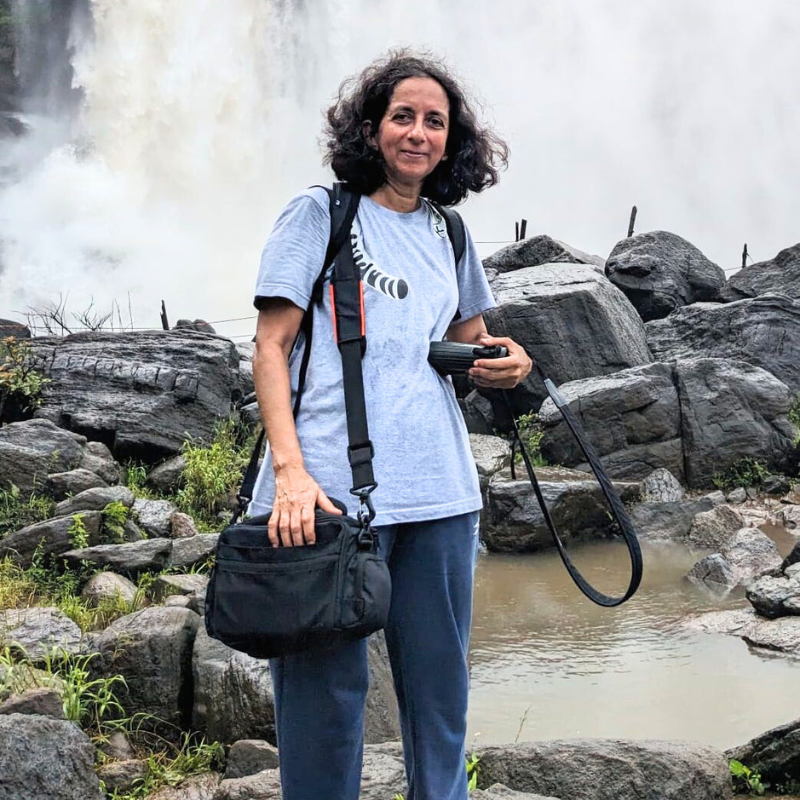
Sujatha Padmanabhan has been a member of Kalpavriksh Environmental Action Group since 1984. Currently, she co-coordinates the publication of books for children on nature, environment and conservation. She has also authored books for children published by Kalpavriksh, Eklavya and Pratham.