
Green in Glorious Technicolour
Award-winning illustrator Rajiv Eipe shows and tells us why illustrated books are the perfect way to explore nature, and how they influence what young readers think, feel and do about the environment

Details
Illustrators of children’s books have been drawing animal characters and natural landscapes for the longest time ever. Exemplary artists like Pulak Biswas, Mickey Patel and Atanu Roy have created memorable art in books like Mahagiri (CBT, 1965), The Story of a Panther (Orient Longman, 1998) and The Gijjigadus and the Fireflies (Katha, 2011) among others. Nature writing wasn’t really a defined category in children’s literature back then, which is why there haven’t been too many studies of how these books explore environmental themes.
I believe Dive! (Pratham Books, 2014) was the first book I illustrated that had a clear environmental theme. This picture book was meant to be a visual journey into a magical underwater world, where the reader accompanies two marine explorers on a coral reef dive. Coral reefs are mind-bendingly beautiful ecosystems that support enormous numbers and varieties of marine life, and it was important for the illustrations to be somewhat accurate in their depictions. I wanted the book to try and communicate the busy, bustling activity and the terrific diversity of shapes, sizes, colours and patterns in a thriving reef. Though initially conceived of as a wordless book, the editors and I realised that having just a few accompanying words of text — species names and the kinds of activities they engaged in — was a nice way for the reader to try and identify marine organisms in the illustrations.
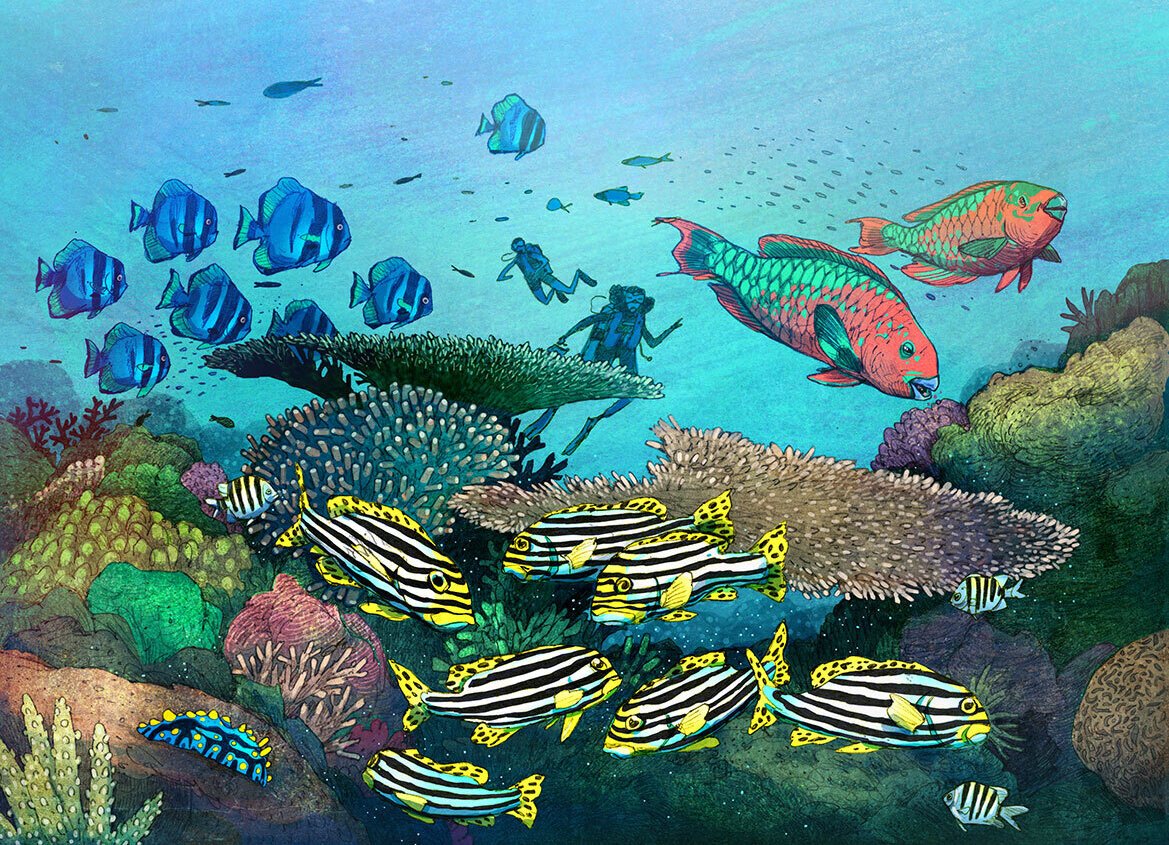
Illustration from Dive!
A decade or so later, we see a great variety of green books being published for children — from animal and nature stories to climate fiction and comics. Chitty: A Dog and Her Forest Farm (Kalpavriksh, 2021), Hello, Sun! (Pratham, 2022), The Monster Who Could Not Climb a Tree (Kalpavriksh, 2022), Lady Tarzan: Jamuna Takes a Stand (Ektara, 2023), When Fairyland Lost Its Magic (HarperCollins, 2023) and Ajay of Agumbe and the Signal Snake (Pratham, 2024) are some books I’ve drawn that have noticeable nature and conservation themes, while Sept-Opus: Adventures of an Almost-Octopus (Rupa, 2015), The Grand Story of Ikli Chokli (Tulika, 2018), Puchku Seeks a Song (Pratham, 2020), Kitten Trouble (Duckbill, 2021), Dugga (Pratham, 2021) and Puppy Trouble (Duckbill, 2024) feature animal characters in prominent roles. In fact, I believe there’s at least one animal or bird in almost every book I’ve illustrated.
An oft-quoted piece of advice to writers is to write what you know, and I suppose the same holds true for illustrators. And if you don’t know enough about something for which you need to make pictures, well, the obvious thing is to learn a little about it. Reading about it is useful, of course, but drawing itself is a wonderful way of knowing more. It takes a keen sense of observation and attention to detail to take in proportions, colour, physical structure and shape — the distance between a dog’s ears, the proportion of a cat’s tail to its body, the chunkiness of a coppersmith barbet’s beak, the colours and patterns in a barn owl’s plumage or snail’s shell, or the shape and arrangement of leaves on a particular tree. But things like body language, qualities of movement and behaviour are equally important, especially since an illustrator, in setting the scene for a story, is also often fulfilling roles of production design, choreography, cinematography and more. For me, making lots and lots of drawings of a character or subject, with variations in poses, expressions and proportions, is a way of ‘breaking ice’ or getting to know them before setting off on the long journey of creating a book together.
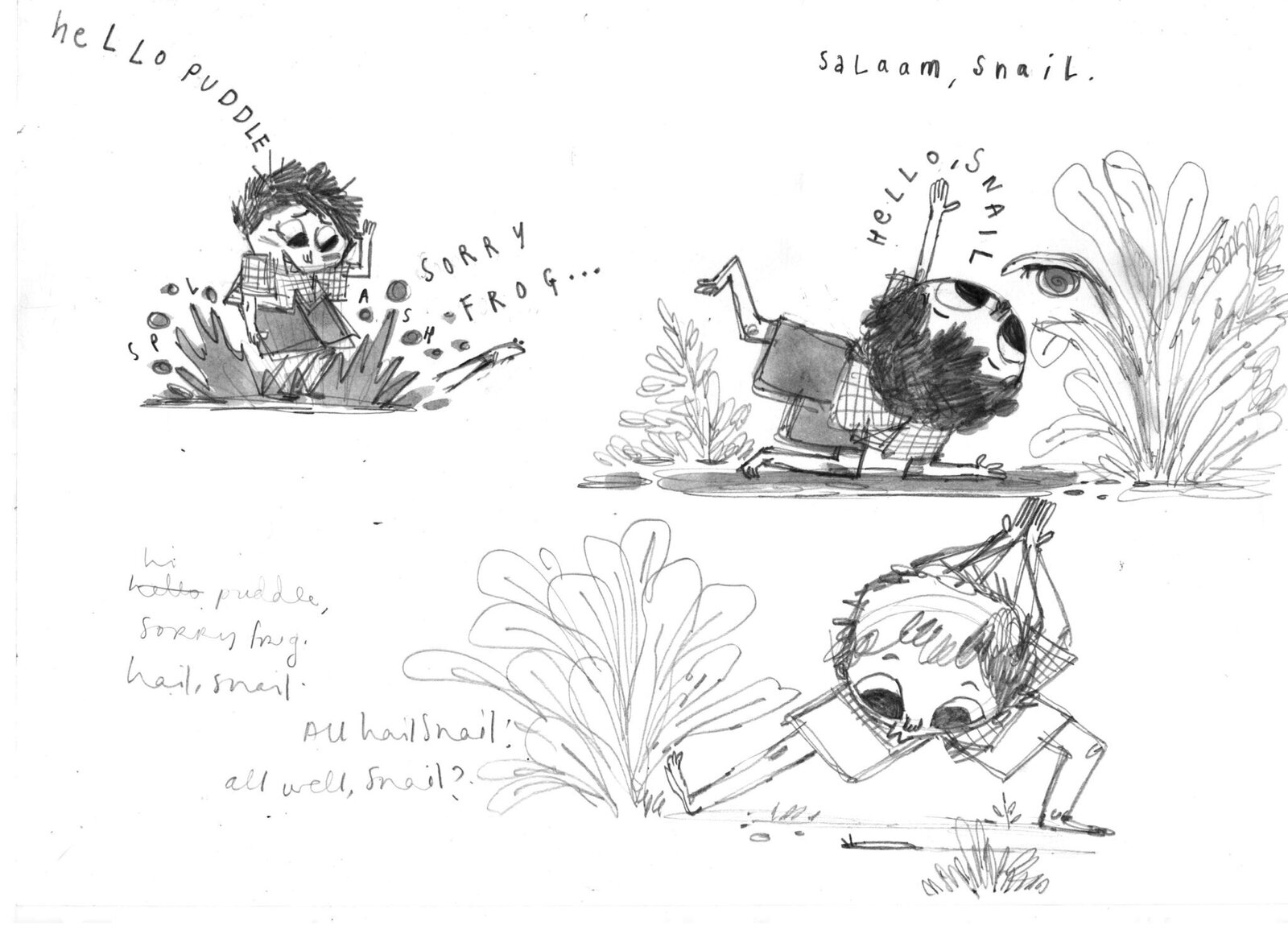
Rough sketches, Hello, Sun!
The natural world has been a constant and immense source of joy, inspiration and learning for my art and for life in general. The fact that opportunities exist to witness wildlife in the form of birds, insects and reptiles even in our grey, smoggy cities is what led to the picture book Hello, Sun! — where a young boy delights in and enthusiastically greets the non-human residents in the immediate vicinity of his semi-urban home. I took many walks through the parks, lakes and wooded areas near where I live, and these provided a steady supply of details and themes to put into the book.
There is much to be captivated by in almost any natural landscape, but I don’t think anything can really match the utter enchantment of a thick, dense rainforest. For the book Ajay of Agumbe and the Signal Snake, I had the privilege and joy of visiting the Agumbe Rainforest Research Station (ARRS) before making the drawings. Ajay Giri, one of the protagonists, serves as field director of the ARRS. This allowed me to soak in (literally) a little of the scenery, vegetation and fauna, and the many photographs, sketches and notes I’d made during the visit helped me populate the scenes in the book.
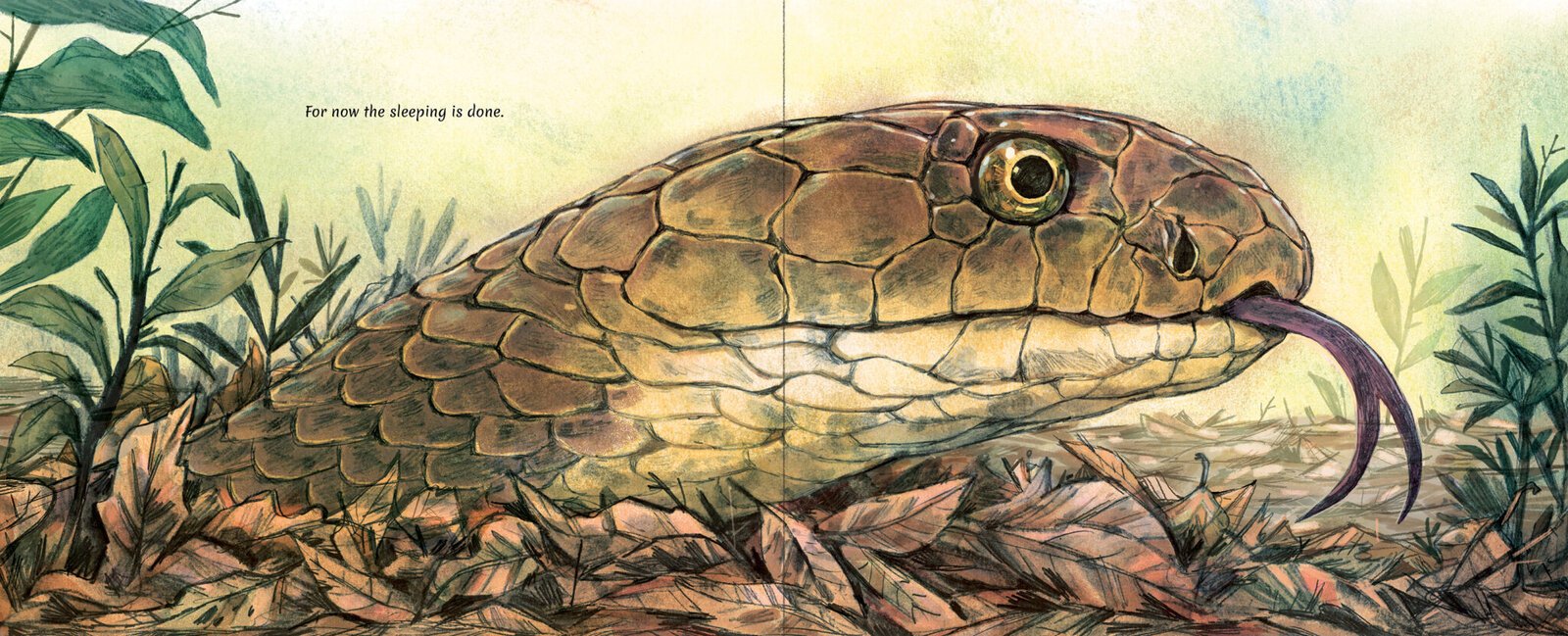
Illustration from Ajay of Agumbe and the Signal Snake
Similarly, for Chitty: A Dog and Her Forest Farm, I was fortunate enough to visit the place where the story is set, at the invitation of the author Serow, who showed me pictures of the dog Chitty and gave me a glimpse of life on and the workings of a forest farm. The author and the editorial team at Kalpavriksh were quite keen that the illustrations in the book should also include some of the flora and fauna of the region where the story is set, even if it doesn’t feature prominently in the story.
While this may sound idyllic, I’d like to say here that I’ve also fully enjoyed working on illustrations for books that are set in busy cities and are filled with (human) characters, such as Pishi and Me (Pratham, 2021), where a young boy walks through the neighbourhood with his aunt and recounts the people and animals he meets, and the small souvenirs he finds and collects. A common thread running through these four books is that much inspiration and many details for the art have come from observation of real-life settings, places, animals and people.
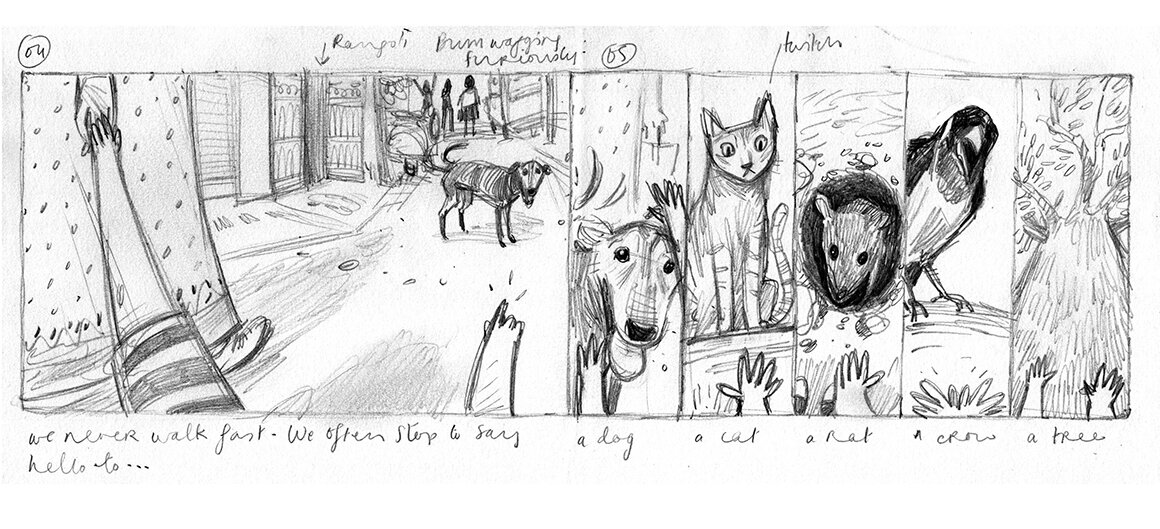
Rough sketch, Pishi and Me
I love the work of Prabha Mallya and Priya Kuriyan, who are always at the top of the list of artists that inspire me. I am amazed by the breadth and brilliance of Rohan Chakravarty’s work. Barkha Lohia’s gorgeous illustrations in Let’s Talk About Trees (Juggernaut, 2024) and Prashant Soni’s stunning and intricate drawings in Jungle Mein Ek Raat (Eklavya, 2024) have been recent inspirations. It would be wonderful if more artists and illustrators worked on nature books — I think there’s room for all kinds of styles and approaches, and specifically lots more space for humour, silliness and portraying the unfettered joy of the natural world. To aspiring illustrators, I’d also say that learning to pay more attention to the natural world in your immediate vicinity can bring the benefit of greater sharpness and specificity to your illustrations. In the last few years, I too have been making a conscious effort to work on more environment- and conservation-themed books and projects, and am always delighted to visually interpret the work of writers and conservationists who know so much more about the field than me, while also trying to write more myself.
I find that children have an instinctive sense of curiosity and wonder for the natural world, but this gets washed away inside the heavily fortressed human settlements in which we enclose ourselves. I hope that nature-and environment-themed books, illustrated or otherwise, can spark a sense of empathy for the rest of the living world, beyond a predominantly anthropocentric perspective that weighs the worth of everything in terms of human benefit.
About the author:
Rajiv Eipe is an animator and an illustrator of picture books and comics. He has worked on children’s books with various publishers and has animated short films for television, film and streaming platforms. In 2020, he was awarded the Parag Big Little Book Award for Illustration. He lives in Bangalore with his family consisting of two cats, one dog and one (other) human.