
Lessons from L B Road, Chennai
R Ramanujam shares some of his experiences from taking classes for child workers.
Details
Learning a trade?
In Chennai in the 1990s, it was common to find boys like Babu, 14 years old, in petrol pumps. For 50 paise, or perhaps 1 rupee in some “expensive” pumps, the child would fill the tyres of your two wheeler or car, checking air pressure. Babu was usually singing the latest Ilaiyaraaja hit while he did the job. You could discuss recent films with him, as he was quite knowledgeable.
When asked whether he was willing to attend some classes in the evenings or during the weekend, Babu was visibly dismayed. At first he thought it was some “police action”, which was a broad term in his vocabulary including any state intervention. After I explained to him that it was not compulsory, and that it would be with the permission of his employer, he was less afraid but yet showed distaste at the prospect. Further conversation led to his emphatic assertion that school had been hell back home in his village in Tiruvannamalai district, and he had been glad when he got the opportunity to come to the “big city” and work.
I asked why he had hated school so much, and Babu laughed. What he revealed was a story of repeated failures in exams and beatings, both at home and in school.
“But don’t you get beaten here also, by your employer?” I asked.
“Oh yes, but I am learning a profession here. Am I not?” Babu asked me.
This was a refrain we kept hearing. Tamil Nadu Science Forum (TNSF), a voluntary group, was then organising efforts to put working children back in school. This was in 1993, closely following the total literacy campaigns in several districts in the state (and not yet taken up in the metropolis). Anyone involved in adult education would note the tremendous futility of such efforts while at the same time children were dropping out of schools, necessitating future adult education programmes.
However, action programmes for finding out-of-school children and putting them back into schools were difficult: a 13-year-old child who had been out of school for three or more years could not cope with the curriculum in Class 8. TNSF organised evening centres in Chennai where children could learn for a year, and after that we could enrol them in school, if not into the age appropriate class, at least some level below.
For a child like Babu whose memory of school was one of fear and failure, the prospect of another school experience was distasteful. This was something we were to see many times in the next few years. More on this later.
Doing Science experiments with children from the tannery was interesting. They approached phenomena in an open manner, uncoloured by textbooks and exams, offering whatever explanations they could come up with, thus in a genuine spirit of inquiry. For those of us conducting the classes, it was a valuable experience, communicating science simply, making up terms as we went along, rather than being bound by textbook language.
Experiments in Taramani
It was much easier to organise classes for children who were working in the tanneries along what is now the “information superhighway” of Chennai. The leather factories that dotted Old Mahabalipuram Road have given way to software companies. But in the early 1990s, many children, boys and girls — 8 to 16 years old — were working in the tanneries. One of my earliest evening classes for child workers was in the Taramani Corporation School for these children. Some students from IIT Madras helped in these classes as well.
Any content teaching was difficult. Children would come by 6 in the evening, having worked all day and were tired and sleepy within half an hour of sitting with books. Necessity forced us to abandon textbooks and use only songs, stories, games, experiments and hands-on activities, being content with whatever learning this led to.
Not schooled in any education theory, what we didn’t know was the role of experiential learning in pedagogy. The internet didn’t exist, and access to such material was difficult. Whatever material we could find from the Hoshangabad Science Teaching Programme (HSTP), Arvind Gupta’s books and other scanty material from the People’s Science Movement went into the mix. All this later contributed to a series of publications by TNSF and in turn, they had a major influence on material developed by (and for) Sarva Shiksha Abhiyan in Tamil Nadu nearly a decade later, especially in its Activity-Based Learning Programme.
Doing science experiments with these children was very interesting. Both boys and girls participated enthusiastically. These experiments were performed with low-cost / no-cost materials, largely relating to mechanics, some on optics and a few in chemistry. They approached phenomena in an open manner, uncoloured by textbooks and exams, offering whatever explanations they could come up with, thus in a genuine spirit of inquiry. For those of us conducting the classes, it was a valuable experience, communicating science simply, making up terms as we went along, rather than being bound by textbook language. These sessions led to articles later published in Thulir, the monthly science magazine in Tamil published by TNSF.
At that time, the focus was on putting these children back in school and ensuring that they would stay there, not drop out again. We achieved some success, in that 14 of our 26 children rejoined school a year later. We were then heartbroken that 12, principally among the older ones, could not. Only much later did we learn that success rates in back-to-school initiatives were rarely above half, indeed often less than one-third.
These classes continued for a few more years. The fact that “our children” struggled in the formal school but yet managed to pass, a few of them even doing well, was a strong positive outcome. Among those who did not rejoin school, one went on to complete schooling in the open schooling system, eventually obtaining her SSLC certificate.
If this was a “success story” of some sort to narrate, working with children like Babu was much harder. In terms of “outcomes” it was a failure, but the process was nevertheless rewarding, and worth speaking about.
No country for working children
Lattice Bridge (LB) road runs for roughly two kilometres, connecting Adyar and Thiruvanmiyur in Chennai. In 1994, alongside LB road there were three movie theatres, several small restaurants and a large number of shops, selling a variety of goods. Today, it’s a busy glittering road, with even more commercial activity, with a “cine-multiplex” replacing one of the old movie halls, and many upscale stores and restaurants. The big difference is that there are no children working in any of them now, whereas thirty years ago, almost every one of them had children doing a variety of jobs: selling peanuts and soft drinks in cinema halls, wiping tables in restaurants, packing goods in newspapers in grocery shops. And yes, children like Babu, assisting in garages and petrol pumps.
Organising evening classes for these children turned out to be extremely difficult. Unlike the tanneries, shops and restaurants were open until late, which meant that children were free only as late as 9 PM. Children working in cinemas were free during the day when we were not. They all had individual employers whose permission was needed, and they were suspicious of us — our intentions. Talking to the traders’ association helped, and we did manage to overcome these challenges to some extent.
However, the night classes were a disaster. 9 PM is no time to sit with any books, children need rest, sleep. All we did was tell stories, discuss them, it became a way to listen to their stories, get them to talk as freely as possible.
The children who worked in cinemas and restaurants stayed there, so it was easy to reach them. On the other hand, the “shop children” were housed in barrack-like arrangements in the slums nearby— several children packed into a room, the dwelling in the care of (typically) an ayah, an elderly lady who fed them early in the morning and at night, the employer providing the day-meal. These arrangements were supported by the employers. Money was sent periodically by the employers to the families of the children. In general, employers saw themselves as helping those families back in the villages. “The boy was simply loitering, and the family is starving, so I brought him here and am taking care of him. They get some money too,” said one.
A crucial dimension to all this was gender: all the children were boys, living entirely in a male world. Nowhere, whether it was at the workplace or where they slept, did they experience any female company. They were subject to all kinds of abuse: verbal, physical and sexual. They were working but had no access to money, and many of them stole, unafraid of the beatings that would result on discovery. They had no money to even think of buying a bus ticket to go home. Their only view of the world came from the Tamil movies in the three cinema halls, all of which they watched multiple times. The process of lumpenisation (a term for the underclass who lack class consciousness and are often exploited by reactionary forces in Marxist theory) was easy to see.
We gave up on classes. What we did instead was organise sports sessions on Sunday afternoons in the grounds of Besant Theosophical School. Football turned out to be a good outlet for their energy and they enjoyed the solidarity of team games. We brought school children from nearby areas and playing together became a positive experience for all the children. The sessions ended with samosas, cutlets and ice cream, the kind of goodies the children longed for.
On Sunday evenings, we organised host families that children from the shop could visit and have dinner with: typically families of children from the Sunday sports sessions, many of whom were from the nearby slums. Including one child was no burden for them and most families welcomed them. Access to female company in family situations provided a softening of these children that no formal education could achieve.
The 2011 census gave a figure of 1.51 lakhs of child workers in Tamil Nadu, much reduced from that of 9.75 lakhs in 1981. The pandemic led to a sharp increase in the number of child workers, with schools closed and children “free” to join family work. The Periodic Labour Force Survey 2018 – 19 estimated the number of child workers in India to be between 18 and 33 lakhs.
Lessons learnt?
In all this, a natural question arises on why we could not or did not seek legal recourse to pull these children out of the labour force. Conversations with Madras Corporation officials revealed the lack of meaningful rehabilitation programmes that could provide alternatives for these children. Where we could talk to parents and families, it was much simpler to put the children back in school over some time (or not). Where children lived away from families, there was no similar recourse, and it must also be said that we lacked education and expertise in such work.
As mentioned earlier, we do not see these child workers in shops on LB Road now. However, small towns all across the country witness children engaged in similar work. Some of them assist their parents, but not all. I do not know if there are child workers living in barrack-like conditions, or how many, but the life of every such child is surely bleak, conditions that no civilised society can accept.
In the mid 90s, Tamil Nadu took up many schemes under the National Child Labour Project, especially night schools under the NCLP rehabilitation programmes in Virudhunagar, Vellore and Kanchipuram districts. TNSF was invited to work out a “curriculum” for the night schools and for training night school teachers. The Chennai experiences turned out to be helpful later in the context of the government-run nilavoli palligal (night schools).
The 2011 census gave a figure of 1.51 lakhs of child workers in Tamil Nadu, much reduced from that of 9.75 lakhs in 1981. The pandemic led to a sharp increase in the number of child workers, with schools closed and children “free” to join family work. The Periodic Labour Force Survey 2018 – 19 estimated the number of child workers in India to be between 18 and 33 lakhs.
Numbers are very important, but our stories, as all stories relating to child labour do, point to the stark reality of everyday life of each child worker. All these children ought to be in school, simply to keep them away from the labour force, so that they experience childhood.
About the Author
R Ramanujam is a faculty member at Azim Premji University. He has been associated with Tamil Nadu Science Forum (TNSF), a voluntary group of science communicators, and is the Editor of Thulir, a monthly children’s science magazine in Tamil. He was a member of the Steering Committee of the National Curriculum Framework 2005 (NCF 2005), and chaired the National Focus Group for Teaching Mathematics. He is a member of the committee set up by Government of Tamil Nadu to formulate the state’s education policy. In 2020, he was awarded the Indira Gandhi Prize for science popularisation by Indian National Science Academy (INSA).
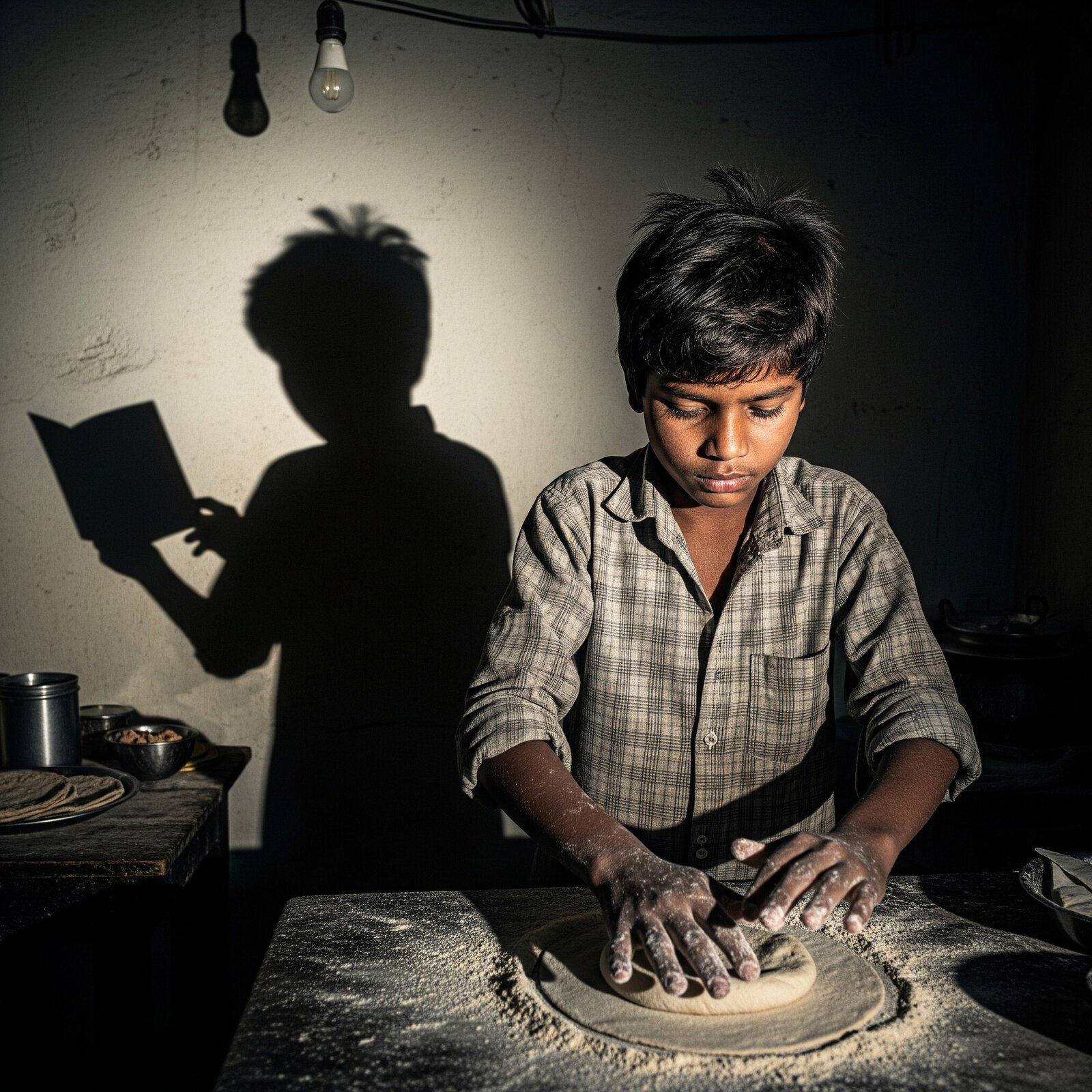
Image generated by a large language model- Gemini AI