Spatial Conceptualisations of Belonging
Sindhu Mathai reflects on understanding ‘belonging’ through spatial formations, after travel by train in Finland
Details
What constitutes the various senses of belonging to a place? A feeling of kinship may arise through a common language, affiliation to a social or religious institution, or a peer group with people of similar age and mutual interests. Could there be other ways in which belonging is created? Social settings provide interesting possibilities to study belonging. Public spaces could be intimidating in their chaos, unwelcome looks, gestures and comments from strangers, or a sense of being overwhelmed in being lost. However, they could also develop calm and repose in a collective and shared sense of movement, such as during travel.
I attempted to conceptualise my experience of belonging in public spaces while travelling in trains and navigating train stations through the coldest part of the year. I tried to interpret this further through narrative inquiry drawing from literature on the production of social spaces.
A trip to Finland last year brought into view snow-clad landscapes, different from my typical experience in India. It also led to curiosity on what might constitute a feeling of connection, even during a brief trip to a foreign country. In my visits to schools in Jyväskylä, I noticed tangible senses of belonging and attention among adolescents in classrooms. There was comfort and trust among children around elders, peers and the larger community. I attempted to conceptualise my experience of belonging in public spaces while travelling in trains and navigating train stations through the coldest part of the year. I tried to interpret this further through narrative inquiry drawing from literature on the production of social spaces.
Narrative inquiry has roots in John Dewey’s (1938) pragmatic philosophy. Narratives selectively emphasise, describe and represent human experience. The “stream of experience” unfolds through space and time. It “stretches” possibilities for generalisation through movement, extending to the realm of the personal, aesthetic and social (Clandinin and Rosiek, 2019). Three short narratives below describe my experience while travelling by train and between train stations in Finland. Each narrative is followed by an interpretation drawing upon spatial relationships.
Narrative One: Familiar sights and smells
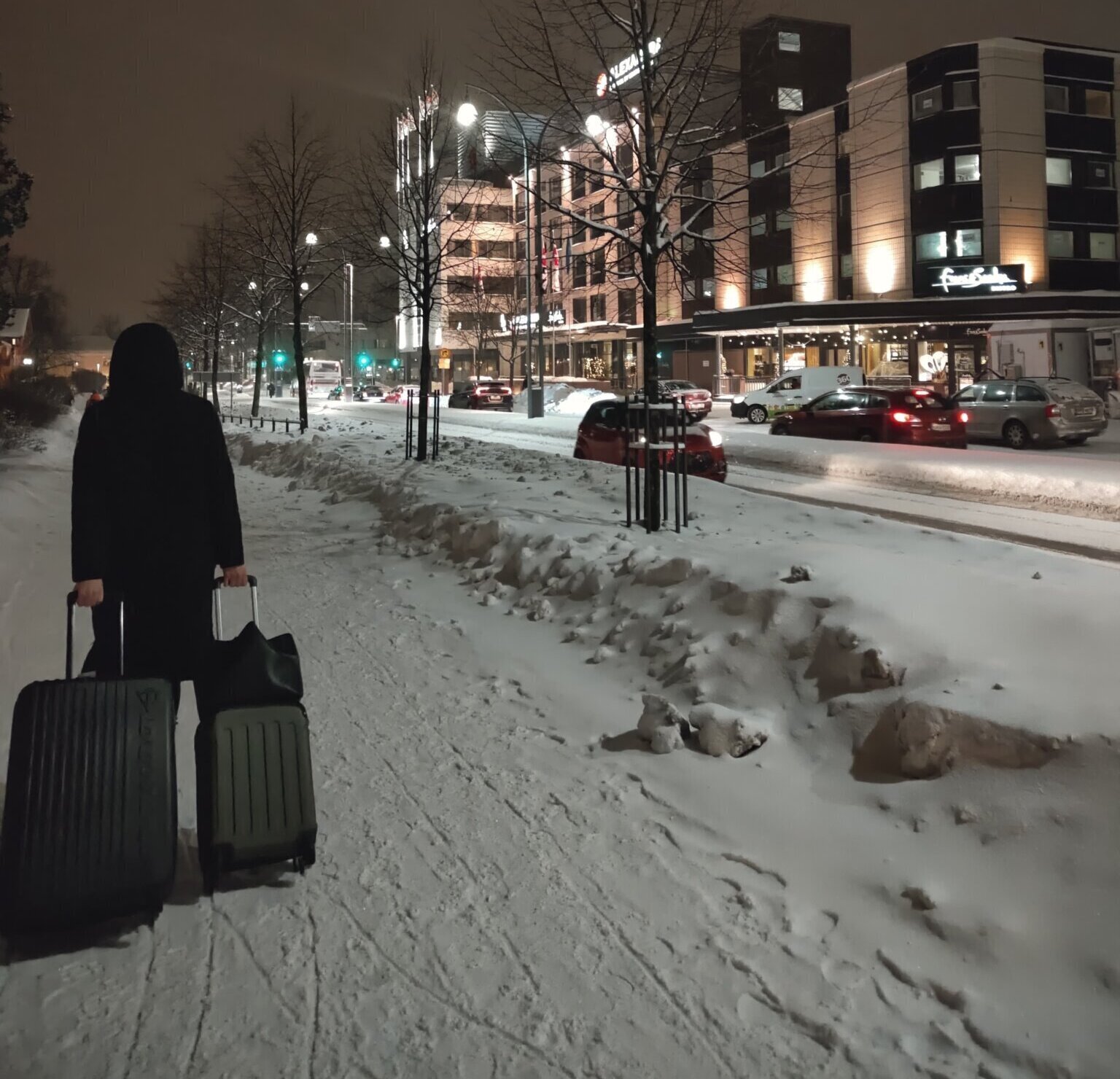
I stepped out of Helsinki airport braving the extreme cold weather (-25 degrees Celsius). A colleague from my host institution, the University of Jyväskylä welcomed me and led me quickly to the train station. Suddenly feeling lighter, I walked briskly. My walking pace is considered to be quick, back home. Here everyone seemed to be walking at my pace or quicker! Glancing through the signs and screens displaying delayed train services (which happened to be the flavour of the season I later realised), another face loomed into prominence. “Could I help with anything?” he asked. Was he trained to watch people’s expressions, offering help when they raised eyebrows, stopped tentatively, or appeared befuddled? While I was thinking through a response, a train whizzed into the station with a sign matching the destination on my ticket and the correct number (Picture 1). I jumped in like I usually do at home while navigating through preferred public transport modes.
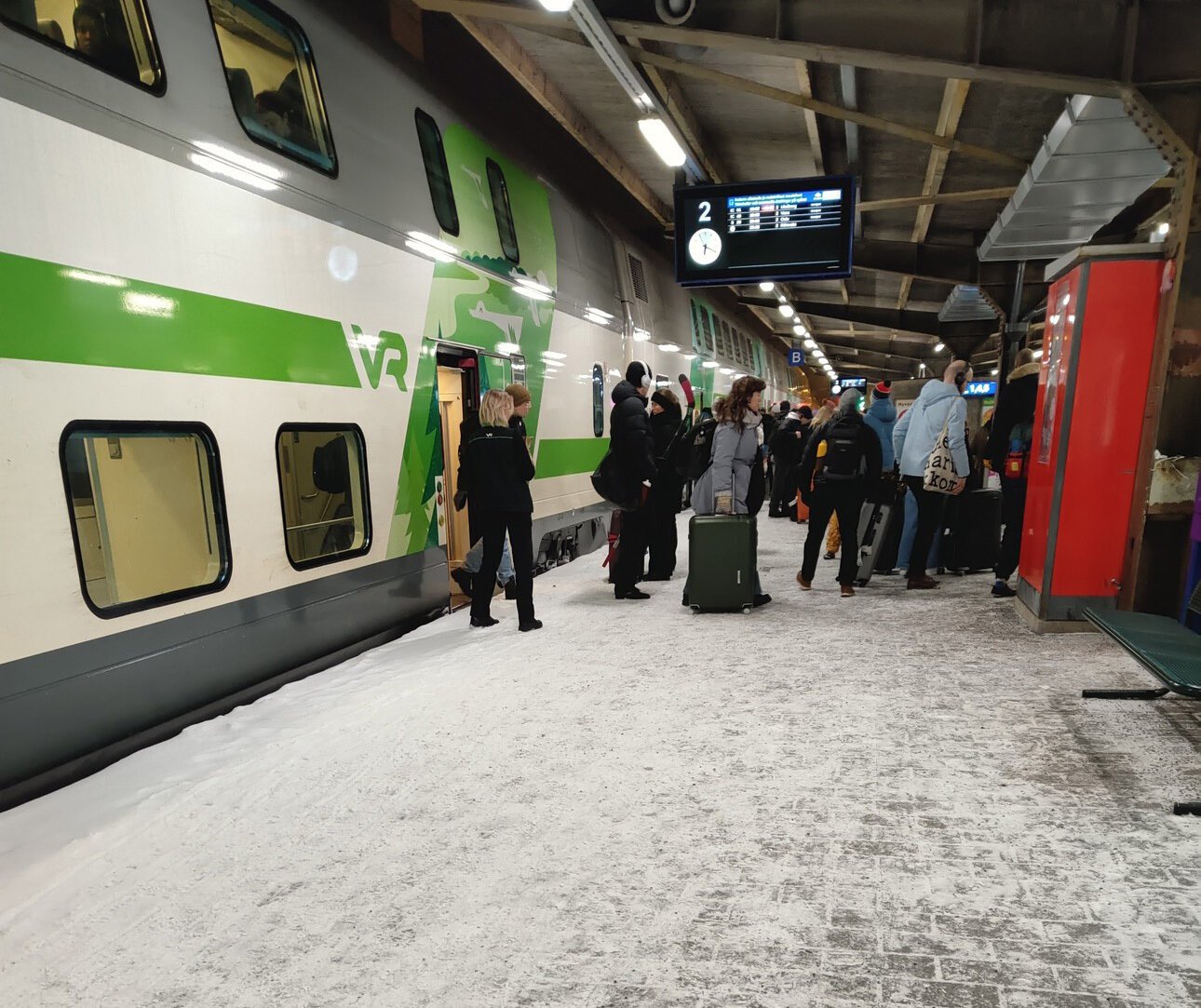
Picture 1: Action-filled, snow-clad train stations
There was gentle chaos inside the train along with a moist chilly wind and a wet floor. I thought it smelt familiar. A more sophisticated Mumbai local train but evoking a similar feeling. I looked around to catch faces nodding, or with looks of recognition. I quickly asked the young woman sitting next to me who also appeared to be a foreigner there about the order of stations. She looked a little alarmed at first and then motioned to the display boards announcing the order. I thanked and looked at her again. “You are travelling alone?” she asked. On enquiring further, she mentioned being a researcher from Japan, visiting here for a project. There was excitement in her eyes when she spoke about studying gender. “Oh, that seems an appropriate area to study in Finland,” I thought aloud. I introduced myself too: a faculty member from India visiting for a research collaboration. She was mildly alarmed and gave me a closer look, quickly relaxing soon after and speaking with wide smiles. My station arrived quickly, and suddenly I felt alone again when I got off. I already missed the friend I seemed to have made, only for a few minutes and will never perhaps see again. We did not think about exchanging numbers or contact information. Perhaps the short encounter was satisfying enough?
Arguments drawing from literature on spatiality present new insights on the multiplicity of spatial transformations when entangled with material contexts. Its spatial moorings are tangible when the memory of a familiar smell, a look of recognition and responsive gestures are evoked. These memories and gestures are knitted with the material contexts of beauty in difficult circumstances, and willingness to create and enter an inter-subjective space. Lefebvre (1991) connects three simultaneous moments of social formation: in thought, practice and creative, poetic acts. Poetic acts within encounters are beyond normative, rule-based stances, bringing to bear a different conception of the ethical (Levinas, 1969). In encounters with strangers, openness in entering an inter-subjective space, even while being aware of inherent difference creates possibilities to transcend it. Levinas calls upon participants in an encounter to be alive to subjectivity and difference in oneself and others with a willingness to develop what is unknown. This could be an explanation for the sense of belonging experienced among strangers in unknown places.
Massey (2005) situates “belonging” in “thrown togetherness” in public spaces, particularly cities, where a sense of the collective develops from a “multiplicity of trajectories”. A train journey might be imagined as a “speeding across on-going stories”; a “meeting up of histories” and not merely a pushing out across space.
Narrative Two: Comfort in public spaces
Getting off at the station with swathes of snow everywhere, I was reminded of landscapes from the film adaptation of ‘Dr. Zhivago’. Next was a walk through snow-filled tracks to the connecting train station. Hopping on to the next train, my eyes fixated on the women sitting nearby: dressed in beautiful warm clothes and looking poised amid chaos. Opposite my seat was a young woman with an infant playing with colourful toys. The baby was successfully receiving the attention he wanted, throwing small tantrums and being playfully dismissive. There was a young man sitting nearby, lost in his mobile phone. I spotted a similar looking athletic teenager, also engrossed in a phone. (Elsewhere, I noticed young fathers taking care of babies and toddlers in public spaces.) The mother quickly began breast feeding her infant who quietened for some time, only to begin another playful tantrum. She seemed perfectly comfortable breastfeeding and so were others around her, I thought. The conductors on the train were extremely friendly. Nearby, an older child and her mother were discussing elegantly. All seemed good inside the train, and I sensed calm in drifting with the graceful crowd. I soon met a friend on the train who was also travelling to the University of Jyväskylä, and we were both received promptly at the Jyväskylä station by our host.
Massey (2005) situates “belonging” in “thrown togetherness” in public spaces, particularly cities, where a sense of the collective develops from a “multiplicity of trajectories”. A train journey might be imagined as a “speeding across on-going stories”; a “meeting up of histories” and not merely a pushing out across space. This was visible in the production of the social, marked by comfort in situations of unease such as the unpredictability of weather and transport availability. The element of choice that is assumed in developing a sense of belonging may well be an important criterion but can be ruptured in moments of collective participation that public spaces create. An unforeseen situation or crisis might therefore lead to collective participation and eventual comfort.
Narrative Three: Fluid and Complex belonging
The journey to Helsinki airport on the way back to India, was similarly marked by cancelled and delayed trains. Being allowed to step on to the next available train, I met a composed woman conductor who was leading everyone inside, cheerfully answering questions. Inside, I was stopped by a small boy whose expression seemed out of a Dickensian novel, asking about seat availability. He struggled with English and was translating from Finnish using his phone. “Which language do you speak,” he asked? “English,” I replied. “But what is your actual language?” he asked, not believing that English could be my home language. “Well, I’m from India,” I said. “We speak many languages.” I answered the questions he partially asked, and he moved away to find an available seat, while I went to find one too. An old lady seated next to me seemed to have emerged from a happy nursery rhyme. She voluntarily translated the announcements delivered in Finnish, and looked at the Jhumpa Lahiri book I was reading with interest. While getting off, I thanked and wished her a safe journey and she wished me back as well.
A sense of comfort in responding to and asking for help from strangers who are visibly different in appearance and dress, language, and disposition calls for a more fluid and complex sense of belonging. Deleuze and Guattari (2013) conceptualise assemblages of animate and inanimate actors through rhizomatic structures which in their chaos typify the belonging experienced when organised structures cannot provide satisfactory explanations. A rhizome is a horizontal (non-hierarchical) assemblage of lines, bulbs, strata and territories. In not having a privileged centre or a given operating logic, any point can be attached to any other point. It is a map “oriented toward an experimentation in contact with the real” allowing for novelty. Delayed trains, stranded commuters, and extreme cold, responded to with quick support and reorganisation of schedules and plans, formed interesting and pragmatic assemblages in difficult conditions.
Concluding thoughts
These narratives and spatial interpretations convey senses of belonging in imperfect situations and contexts — of a community willing to let go of the unpredictable and become comfortable with harsh conditions. The little boy’s questions to a stranger, the infant’s happy tantrums that were encouraged, my confident newly found and lost Japanese friend, the old lady offering to help, and the ever-cheerful train conductors, manifested this spirit. As Youkhana (2015) summarises, these articulate fluid senses of belonging “which entangle social, imagined, and sensual-material relations that are constantly re-articulated and re-negotiated by actors in their day-to-day practices.”
Conventional school classrooms may not foster a sense of belonging, particularly for adolescents, owing to exclusionary practices unresponsive to the unique contexts children bring. Acceptance of social categories alone may become deterministic if unreflectively homogenised. Therefore, understanding spatial formations in public spaces and their implications in school classrooms provide refreshing alternatives. The classroom becomes another extension of the public, with uncertainty around situations, choiceless-ness and strange encounters with structures, particularly for adolescents.
I noticed that these values in public spaces were understood, practiced and spoken about quietly. They emerged in unplanned experiences which were constantly being created in difficult circumstances. Why would we then not expect to sense belonging with schooling? A broader framework of belonging could lead to acceptance, and familiarity with school requirements. In not having to constantly navigate contradictory senses of belonging, children imbibe values and dispositions situated in a larger context of well-being.
References
- Clandinin, D. J., & Rosiek, J. (2019). Mapping a landscape of narrative inquiry. In Journeys in Narrative Inquiry: The Selected Works of D. Jean Clandinin (pp. 228 – 264). London: Routledge. https://doi.org/10.4324/9780429273896 – 15
- Lefebvre, H. (1991). The production of space. Oxford, England: Blackwell.
- Levinas, E. (1969). Totality and Infinity: An Essay on Exteriority (trans. By Lingis, A.) Pittsburgh, PA: Duquesne University Press. (Original work published 1961)
- Youkhana, E. (2015). A Conceptual Shift in Studies of Belonging and the Politics of Belonging. Social Inclusion 3 (4), pp: 10 – 24.
- Deleuze, G., and Guattari, F. (2013). A Thousand Plateaus. London, England: Bloomsbury Academic.
- Massey, D.B. (2005). For Space. London, England: Sage.
About the Author
Sindhu Mathai is an MA in Education faculty member at Azim Premji University. She teaches courses in science education and curriculum studies. Her recent projects are in the areas of informal science learning, graphical literacy, and space-time relationships in the classroom. A couple of blogs on her trip last year to Finland have been written by her and the host institution, the University of Jyväskylä.
Photos Credit: Sindhu Mathai