
Are many Indians Entrepreneurs, because they have to be?
Gopi Sankar G explores forms of entrepreneurship in India
Details
Last year, some of us at the University, in collaboration with the community engagement cell, initiated a research project to examine the entrepreneurship landscape in a few nearby panchayats. However, this essay zooms out and presents a few thoughts on the forms of entrepreneurship that we see, especially in India. Significance of entrepreneurship is well recognised in the academic, practice, and policy worlds.
Entrepreneurship plays an important role in the economic development of a country since it creates employment opportunities and promotes innovation, drives economic growth and provides solutions to some pressing social challenges. Micro, Small, and Medium-sized Enterprises (MSME) form a considerable share of the global entrepreneurial landscape.
The World Bank estimates, based on data from 77 economies, that MSMEs employ about 72% of private sector employees. In some countries, this figure is as high as 78%. It may be useful to note that MSME as a category is vast, with enterprises ranging from having one employee to 250 employees, locations varying from household premises to industrial areas. The first sub-category, Micro, itself is a broad category. Recognising the increasing importance of MSMEs in the global economy, the United Nations has designated 27th June as MSME Day.
In India, like in many other emerging markets, MSMEs form a major contributor to industrial growth and employment generation. Recent estimates suggest that there are 59.3 million registered MSMEs in the country, 98.5% of which would qualify as Micro enterprises. (India’s Ministry of MSME defines this as “an enterprise where the investment in plant and machinery or equipment does not exceed two and a half crore rupees [0.29 million USD] and annual turnover does not exceed ten crore [1 million] rupees”.) MSME-related products accounted for 45.73% of India’s total exports in FY 2023 – 24. According to data released by the Ministry of MSME, employment reported by MSMEs in India rose from 27.30 million in 2020 – 21 to 97.40 million in 2023 – 24. Budgetary outlay of the Union Ministry of MSME during this period went up from INR 5,664.22 crore (USD 661.70 million) to INR 22,138.01 crore (USD 2586.21 million). If a 2024 report1 published by KPMG is anything to go by, India has a vibrant entrepreneurial ecosystem with an increasing democratisation in the entrepreneurial landscape. About 20% of the MSMEs in the country are women-owned, close to 45% of the startups originate from tier II and III cities, and there are more than 1000 incubators facilitating and promoting entrepreneurship.
Entrepreneurs are not merely business owners but are ‘change agents’, who innovate and introduce something new in the economy
In the popular imagination, there is a certain glamour associated with entrepreneurship and entrepreneurs. Joseph Schumpeter defined entrepreneurs as “individuals who exploit market opportunity through technical and/or organizational innovation”. According to him, the process of “creative destruction” drives entrepreneurs. In his conceptualisation, entrepreneurs are not merely business owners but are ‘change agents’, who innovate, who introduce something new in the economy. Entrepreneurs play a transformative role. Other entrepreneurial traits include risk taking, identify opportunities and pounce upon them, think creatively, and gainfully organise various resources. Therefore, entrepreneurship is perceived as something that is not everyone’s cup of tea. The Schumpeterian image of an entrepreneur is that of a passionate, driven, and adventurous individual, most likely a male.
However, there are other entrepreneurs who come across as an absolute contrast to this image. These are individuals who take up entrepreneurship as a source of livelihood, not because of opportunities identified but instead due to the lack of any. The entrepreneurship literature in the past decade or so has recognised the heterogeneity among entrepreneurs, at least as two categories, at a fundamental level – transformational entrepreneurs, “those who aim to create large, vibrant businesses that grow much beyond the scope of an individual’s subsistence needs and provide jobs and income for others” and subsistence entrepreneurs, “those who become entrepreneurs as a means of providing subsistence income” (Schoar 2010)2. Subsistence entrepreneurs dominate the entrepreneurial landscape in emerging markets like India. They start as tiny enterprises and remain so without any substantial growth in size or jobs created, giving employment to the entrepreneur and, at best, potentially to a few family members (often unpaid). Another distinction is in terms of “opportunity” and “necessity” entrepreneurship. There is a large scholarship in the burgeoning entrepreneurship literature3 that refers to these two categories to distinguish motivations to start a business. Opportunity-driven entrepreneurs create businesses when they see a business opportunity, whereas necessity-driven entrepreneurs are forced into starting a business due to the lack of options in the labour market.
Insights from three rounds of Annual Surveys of Unincorporated Sector Enterprises (ASUSE) conducted by the National Sample Survey Office illuminate some of these categories among entrepreneurs. Unincorporated sector enterprises include enterprises in non-agricultural sectors such as manufacturing, trade, and other services, ranging from those that require hardly any skill or capital to more sophisticated ones that require specific skills and significant investment. The three rounds of ASUSE were conducted in consecutive years starting from 2021 – 22.
A few instructive patterns emerge from ASUSE. Over the years, there has been a growth in the estimated number of establishments falling into unincorporated enterprises category. Consistently, a disproportionate share of the establishments is accounted for by Own Account Establishments (OAE), those establishments which have not employed even one hired worker on a regular basis. The share of OAEs among the estimated number of establishments for the years 2021 – 22, 2022 – 23, and 2023 – 24 is 85.93%, 85.08%, and 86.38%, respectively. A similar pattern is reflected in the data at the global level. The latest report of the Global Entrepreneurship Monitor, based on data collected from 51 economies, shows that a large number of entrepreneurs have created jobs for themselves, no one else; this highlights the limiting potential of entrepreneurial activity as a transformative one. The predominant form of ownership among the unincorporated enterprises surveyed under ASUSE is proprietorship. A significantly large share of enterprises, particularly OAEs, are located within household premises. “Other Retail Trade” (read, petty shops) form the greatest number of establishments under any one category, generating more than one-fourth of the total employment in this sector.
According to the ASUSE data, a significant 26 percent of unincorporated establishments in 2023 – 24 are headed by female proprietors. This observation is, perhaps, driven by the manufacturing sector with a share of about 58% female-headed enterprises. Further, intersection of social group-based identity and entrepreneurship makes the Indian context more complex. There is a strong relationship between caste and enterprise ownership. Evidence from the Economic Census suggests that historically marginalised social groups are under-represented in the overall enterprise ownership in India (Rakshit & Basole 2024)4. Among the few entrepreneurs who come from these identities, a disproportionately high share is engaged in enterprises that are subsistence oriented. Insights from ASUSE data vindicates this. Across the three rounds, more than 50% of the establishments are owned by Other Backward Classes while ownership by Scheduled Castes and Scheduled Tribes hovers around 13% and 4%, respectively.
Thus, ASUSE data points to entrepreneurship in the form of tiny business units that mostly provide employment only to the entrepreneurs themselves, headed largely by individuals belonging to marginalised social categories. Given the extent of investment and scale of operations, most of them, if not all, would technically qualify as Micro enterprises. How should one interpret the growing number of such unincorporated establishments? Does it suggest the vibrancy of the entrepreneurial ecosystem seen among startups that facilitate individuals’ accumulation of wealth? Alternatively, is it an indication of growing distress among the poor and marginalised that forces individuals to turn to entrepreneurship for a livelihood?
Insights from my own research on unincorporated enterprises over the past 18 months make me lean towards the latter as a plausible scenario. I have been part of two field-based research projects that studied the motivation and operational details of unincorporated enterprises in a few taluks of Karnataka and Andhra Pradesh. Data from our study suggests patterns consistent with that of ASUSE data. Interestingly, a large majority of our respondents reported lack of other opportunities as the reason for starting business, indicating that they are necessity-driven entrepreneurs.
The existing vibrant entrepreneurial ecosystem in India seems to be elusive for the necessity-driven subsistence entrepreneurs. One should not forget that the number of people engaged in localised concentrations engage in this kind of entrepreneurship. Therefore, it is imperative to design and create support systems that cater to the specific needs of this sector. Systematic studies are required to estimate the resource base and skills, and to identify challenges and support needs of people in this sector. Business activities with growth potential should be identified. Entrepreneurs with transformative potential are to be identified as well. There should be a coordinated effort among various stakeholders including civil society organisations, financial institutions, training institutes, and other state and market players to create a conducive environment for the growth of entrepreneurship. Let this MSME day be an opportunity to start channeling energies towards this end.
References
Rakshit, A., & Basole, A. (2024). Entrepreneurship and marginalised social identities in India. Economic & Political Weekly, 59(13), 40 – 48.
Schoar, A. (2010). The divide between subsistence and transformational entrepreneurship. Innovation policy and the economy, 10(1), 57 – 81.
About the author
Gopi Sankar G teaches at the School of Development, Azim Premji University. Prior to his PhD, Gopi Sankar worked with corporate, non-government and government organisations cumulatively for a decade spending significant time in the social sector. He has also co-founded a not-for-profit organisation, Jeevana Vayo Swasthya Foundation, which aims to facilitate the elderly to lead a quality life with dignity, freedom, and autonomy.
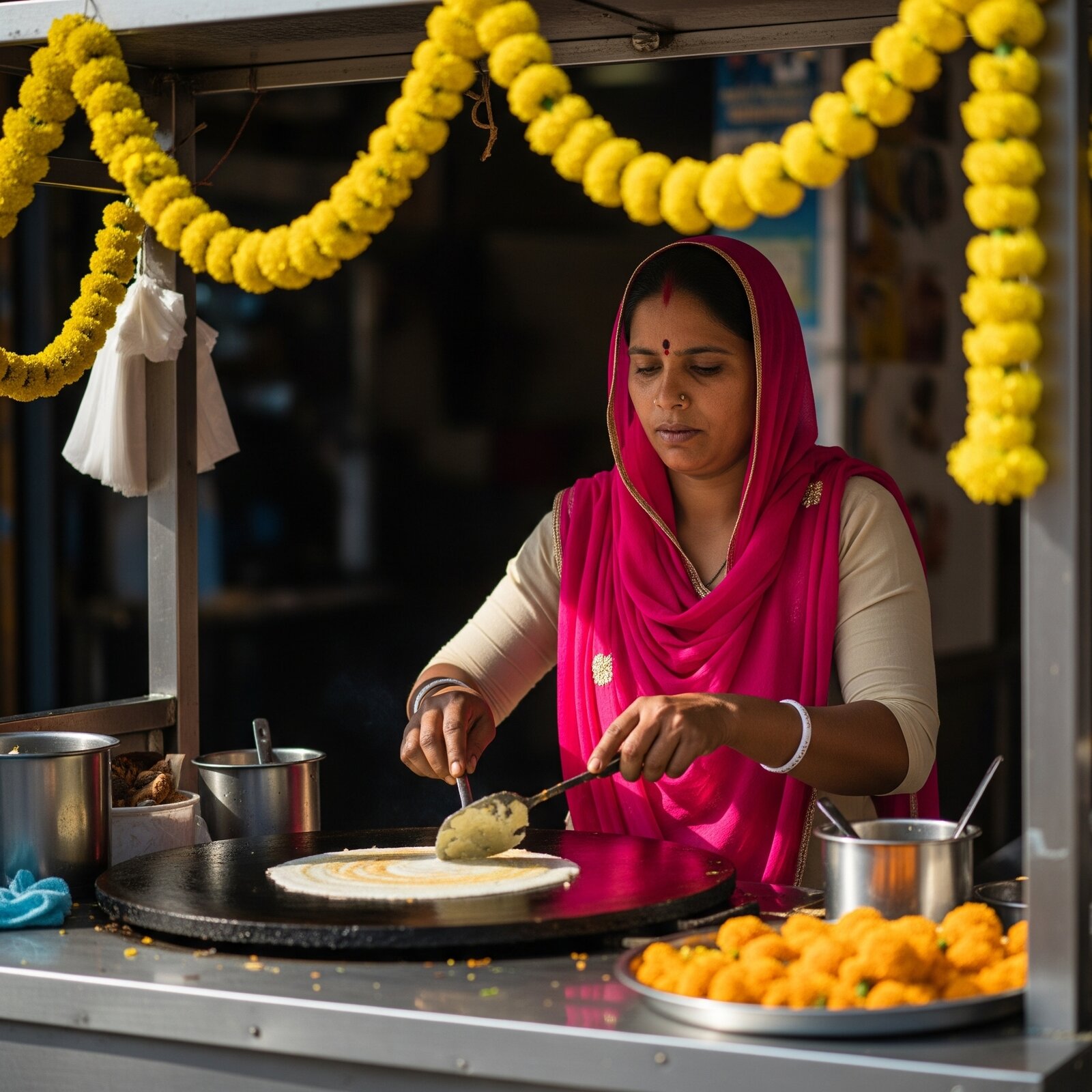
Featured Image: Generated by a large language model- Gemini AI
Schoar, A. (2010). The divide between subsistence and transformational entrepreneurship. Innovation policy and the economy, 10(1), 57-81.↩︎
Schoar, A. (2010). The divide between subsistence and transformational entrepreneurship. Innovation policy and the economy, 10(1), 57-81.
Entrepreneurship is a relatively new field of research compared to the traditional management disciplines. The literature on entrepreneurship has been growing rapidly in multiple directions. One of the streams of research is on themes such as opportunity vs necessity-driven entrepreneurship. This is a recent literature, emerged in the past two decades and is still developing.↩︎
Entrepreneurship is a relatively new field of research compared to the traditional management disciplines. The literature on entrepreneurship has been growing rapidly in multiple directions. One of the streams of research is on themes such as opportunity vs necessity-driven entrepreneurship. This is a recent literature, emerged in the past two decades and is still developing.
Rakshit, A., & Basole, A. (2024). Entrepreneurship and marginalised social identities in India. Economic & Political Weekly, 59(13), 40-48.↩︎
Rakshit, A., & Basole, A. (2024). Entrepreneurship and marginalised social identities in India. Economic & Political Weekly, 59(13), 40-48.