Emerging Perspectives on Teaching and Learning of Mathematics — Implications for Teacher Education
A shared space for mathematics teacher educators to reflect on and discuss the preparation of mathematics teachers today.
Details
About the summer school
Over the past decade, teacher education in India has undergone significant shifts. The National Curriculum Framework for Teacher Education (NCFTE) 2014 highlighted the need to strengthen initial teacher preparation by extending programme duration and deepening the nature of courses offered. It recommended that teacher education programmes include stronger foundations in educational themes, subject knowledge, and subject-specific pedagogy.
More recently, NEP 2020 and the Integrated Teacher Education Programme (ITEP) have further emphasised the importance of strong disciplinary understanding along with the ability to design developmentally appropriate teaching – learning practices that respond to the diverse needs of learners.
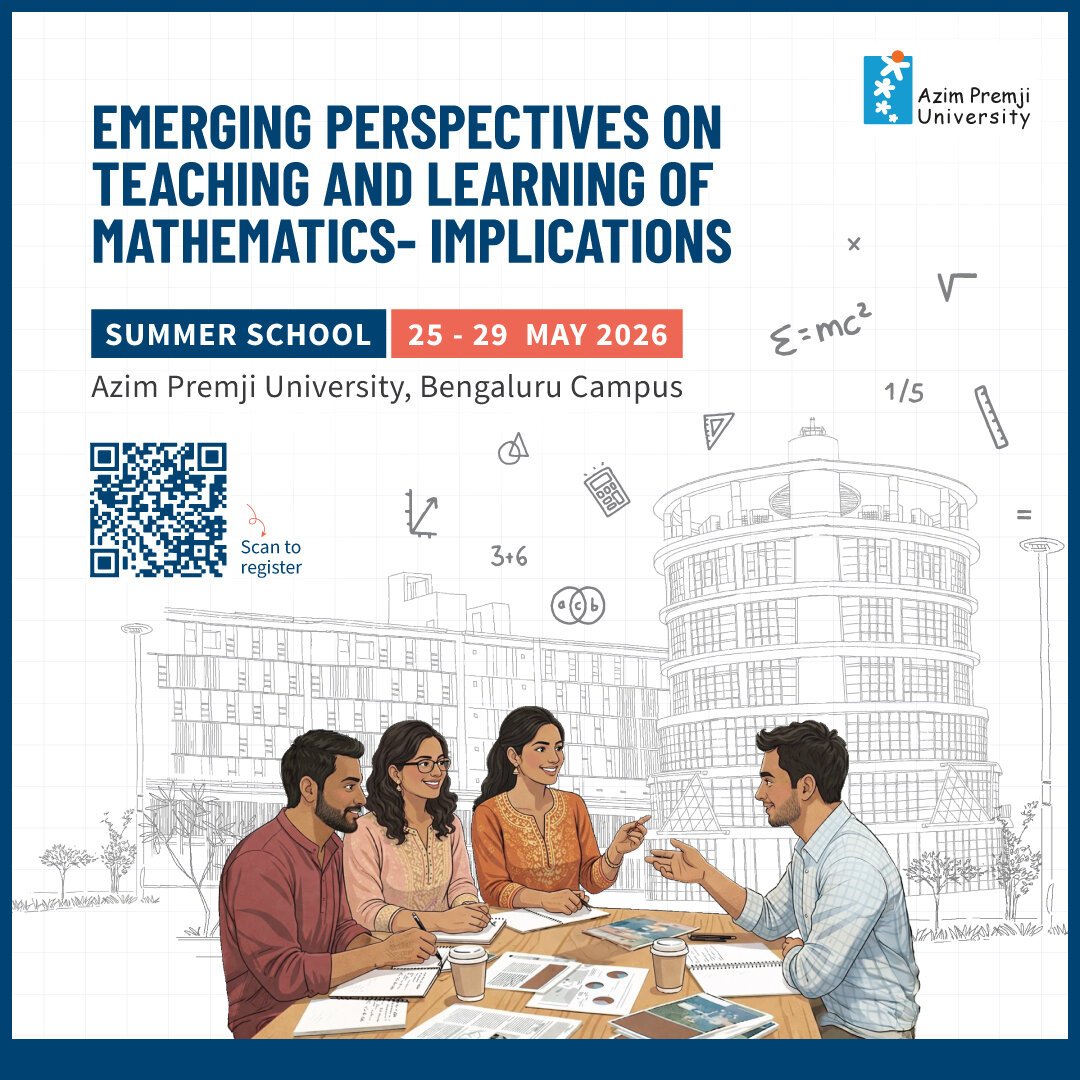
Against this backdrop, the Summer School on Emerging Perspectives on Teaching and Learning of Mathematics aims to create a shared space for mathematics teacher educators to reflect on and discuss the preparation of mathematics teachers today.
The summer school seeks to engage participants in conversations around two central questions:
- Are the existing pedagogy of mathematics courses sufficient to prepare teachers effectively?
- If not, what gaps do we notice and what forms of preparation might better support competent mathematics teaching?
Focus of the programme
The summer school will aim to:
- Create a shared space for deliberation on existing courses and modules in mathematics teacher education and how they support teachers in preparing to teach mathematics.
- Initiate discussions around our evolving understanding of teaching and learning mathematics, and how these ideas should inform teacher preparation.
- Reflect on the implications for mathematics teacher education practices, including course design, field engagement, and professional development.
Participants will also be invited to share their own courses, modules, and experiences of working with pre-service and in-service teachers.
Themes for discussion
The programme will engage with questions such as:
- How do teacher education programmes support teachers in representing and communicating mathematical ideas meaningfully?
- How well do current programmes help teachers make sense of curricular expectations and textbook content?
- How can teachers learn to notice, interpret, and respond to students’ mathematical thinking?
- What kinds of tasks and learning environments support deeper engagement with mathematics?
- How can teacher education programmes support teachers in designing meaningful assessments?
These questions emerge from changing understandings of learning mathematics,from behaviourist approaches to constructivist, social constructivist, and socio-cultural perspectives, which highlight the teacher’s role in mediating mathematical knowledge and creating environments that promote reasoning and mathematical thinking.
Who should participate?
The programme invites:
- Mathematics teacher educators from colleges and universities
- Faculty involved in teacher education programmes with mathematics education focus
- Educators from NGOs and organisations working in mathematics education
- Professionals engaged in mathematics teacher professional development
Participation process
To express interest in participating, please send us a brief note explaining why you would like to join the programme by: 19 April 2026
Participants will be informed of the outcome by: 1 May 2026
Upon confirmation, participants will be requested to share the following materials by 11 May 2026:
- Course documents for Pedagogy of Mathematics / in-service training modules
- Illustrative tasks, assignments, or exercises used in these courses
- A short note on how student-teachers are prepared for practice teaching or internship
- A brief reflection on how effectively the programme prepares mathematics teachers for classroom practice
Logistics
Participants will need to cover the cost of their accommodation (INR 500+tax per day) and breakfast/dinner, which will be arranged on the university campus. Accommodation will be provided in shared rooms (two participants per room). Limited accommodation is available.
The University will support:
- Travel expenses up to 3‑AC train fare (if required)
- Working lunch during the programme
The programme will include contributions from University faculty and external experts in mathematics education.