
New Approaches to Economy and Society
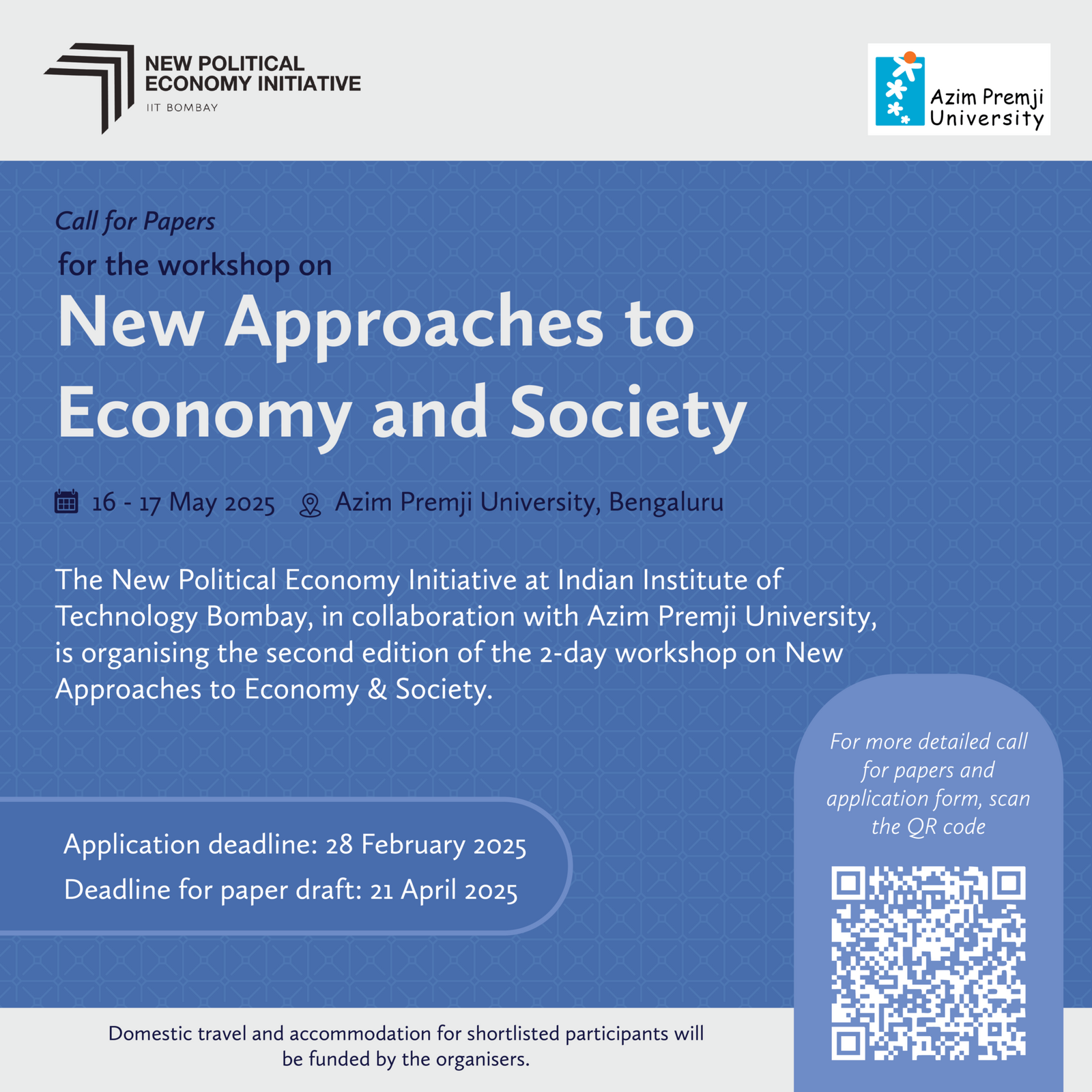
Inviting you to a 2‑day workshop organised by The New Political Economy Initiative at IIT Bombay, in collaboration with Azim Premji University
Details
The Indian economy is understood to have experienced incomplete structural transformation or premature deindustrialisation (Rodrik, 2016) marked by services-led growth and a swelling informal sector (Ghose, 2021; Basole, 2022). Alternatively, it is characterised as formal subsumption to capital (Rao and Vakulabharanam, 2018), the presence of a large need economy (Sanyal, 2014), or an economy dominated by petty and commercial or merchant as opposed to industrial capital (Harriss-White, 2018). Within this larger macroeconomic “given,” caste, gender, religion, ethnicity, etc. are seen to refract the impact of economic change and public policy in economics literature.
In sociology, social change captured through caste studies or village studies often treats the economic landscape as pre-existing or outside the sphere of inquiry. There is little attempt to link the two spheres of analysis in either disciplines i.e., explore the ways in which social relations, themselves dynamic, impact or shape the very contours of the economic landscape at macro, meso, and micro scales. In other words, how do social relations structure economic processes, outcomes, and trajectories?
If caste relations are to be understood as a resource or a network (Mosse, 2018), under what conditions do such networks become heterogenous, and when do they remain hostile to the entry of capital from other jatis, gotras, or kin-groups (Upadhya, 2023)? How do caste relations manifest in and shape contemporary systems of credit? What are the implications of the caste-mapping of capital for the structuring of labour markets and costs? How do these shape procurement and distribution chains? What are the consequences for profitability, entry of capital, and competition? What are the conditions under which the caste- and kinship- nature of capital is growth inducing, and when does it prohibit expansion? What is the sociology of the transformation (or lack thereof) of agrarian capital and merchant capital into industrial capital (Chari, 2004; Damodaran, 2018; Cowan, 2018)? Under what conditions does regional caste-rooted capital transcend or expand its province (Kalaiyarasan and Vijayabaskar, 2021; Benbabaali, 2018)?
What are the implications of our caste-graded sociality on spending decisions? Within the household-enterprise or the business family, social status is a productive resource that requires maintenance and improvement. Decisions of consumption spending are deeply tied to status and cannot be disentangled from investment. What can be said about changing consumption practices across social groups and regions (Aslany, 2020; Khamis et al., 2012)? What does this tell us about saving and investment behaviours? How does religious morality interact with and structure the economy (Rahman, 2022)?
In sociology, social change captured through caste studies or village studies often treats the economic landscape as pre-existing or outside the sphere of inquiry.
Status is equally produced by gender relations in and beyond the household. A sizeable economics literature employs the framework of social reproduction theory to make sense of women’s time-poverty (Mukherjee, 2017), contributions of unpaid work in the reproduction of household labour and enterprise (Rao et al., 2024; Naidu and Ossome, 2016) and female labour force participation in India (Naidu and Rao, 2018). Others like Eswaran et al. (2013) attribute the decline in female labour force participation to caste-based status production. Ethnographic methods have the capacity to yield insights on the processes and mechanisms underlying these economic phenomena (as in Ponniah (2017) and Harriss-White (2003)).
The New Political Economy Initiative at Indian Institute of Technology Bombay, Powai, Mumbai in collaboration with Azim Premji University Bengaluru, is organising a 2‑day workshop on New Approaches to Economy & Society on 16 and 17 May 2025 at Azim Premji University, Bengaluru. This workshop is the second edition of the May 2024 convening that was hosted at and in collaboration with the Indian Institute of Technology Mandi.
For the second edition, we want to bring together mid- to advanced-graduate students and early career scholars whose work speaks to the following themes:
- Caste and product, credit, and labour markets
- Caste and information networks
- Caste and structural transformation
- Business families and business communities
- Status production, caste, and consumption practices
- Religious beliefs and economic structures
- Economic sociology of supply chain
- Gendered production and reproduction of economic life
We are especially interested in submissions that employ ethnographic methods to unpack economic phenomena but are open to works that are primarily quantitative or theoretical. Participants will be paired with respondents who are experienced in the field to provide constructive feedback. Applications that speak most closely to the workshop theme will be given preference and expected to submit a completed workshop draft by 21 April 2025.
How to Apply?
Please submit an extended abstract of 800‑1000 words that details your research question, methods, and preliminary findings through this form.
Domestic travel and accommodation for shortlisted participants will be funded by the organisers.
Important Dates
| 28 February 2025 | Deadline to submit the extended abstract |
| 20 March 2025 | Announcement of shortlisted participants |
| 21 April 2025 | Deadline to submit draft paper for the workshop |
| 16 – 17 May 2025 | Workshop at Azim Premji University, Bengaluru |
Aslany, M. (2020). Contested Capital: Rural Middle Classes in India: Rural Middle Classes in India. Cambridge University Press.
Basole, A. (2022). Structural transformation and employment generation in India: Past performance and the way forward. The Indian Journal of Labour Economics, 65(2), 295 – 320.
Benbabaali, D. (2018). Caste dominance and territory in South India: Understanding Kammas’ socio-spatial mobility. Modern Asian Studies, 52(6), 1938 – 1976.
Chari, S. (2004). Fraternal capital: Peasant-workers, self-made men, and globalization in provincial India. Orient Blackswan.
Cowan, T. (2018). The urban village, agrarian transformation, and rentier capitalism in Gurgaon, India. Antipode, 50(5), 1244 – 1266.
Damodaran, H. (2018). India’s new capitalists: caste, business, and industry in a modern nation. Hachette India.
Eswaran, M., Ramaswami, B., & Wadhwa, W. (2013). Status, caste, and the time allocation of women in rural India. Economic Development and Cultural Change, 61(2), 311 – 333.
Ghose, A. K. (2021). Structural change and development in India. Indian Journal of Human Development, 15(1), 7 – 29.
Harriss-White, B. (2018). Awkward classes and India’s development. Review of Political Economy, 30(3), 355 – 376.
Harriss-White, B. (2003). India working: Essays on society and economy (No. 8). Cambridge University Press.
Kalaiyarasan, A., & Vijayabaskar, M. (2021). Why does the ‘Provincial Propertied Class’ remain provincial? Reading the agrarian question of capital through caste. Urbanisation, 6(1), 16 – 34.
Khamis, M., Prakash, N., & Siddique, Z. (2012). Consumption and social identity: Evidence from India. Journal of Economic Behavior & Organization, 83(3), 353 – 371.
Mosse, D. (2018). Caste and development: Contemporary perspectives on a structure of discrimination and advantage. World development, 110, 422 – 436.
Mukherjee, A. (2017). Three Essays On “Doing Care”, Gender Differences In The Work Day, And Women’s Care Work In The Household. Unpublished doctoral thesis, University of Massachusetts at Amherst.
Naidu, S. C., & Ossome, L. (2016). Social reproduction and the agrarian question of women’s labour in India. Agrarian South: Journal of Political Economy, 5(1), 50 – 76.
Naidu, S. C., & Rao, S. (2018). Reproductive work and female labor force participation in rural India.
Ponniah, U. (2017). Reproducing elite lives: Women in Aggarwal family businesses. South Asia Multidisciplinary Academic Journal, (15).
Rao, S., Ramnarain, S., Naidu, S., Uppal, A., & Mukherjee, A. (2024). Work and social reproduction in rural India: Lessons from time‐use data. Journal of Agrarian Change, 24(3), e12569.
Rao, S., & Vakulabharanam, V. (2018). Migration, crises, and social transformation in India since the 1990s. In C. Menjívar et al. (eds.) Handbook of migration crises, 261 – 278. Oxford University Press.
Rodrik, D. (2016). Premature deindustrialization. Journal of economic growth, 21, 1 – 33.
Sanyal, K. (2014). Rethinking capitalist development: Primitive accumulation, governmentality and post-colonial capitalism. Routledge India.
Rahman, T. (2022). Landscapes of rizq: Mediating worldly and otherworldly in Lahore’s speculative real estate market. Economic Anthropology, Wiley Blackwell, vol. 9(2).
Upadhya, C. (2023). Caste and Capital. In S. Jodhka and J. Naudet (eds.) The Oxford Handbook of Caste, 76 – 90. Oxford University Press.