Biological Invasion and Stakeholder Engagement in India
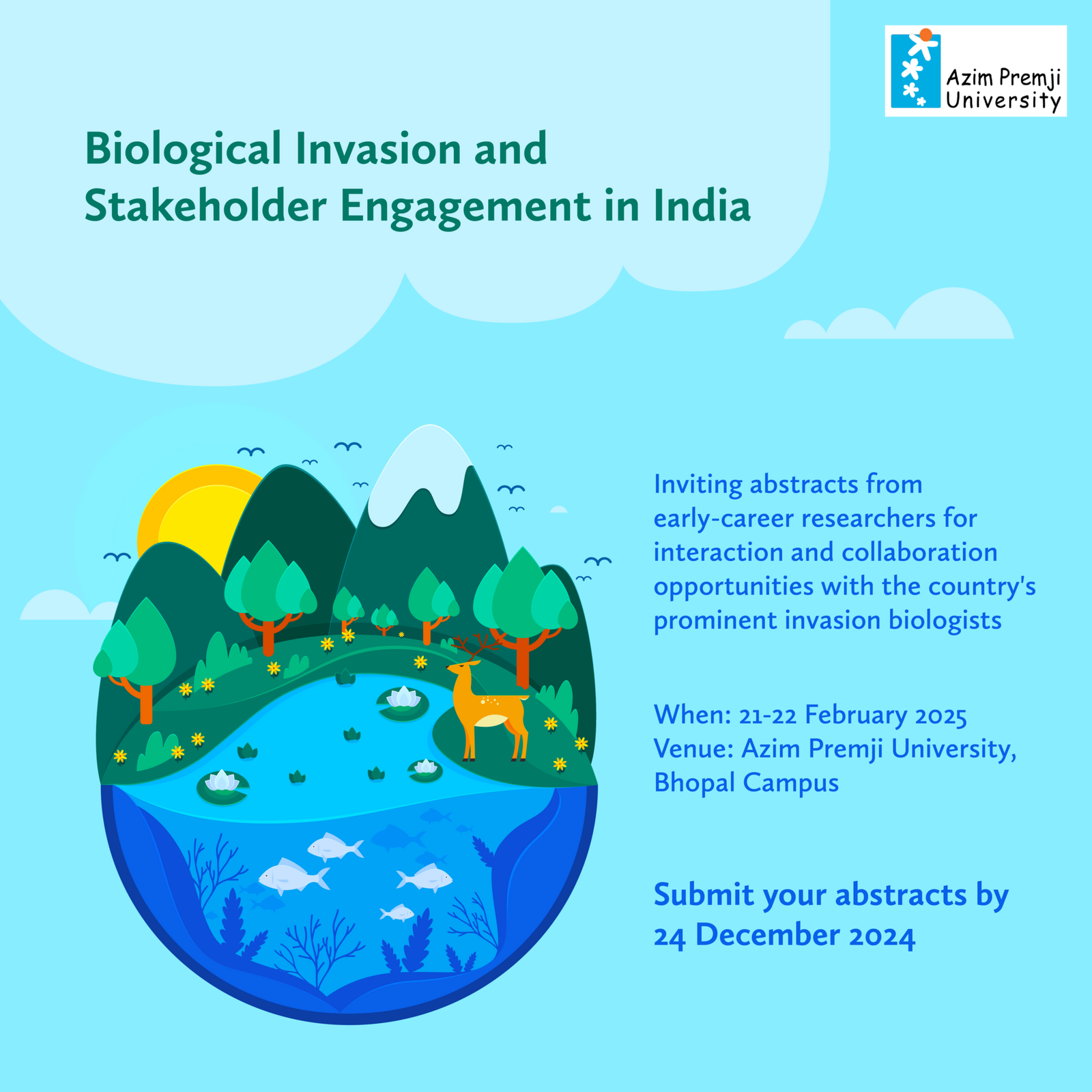
Inviting abstracts from early career researchers for lightning talks, interaction and collaboration opportunities with prominent invasion biologists of the country
Details
Invasive alien species (IAS) represent one of the major environmental challenges for conserving global biodiversity and economic development. Emerging economies, like India, face the greatest threat of biological invasion due to the increasing globalisation of trade and the changing climate. Yet the response capacities of these countries are not adequate to deal with this problem because of knowledge gaps, lack of coordination between stakeholders, and little awareness of the IAS problem.
The forum brings together various stakeholders on a single platform to discuss the pressing issues related to the impacts, knowledge, and management of the IAS in India. In this forum, we will identify and address the gaps in IAS research, education, data, and policy. By fostering collaboration and partnerships within and beyond academia, the forum aims to enhance linkages between science, policy, and practice, and make research more relevant to implementers.
Themes:
- Impacts (Environmental and socio-economic impacts across ecosystems)
- Knowledge (Distribution, pathways, mechanisms, risk assessment, public perception)
- Management (Practices and policies to manage invasion)
- Gaps (Research, policy, data, and how to address them)
Expert presentations: In the conventional style, the invited experts will talk about their research related to the meeting themes. Each session is approximately 30 minutes, including audience questions and discussion.
Lightning talks: Presenters will be provided 5 to 7 minutes to discuss their work. The presentations will be grouped under a particular theme. The speakers will highlight only the pertinent points and facts of their work.
Roundtable discussions: These sessions are designed to allow participants to form groups around the meeting themes and have an open discussion. Each session will be approximately 1−1.5 hours. At the end of each session, groups will share key points and findings with others.
Birds of a Feather: Informal sessions where participants gather and interact with one another based on their common interests. These sessions are arranged during regular session breaks (15−30 minutes) and are intended for building networks and fostering collaboration.
The forum is open to a diverse body of academics, researchers, students (PhD and above), and practitioners from India. To join the meeting, please submit an abstract of your work. Note the following:
- The abstract should respond to the meeting themes.
- Word limit: 300 words
- The abstract must be submitted through the abstract submission form by 24 December 2024.
- Please follow the guidelines mentioned in the submission form.
- Do not send your abstract through email. Please use the abstract submission form.
- Notification of acceptance/rejection for abstracts will be sent no later than 6 January 2025.
- There is no registration fee to join the meeting.
Abstracts related to works on less-studied species and ecosystems are welcome and encouraged. Facilitating dialogues on the diversity of IAS in India is one of the major objectives of this meeting.
Key Dates
Last day for submission of abstracts
Notification of acceptance
- –
Meeting
In case of queries, write to us at invasionbiology.bhopal@apu.edu.in
For more details, please visit the meeting webpage: https://indianforum.wixsite.com/invasionbiology
Organising Committee
- Achyut Kumar Banerjee
- Mansi Mungee