
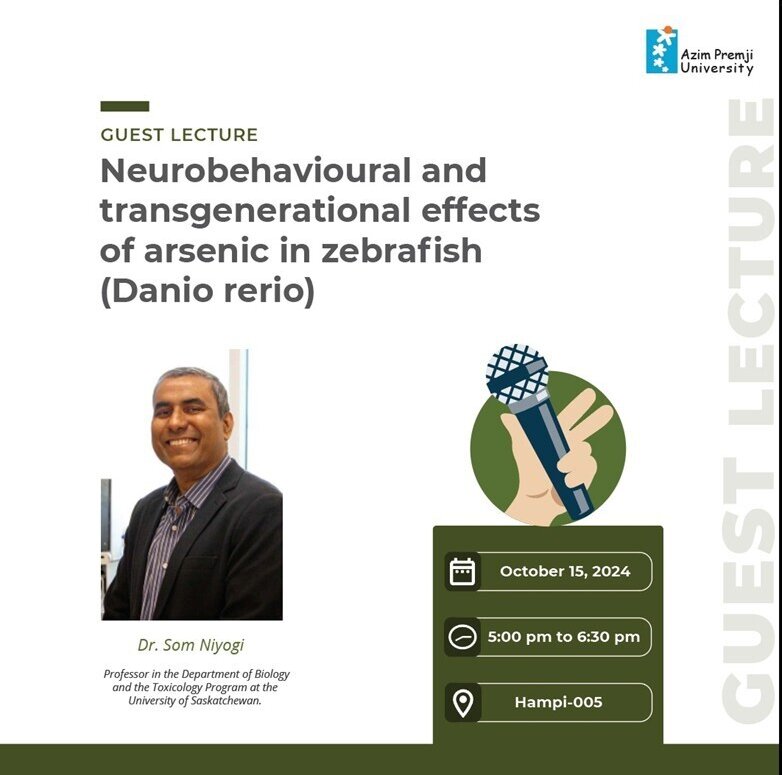
Neurobehavioural and Transgenerational Effects of Arsenic in Zebrafish (Danio rerio)
New insights in the light of Arsenic exposure impacting over 150 million people across more than 70 countries
Details
Arsenic (As) exposure represents a significant global health concern, impacting over 150 million people across more than 70 countries. Although chronic arsenic exposure has been directly implicated in various types of adverse health effects including skin lesions, reproductive failure, cardiovascular and metabolic impairments, and cancer; recent epidemiological evidence suggests arsenic exposure even at a relatively low level can lead to neurobehavioural disorders.
Specifically, arsenic exposure during early life and adulthood has been implicated in cognitive impairments, affecting learning, memory, and intellectual performance. Research in Som Niyogi’s lab focuses on understanding how developmental and chronic exposure to environmentally relevant levels of arsenic impairs neurodevelopment and neural signalling pathways in the brain leading to behavioural disorders, specifically cognitive functions, using zebrafish as a model organism.
Zebrafish have rapidly emerged as a popular model organism for neurobehavioural studies and are increasingly being used to enhance our understanding of the neurobehavioural effects of pharmacological compounds and contaminants. This species exhibits a repertoire of neurobehaviours comparable to humans including cognitive functions and has several brain regions that are functionally similar to the human brain and almost 70% of its genes have human orthologues.
Moreover, their high fecundity and relatively short developmental cycle make zebrafish ideal for examining inter/transgenerational effects of contaminants. Our recent work also demonstrates that arsenic-induced cognitive deficits are inherited across multiple generations in zebrafish via both maternal and paternal lineages, and provides new insights into the epigenetic underpinnings of the transgenerational inheritance of such neurobehavioural disorders.
About the Speaker
Dr. Som Niyogi is a Professor in the Department of Biology and the Toxicology Programme at the University of Saskatchewan. Renowned globally for his pioneering research on the effects of metals on fish physiology and development, he has significantly advanced our understanding of how environmental contaminants induce adverse transgenerational physiological and neuro-behavioural effects through chronic exposure. His laboratory employs zebrafish and cell-culture models to explore these impacts.
Beyond his research, Niyogi is a dedicated educator, having mentored over 40 researchers and nurturing the next generation of scientists in ecotoxicology and ecophysiology.