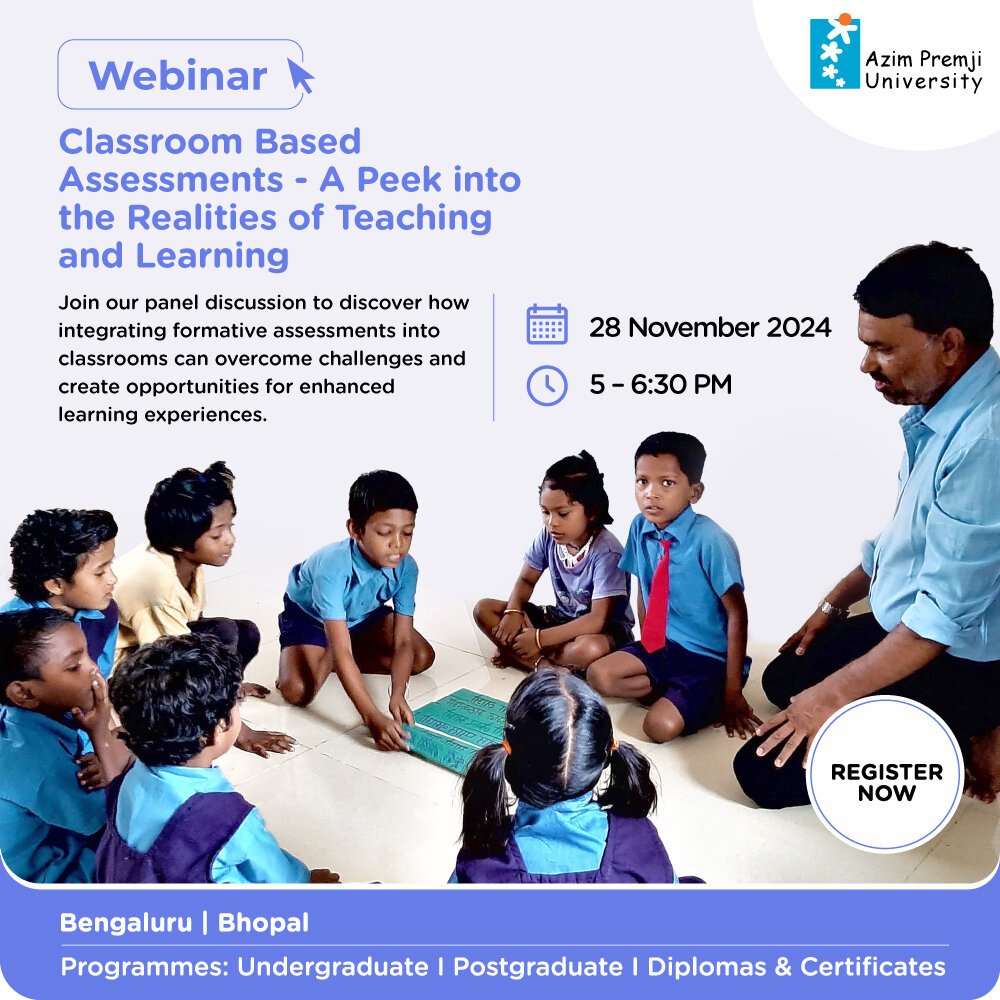
Classroom Based Assessments — A Peek into the Realities of Teaching and Learning
Details
Educational policies over the years have been highlighting the need to move towards more holistic assessments of students to support their learning. . Post Right To Education, 2009 (RTE) the Continuous and Comprehensive Evaluation (CCE) programme was conceptualized to formulate a holistic understanding of student learning and development through a comprehensive assessment of their progress. Most recently the NEP 2020 highlights the need to move towards competency based assessments and reiterates that the primary purpose of assessment will indeed be for learning.
Classrooms being a very dynamic space, how do we view assessments for learning in such a context? Over the years how has our understanding about formative assessments or assessment for learning evolved? How relevant is it to integrate assessments as part of your daily teaching-learning processes? As a teacher how do you balance the responsibility of teaching and assessments in your day-to-day practice? What are certain tools and processes in place to meaningfully undertake assessment for learning?
Join us for a panel discussion wherein educational practitioners from across the country try to unpack these critical questions. The discussions will provide an insight into the theory and practice of formative assessments from a practitioner’s perspective in the context of actual classroom scenarios.
Panellists:
1. Ajay Cadambi- Educator & Exams Officer, Head Start Educational Academy, Bangalore
Ajay is a high school History teacher passionate about creating student-centred learning experiences that connect to students’ lives. With over a decade of teaching experience, he believes that historical thinking must form the bedrock of all inquiry in the classroom and that teaching history must go beyond memorising dates and events. Analysis, source criticism and perspective building must be the focus of all efforts. Given that most historical thinking is complex, he emphasises formative assessment as the cornerstone of his pedagogy so that learners grow in response to their everyday engagement in the classroom and beyond. Through reflective discussions and tailored feedback, he encourages students to think critically, ask questions and build on their understanding over time by taking ownership of their own learning. Ultimately, he hopes that students will develop an appreciation for the historical method. He is currently enrolled in the Post Graduate Diploma in Education — Educational Assessment at Azim Premji University, Bangalore.
2. Amit Mishra- Principal, Azim Premji School, Uttarkashi
Amit is presently working as Principal, Azim Premji School Uttarkashi. He has completed his BA-Hons. from BHU and MA from Hindu College, Delhi University. He also holds a PGDM in translation. Amit has teaching experience in Hindi language and literature and has also been involved in translation work of multiple policy documents. He has been working in multiple areas related to language teaching and assessments.
3. Anuradha Joshi- Principal, Sardar Patel Vidyalaya, Delhi
With over three decades of experience in building and transforming educational institutions, Ms. Joshi brings a wealth of knowledge and a proven track record in driving change within the education sector. Her career includes direct teaching of over 5,000 students in diverse geographies and leadership roles in institutions that have shaped the lives of more than 50,000 learners, many of whom have become leaders in academia, science and technology, administration, media, business, and entertainment worldwide. She was recognized by the Directorate of Education, Govt. of Delhi for excellence in education of the Vidyalaya for the years 2014, 2015, and 2016. She has served as a nominated member in the Governing Council of NCERT as well as the Governing Board of New Delhi Municipal Council schools. She was part of the committee that developed the middle school science syllabus for CBSE’s international curriculum and has also worked in an advisory capacity for “SHUNYA”: the environment curriculum for CBSE
4. Shilpi Banerjee- Faculty, Azim Premji University
Shilpi has been working with the University since 2017. She has a PhD in Educational Assessment from International Institute of Information Technology, Bangalore. Prior to that, she attended Nagpur University for a Bachelor’s degree in Electronics Engineering and Maulana Azad National Institute of Technology, Bhopal for MTech in Digital Communication. Her current research interests include development of feasible quality assessment prototypes for formative purposes, assessment design and statistical evaluation of large-scale assessment data. She is also involved in designing and offering courses in various aspects of assessment to teacher educators, education functionaries, practitioners, and MA Education students. She is part of various technical committees set up by state and national boards to strengthen the design of board examination and classroom assessments.
Moderator
Anupama Raj- Faculty, Azim Premji University