The Great Outdoors: What it’s Like to Manage the Campus Greenery
Victor Raj, who is in charge of campus landscaping, reveals the thought, planning and collaboration that is going into what the Azim Premji University looks and feels like today.
Details
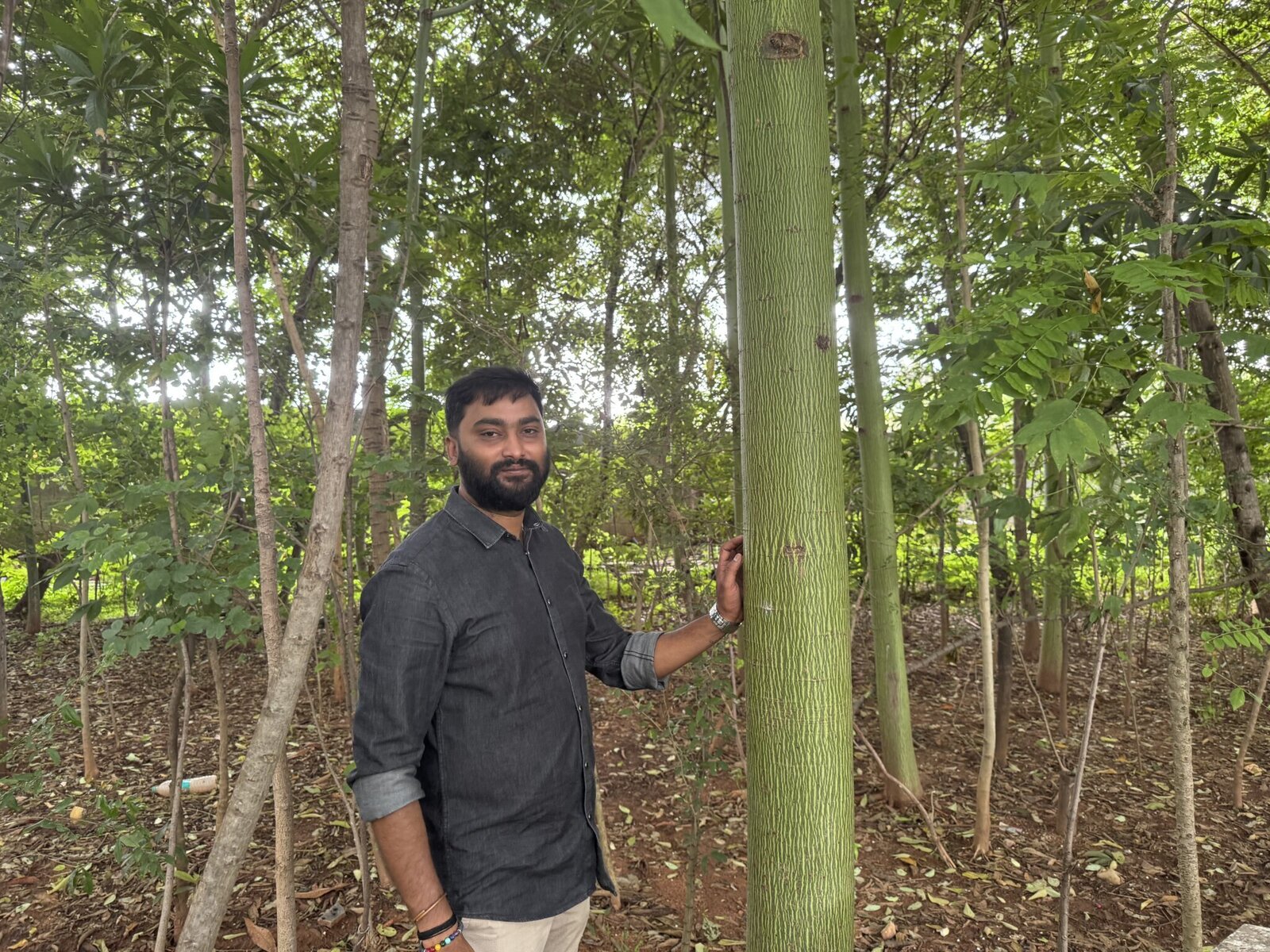
Walking around the university campus with Victor Raj is an exhilarating experience for any nature lover. He nonchalantly makes sharp observations and offers trivia about what he is seeing along the way.
At one spot near the library building, he points at an Indian siris tree and says, “The seeds of this tree blew its seeds outside the cricket ground and now its babies have started growing there.” As we walk around the amphitheatre, he waves over Balamurugan, the proprietor of a partner horticulture company, and the two have a quickfire discussion in Tamil on the best trees to plant along the amphitheatre perimeter. “We need a canopy,” insists Victor. “Let’s put oovarasu trees (Thespesia populnea) in the front and bauhinia in the back. Oh, and what happened to the 200 multiplex bamboos that have been ordered?” Truly, Victor seems to know everything about every square foot of open earth inside the Azim Premji University campus in Sarjapura, Bengaluru.
How it began
Interestingly, when Victor joined Azim Premji University’s facilities team in 2012, he did not have even a faint intention to establish himself as the resident horticulturist. “I didn’t know anything about trees or species — zero knowledge,” he says. It was only when he visited his wife’s home in Munnar, Kerala, that the BCom graduate began to envision a more ecologically vibrant atmosphere for his workplace.
It started with minor projects such as deciding what fruit trees to plant in which patch. At the time, the undergraduates lived and studied in a small rented campus in Sompura. “On one side was the hostel and on the other side, the academic building. We wanted a barricade separating the two, but without civil work,” he described. Eventually, Victor was able to plant passion fruit plant creepers with the scaffolding support of a pillar. “So whenever it bloomed, there would be purple flowers all over.”
That was, in a sense, his origin story. Since then, he has been actively educating himself by consulting horticulture experts, ecologists on campus, visiting nurseries, learning species names and conducting little experiments. Noting his growing interest in landscaping, his supervisor made things official. “When we moved to the new campus, he told me to take care of the entire landscaping.” As of September 2025, Victor had completed the landscaping of cluster one, which included the academic section of the university, and moved on to cluster two. His mission was to plant almost 3,500 trees, some shrubs and minimal ground cover.
When landscaping a college campus, there are several factors to consider. “There must be good shade, and we want to avoid too much shedding of leaves and fruits to ensure ease of maintenance,” says Victor. Apart from this, he takes feedback from the members of the campus to try and strike the almost elusive balance between aesthetics, utility, practicality and biodiversity.
Organic over chemical
One thing he is unwilling to compromise on, however, is the thumb rule to avoid pesticides. “From day 1, we have only used biopesticide—for example, a mixture of neem oil with water and some kind of a soap (to dilute the oil) is sprayed on the trees and shrubs to keep insects away,” he elaborated.
And for the soil, the team relies on organic manure over any chemical fertilisers. “When we first did landscaping, there was a lot of mortality [of trees]. This was because they had just added a couple of feet of red soil over debris before planting trees,” says Victor. To replenish the earth, his team had to use manure collected from the organic waste converter mixed with coffee bean waste, and treat the soil every six months.
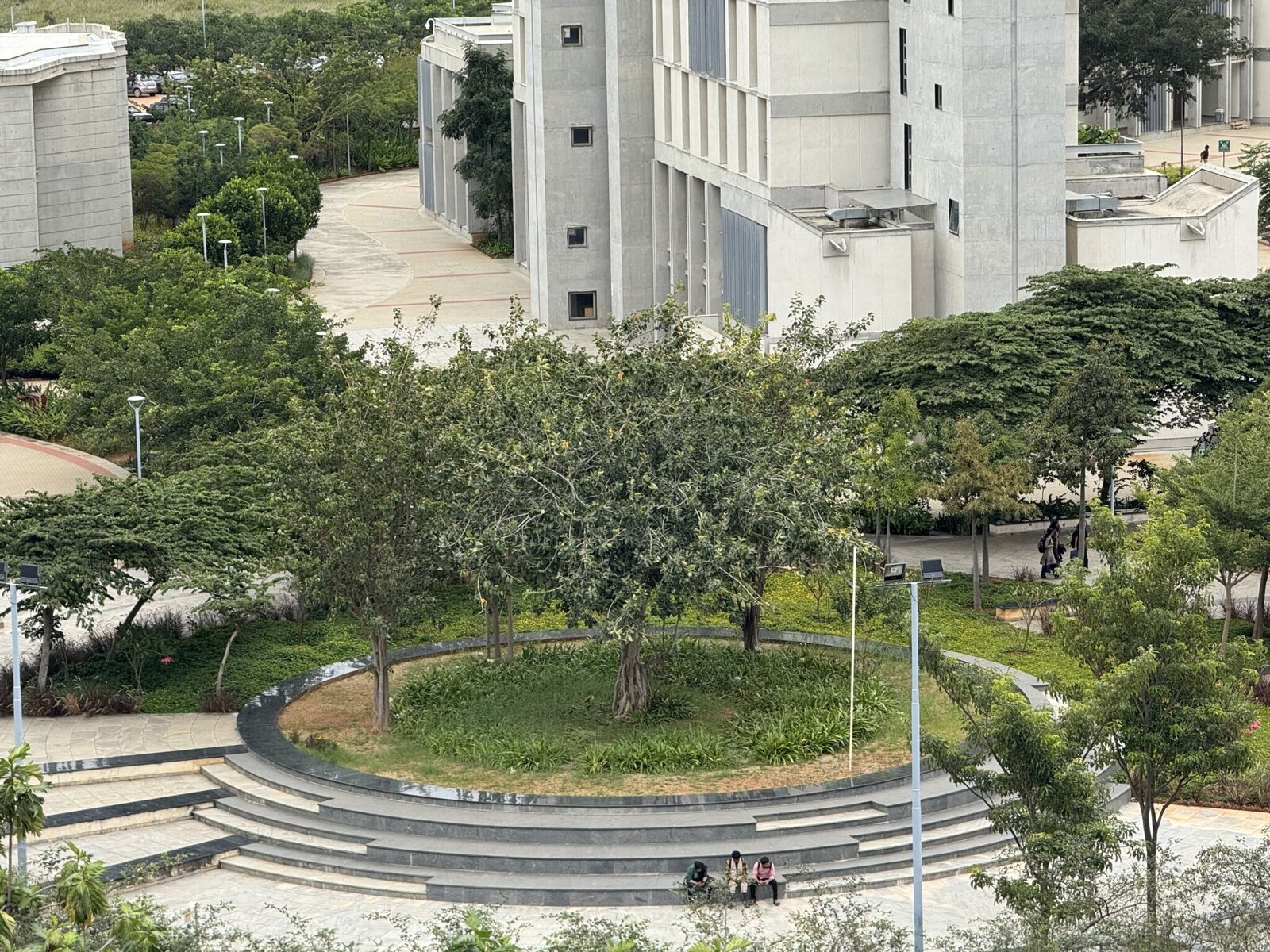
As we passed the central plaza of the campus — the ever bustling “Kabira” as it has been named — Victor pointed out that the star of the show, a banyan tree at its apex, was transplanted from Yasmeen Premji’s home. “When we transplanted it during the peak summer of 2021, it didn’t have a single leaf,” he says.
Shifting adult trees to new locations is no mean feat. If the root system isn’t preserved effectively, it’s common for the extracted tree to die from stress before it can establish itself in its new home. But this is something Victor is very serious about. Once, he was informed that a group of trees needed to be cleared to allow for an approach road to the school on campus. “I said to them: No uprooting! We will transplant instead.”
The process of transplantation is meticulous: “We first dig out the tree. Then we cover it with a gunny bag and treat it with some medicines so that the roots do not start rotting. Within 10 days, new roots start developing.” Only then, do they move the tree to the new location. This waiting period is critical, stresses Victor, ruefully recollecting the time that a guava tree died after being transplanted immediately without his knowledge. The team has transplanted about 40 trees so far, the survival rate has been nearly 100 percent, even with tricky species such as neem (Azadirachta indica) and Indian cork tree (Millingtonia hortensis).
Fruity business
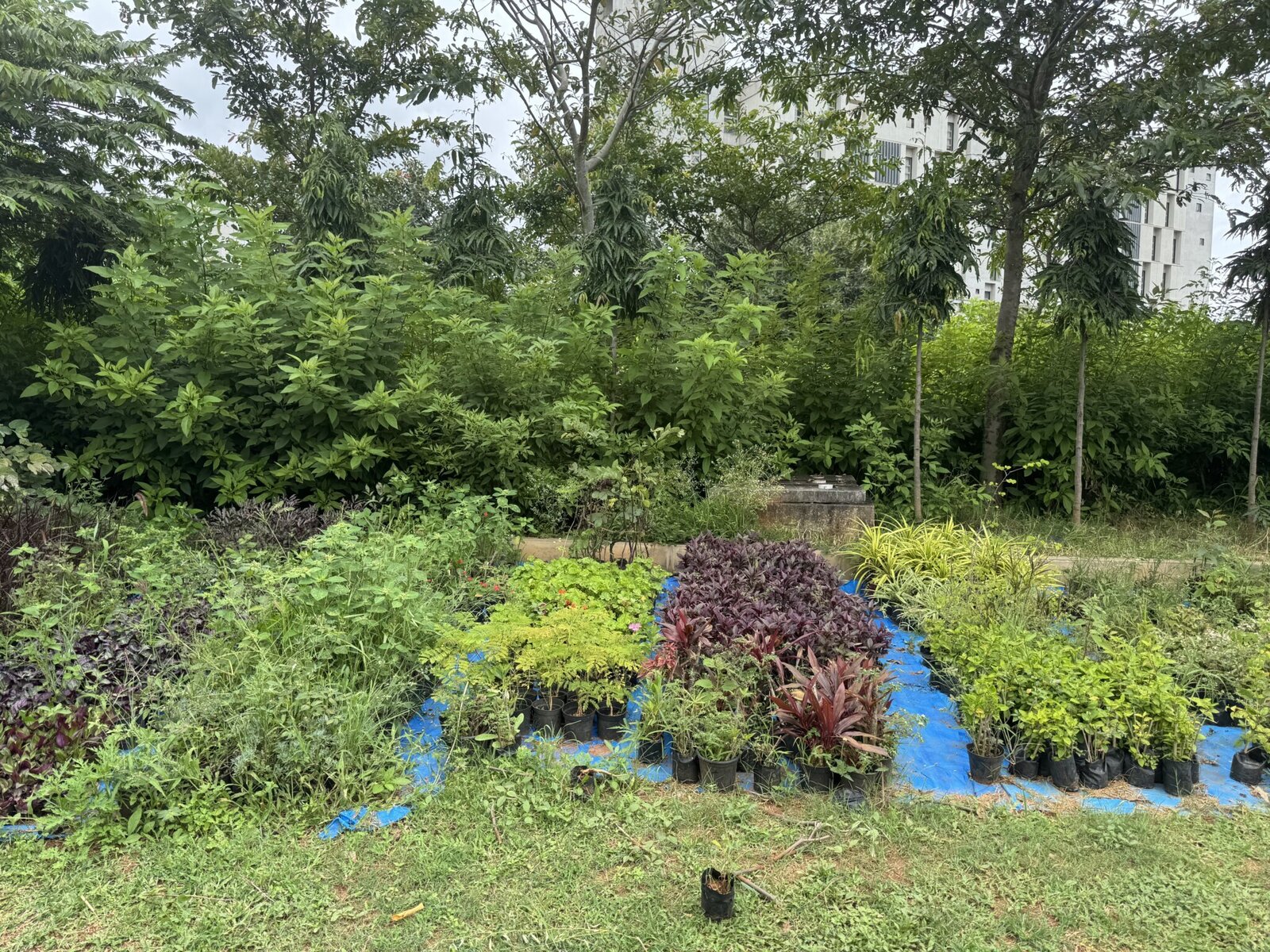
As we strode along the ‘Surpur’ building, mango, guava and pomegranate tree saplings gently swayed in the breeze. “We have planted these so that the school children in the building can eat the fruits,” he explained. Fruit trees aren’t a priority for most landscapers, owing to the mess rotting fruits can create and the animal life they attract, but Victor has a soft spot for them. The keen observer might notice an ash gourd vine creeping near the student hostels, or a turmeric plant tucked into another corner of the campus. Once, on her way to a meeting, Harini Nagendra, an ecologist who has been a part of the university since its earliest days, was surprised to spot sugarcane stalks! When she asked Victor about it, she discovered he had planted it after finding discarded sugarcane tossed aside in a corner. Why waste it was Victor’s response.
According to Victor, the campus has almost 50 to 60 fruit varieties from different parts of India. A significant chunk of these grow in a buffer zone on campus. The buffer zone has been unofficially dubbed “Victor’s garden”. The occasional bounty is announced to all members via email: “Organic and pesticide-free sweet potatoes/breadfruit/sugarcane to satisfy your health and taste buds! We have been working in the buffer zone to grow this for the past six months. The money collected will be used for buying seeds to grow more vegetables in the buffer zone.”
Being a landscaper also means continuously responding to feedback from the campus community. He says, “When we prune the taller shrubs regularly, some people question us without realising that there are reasons.” What kind of reasons? The shrubs can be thorny and while able-bodied people can easily manoeuvre past, the path can hurt people who are blind. This is something Victor has become sensitive to, thanks to the inputs by the inclusion team on campus.
Landscape becomes lab
The ecologists on campus too have an important role to play. Ovee Thorat, who teaches biology at the university, brought up the recent case of a spike in allergic skin reactions among students and members. At first, the suspicion fell on the grasses that grew wildly around the auditoriums, but later it emerged that it was the aromatic and deceptively beautiful spider lilies that were to blame. “Students would stop to admire these flowers without knowing they release an inflammation-causing sap when handled,” Ovee said. Realising that this was also making it challenging for the gardeners to manage these plants, it was decided to remove these plants lining the pathways and replace them with marigold, henna and jasmine plants instead.

Even as I was starting to feel tired from our walk in the noon sun, I sheepishly noted that Victor looked as fresh as ever. “I normally walk about 18,000 to 20,000 steps a day,” he said, as he showed me the way to a terrace where a specialised digital camera had been installed recently. Facing the university’s lush teak forest, this phenocam is poised to capture a shot of the foliage every noon. Eventually, these time-lapse images will be used to generate a near-continuous visual record of canopy changes and environmental conditions. “We will be able to see how the patch looks during summer, monsoons and finally the leaves shedding during winter,” he explains.
With time, and maybe a few more phenocams, climate scientists on campus will be able to make important calculations such as how much carbon the entire area is sucking in. “This is how landscaping is helping climate scientists capture data,” said Victor, as he surveyed the teak forest below.
Harini Nagendra also has some potential research ideas involving the campus greenery. She noted that there are a few clumps of trees of similar species — such as the tamarind grove — which may be benefiting from mycelial networks. Recent studies have suggested that these underground, root-like networks of fungi connecting trees may enable them to communicate and enhance the communication and cooperation between them in stressful conditions. “This is an interesting test case! In five or six years, we can measure if this is happening,” she said. Besides this, the campus has been the site of a number of arachnid and insect behaviour studies, too.
A road to a sustainable campus
There is still some way to go before any campus gets the balance of greens just right. Divya Uma, who teaches biology at the university, points out that there are more stretches of monoculture and ornamental plantation than is ideal for a sustainable campus. “Plants such as the Acalypha bushes and spider lilies are not native so they won’t attract insects or birds. In contrast, butterflies love the lemon patch near the Darshini cafeteria!”
“It’s been hard because it comes down to what is practical, what is possible,” she sums up.
“You can read about the fig-wasp interaction in textbooks and see it on videos online, but here students can see it on campus. Walking up to the fig trees around here and observing the wasps has become a part of the routine for us. The landscape becomes the classroom.”
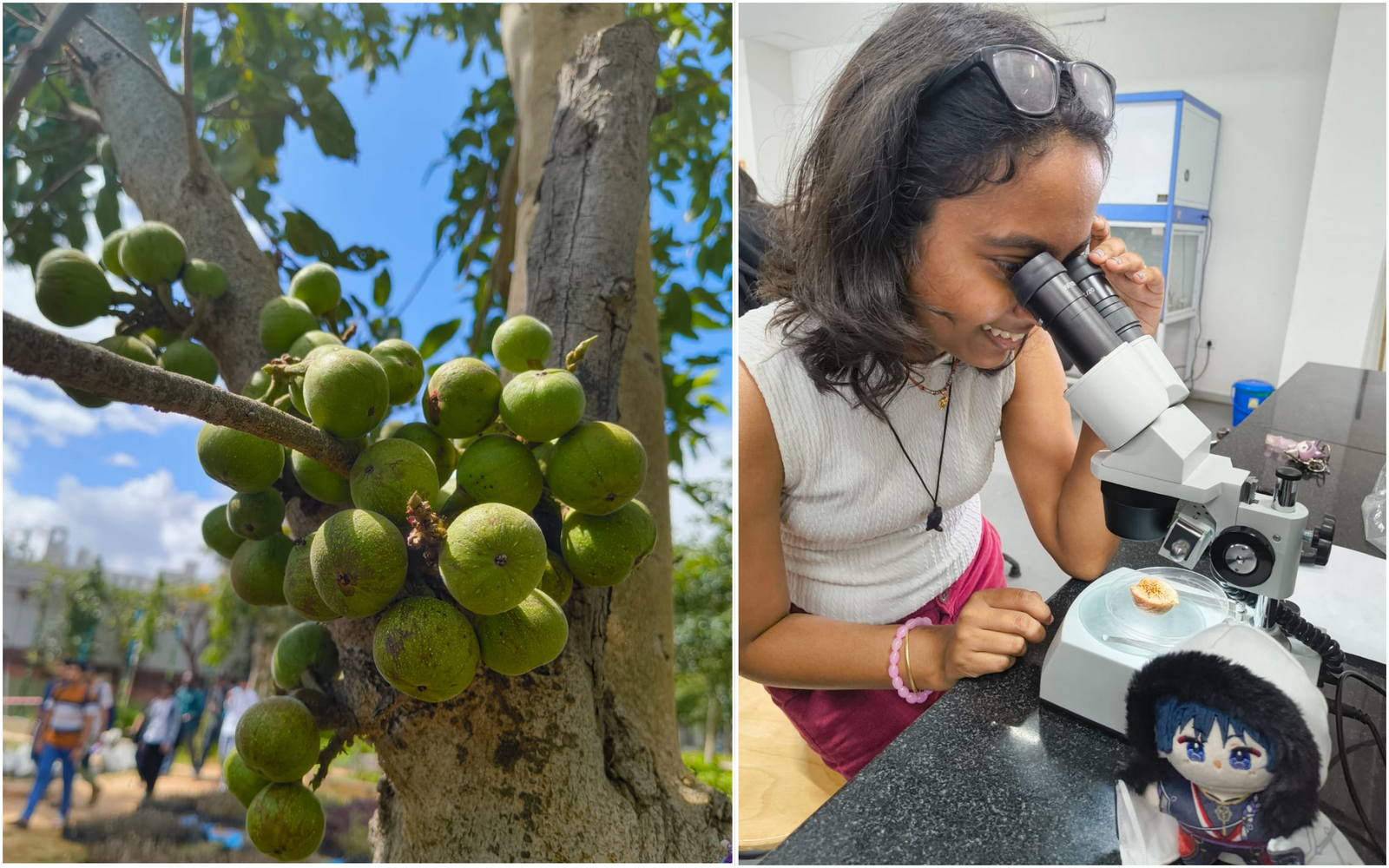
In July 2025, Ramchandar K, Principal, Azim Premji School, Bengaluru took 24 of his Grade IV students on a bird walk around campus. Victor joined them and together the group was able to identify 22 bird species. Ovee too routinely uses the trees as a teaching tool for her undergraduates. The fig trees, in particular. “You can read about the fig-wasp interaction in textbooks and see it on videos online, but here students can see it on campus. Walking up to the fig trees around here and observing the wasps has become a part of the routine for us. The landscape becomes the classroom.”
Witnessing the campus he helped green buzzing with animal life gives him a lot of satisfaction. “We don’t see this just as a landscaping job,” he remarks. “We see this as a home to other animals, a place with many interconnections.”
About the author
Nandita Jayaraj is a Science writer and Communications Consultant at Azim Premji University.