
Wild about Verse
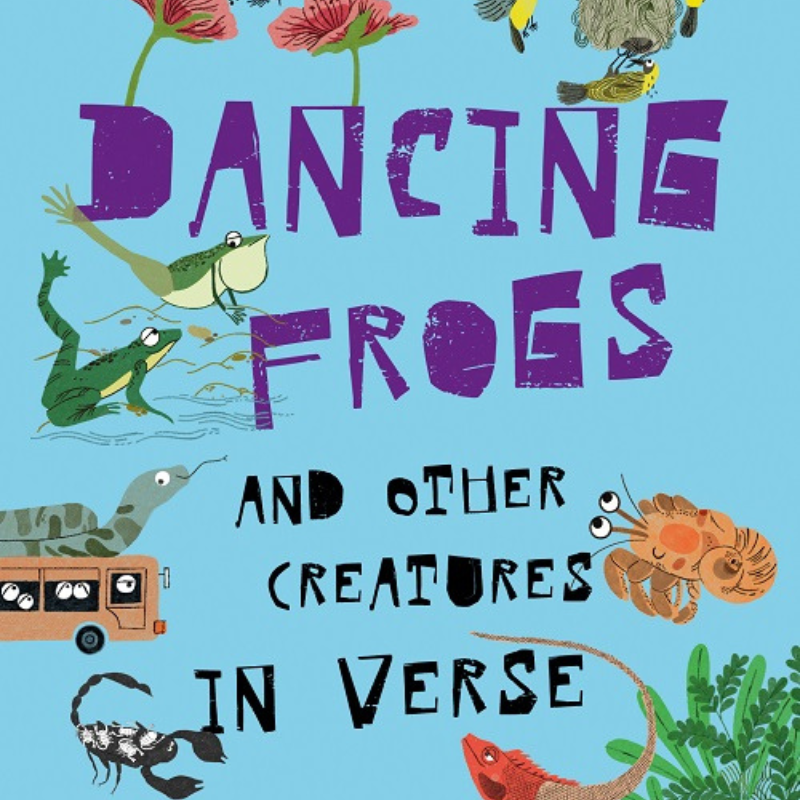
Book Title: Dancing Frogs and Other Creatures in Verse
Author: Zai Whitaker
Illustrator: Bhargavi Rudraraju
Publisher: Talking Cub (paperback, ₹399)
Reviewed by: Suchi Govindarajan
Details
In poetic literature for adults, rhymes are no longer a requirement. Or, to put it more accurately, direct rhymes are no longer a requirement. We still need slant rhymes, internal rhythms, alliteration and all the devices that make poetry so distinct from prose. But there is a reason that rhyming poetry lives on in children’s books. Sound patterns help children learn, understand and remember. As a child, I recall being very taken in by the musicality that a good rhyme could produce. Learning by rote was a chore, but when there were rhymes, or indeed any sort of rhythm, it became a fun activity. When the teacher read out the maths tables to a chanting pattern, they too became easier to repeat and remember. This is borne out by research as well. As writer and educationalist Mem Fox puts it succinctly in her book, Reading Magic, “Rhymers will be readers; it’s that simple”.
But for writers, rhymes can be difficult to compose, or rather, compose well. They force you to focus a little too much on how a line ends, rather than what it says. With word-choice too, you must balance meaning with sound. The secret, I believe, is to not take yourself or the task of poetry too seriously. And this is where Zai Whitaker excels.
The first poem about beetles has a fun “WOWEE” (yes, in all caps!) right in the middle of the line, just to adjust for sentence length. And everywhere, her verse is full of delightful touches.
Consider this, about the call of the bull frog:
Makes my ears
Curl in fright
Brings on tears
Of un-delight
Here’s one about the Robber Crab:
The Robber Crab’s the size of a plate
Which doesn’t really help its gait
Its walk is noisy,
CLACKETY-CLACK,
And makes a rather curvy track
As these examples illustrate, the creatures in the book are anything but stereotypical choices. Of course, given Zai Whitaker’s work with the Madras Crocodile Bank, there are crocodiles and snakes. But there is also the little ant-lion and the stick insect. There is even a poem written by a cockroach!
Each poem is prefaced with a bit of context. The author’s experience as a teacher helps here. She has her pulse on what a child might find cool or funny or disgusting. There is no talking down to the reader either. Scorpions have a “caring, loving side to them”, she informs us, but their mum might gobble them up! Elsewhere, she tells us about how thousands of sea-turtles drown every year, or how many untrue myths there are about snakes. I found these nuggets of prose so perfectly sized too. They enhance rather than interrupt the flow of poetry through the book.
Bhargavi Rudraraju’s illustrations are gorgeous and mischievous. I felt like turning back the pages to examine them every time I finished a poem.
Dancing Frogs and Other Creatures in Verse is an expanded edition of The Boastful Centipede and Other Creatures in Verse, which was first published by Puffin Books in 2006. It would be lovely to have an illustrated colour edition, so we can immerse ourselves more fully in Zai Whitaker’s world of rhythm and rhyme.
There is little to criticise in this enchanting book. I can think of nothing better to do than read this book on a lazy afternoon, maybe stopping only to watch a bird or an insect. Or, to put it in Zai Whitaker’s style:
Find yourself some time
to sit with this book of rhyme.
When you see a bug walk across the pages
you’ll be hooked for ages!
About the reviewer:
Suchi Govindarajan is a writer, poet and photographer. She’s the author of three picture books for children. After a long career as a technical writer, Suchi now enjoys leading people on nature walks and birdwatching tours.