
Paws, Claws and Punchlines
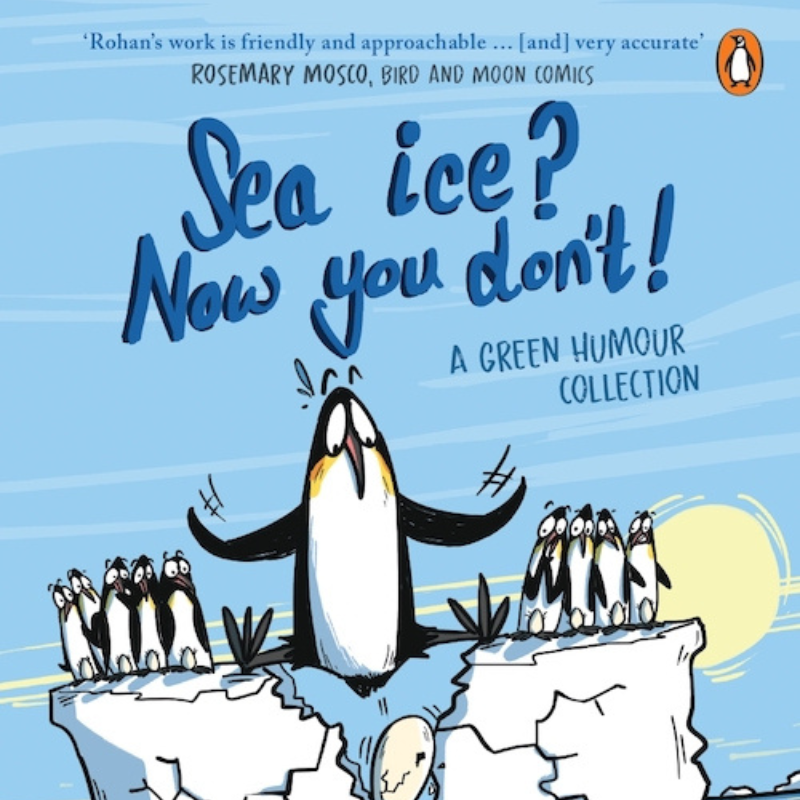
Book Title: Sea Ice? Now You Don’t! A Green Humour Collection
Author: Rohan Chakravarty
Illustrator: Rohan Chakravarty
Publisher: Penguin, 2024 (paperback, ₹799)
Reviewed by: Vinayak Varma
Details
Sea Ice? Now You Don’t! is an enjoyable and well-produced collection of cartoonist Rohan Chakravarty’s comics that have appeared in various newspapers, magazines and online platforms across the last eight years. The fact that all of these cartoons remain relevant today, despite the passage of nearly a decade, is the great tragedy of our age. The big challenges persist, the catastrophes keep compounding, billionaire egos and warmongering still take precedence over planetary health, and biodiversity continues to wither and shrink — man-made horrors beyond our comprehension (though perhaps not yet beyond our salvaging).
It takes a certain stubborn optimism to find the humour in these wilful end times. It takes a certain artistic skill to be able to apply that optimism to a popular medium and make it resonate with the public. It takes a strong sense of balance to be able to weigh the strictures of the scientific community against the lay reader’s atrophied attention span. And it takes a lightness of touch to do so with joy and heart. Chakravarty makes a spirited attempt at all of this, albeit with varying degrees of success. (Of course, this entirely depends on how you define success in such a difficult niche of cartooning.)
There’s this growing view among conservation-driven storytellers that it’s wrong to anthropomorphise animals in service of a narrative, because this imposes human values and morals on creatures that shouldn’t be so narrowly defined. They say that animals should have agency and rights even if they clearly have nothing at all in common with humans, and that they needn’t be emotionally relatable for us to be motivated to protect them. While the intention of this argument is understandable and entirely correct, I humbly submit that — when done with care and empathy — it’s also fine and quite possible to impart a certain humanity (for lack of a better word) to animals without Disneyfying every bit of reality out of them and thereby rendering their wildness inert.
It’s possible to hit that balance between too-cutesy and vaguely approachable, and Chakravarty’s Green Humour does particularly well in this regard. He finds a way to give his animal characters tangible personalities and, more crucially, a voice, without robbing them of their essential animalness. They get to weigh in on everything from adverse policy decisions to absurd pop culture, all the while retaining their context, perspective and specificity.
But why is it so important for animals to have a voice at all? Why make them relatable? Why must they be funny in order to be liked? Well, because many of us still see wildlife as indistinct objects in the general landscape, far removed from the life we understand, existing only to be reshaped at our discretion like a pile of Lego blocks. It takes some internal recalibration to begin to see our fellow creatures as beings with thoughts and histories and social behaviours, to see them as neighbours or even distant relatives, and to view their habitats as homes and neighbourhoods. A sheet of ice is no longer just a sheet of ice when a penguin living on it seems to face the same anxieties as a homeowner in a crumbling old tenement. A frog is no longer just a frog when it becomes a Bollywood fashion influencer. A tiger with self-awareness and a political bent suddenly turns into a spokesperson for the entire wild community. An endangered guitarfish sings the blues, and maybe this time you’ll see it as something more than a faceless mass of fin and gill caught in a trawler’s net. Think of these cartoon animals as training wheels for our inner toddlers. If we learn to see the humour in them, perhaps we can also then begin to perceive their pain.
The obvious pitfall of making cartoons on chronically misunderstood subjects like wildlife degradation and environmental loss, where the purpose is ostensibly as much to inform as it is to entertain, is that some exposition (plus what many might construe as preachiness) can often become an unfortunate necessity. Particularly when you’re addressing broader audiences that are likely unfamiliar with the jargon and politics of conservation biology, or, indeed, the mating habits of your garden-variety nudibranch. So it can be hard to imagine and craft your work like a “pure” humourist who can afford to focus on the gag for the sake of the gag, who can happily engage in meta-ness and genre-subversion because, well, what else is left to do with this most venerable of formats?
In trying to spin science into broad comedy though, clever setups can get bogged down by fact, which in turn can soften or entirely deflect an otherwise solid punchline. And the reverse is also true: clarity of thought and intent — the cornerstones of good outreach — can get pulverised when forced into the framework of a silly pun. The greatest teachers (if such beings still exist) will tell you that a memorable lecture can by turns educate, enrapture and entertain. But doing all of these simultaneously, while also raising LOLs, and also by some miracle shifting your crappy worldview, is like juggling leopards while water skiing across an oil slick. All this is to say that Rohan Chakravarty is a brave (and slightly deranged) man to attempt such a cat-astrophic circus act (I had to! I’m trying to prove a point about low-hanging puns), and while he does sustain a few gouges and bites in the process, he largely survives the ordeal, limbs intact, and for this he must be applauded.
Sea Ice? Now You Don’t! is a fun collection, if at times a little uneven. But it makes you think and wonder, it resists cynicism, and the cartoons have heart. At a time when the whole world seems to be sliding away into darkness, this book points resolutely towards the light. For that alone, it’s heroic.
About the reviewer:
Vinayak Varma draws and writes. Find him at mixtape.in