
Of Rom, Reptiles and Reminiscences
Book Title: Scaling Up
Author: Zai Whitaker
Publisher: Indian Pitta/Juggernaut, 2024 (paperback, ₹599)
Reviewed by: Srinath Perur
Details
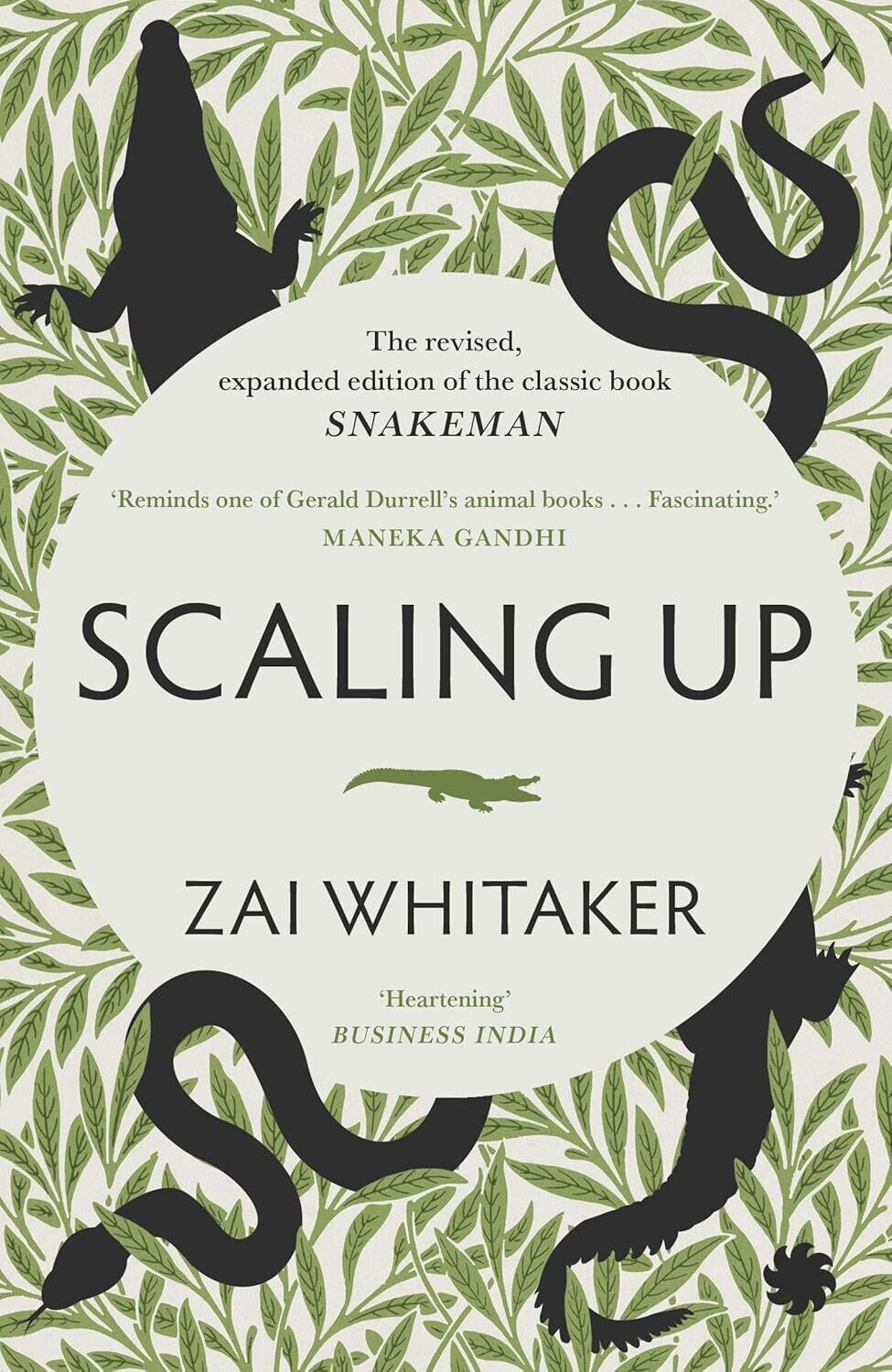
Scaling Up is one of those titles that say little in isolation and a lot in context. First, to honour the pun, it’s a book about Zai and Rom Whitaker’s lives in reptile conservation, especially their prominent association with Chennai’s Snake Park and Croc Bank. The title also takes in the institutional evolution from “education and myth-busting” to “serious herpetology” extending across the country. The 1970s and ‘80s were a period when wider conservation efforts were gaining momentum in India, and the book provides a window into the times. Then, this is literally a scaled-up book — an expanded and updated edition of Zai’s 1989 book Snakeman.
This last aspect is perhaps what gives Scaling Up a certain chimerical quality. It begins as a biography of Rom, going quickly over his early, swashbuckling years in India and the United States. Zai enters the book in a significant way with her marriage to Rom. She comes from a family of naturalists — in fact, the words that make up the title of this book were uttered by her grand uncle, the ornithologist Salim Ali. Her father Zafar Futehally started the Indian chapter of WWF, where she and her sister helped out from an early age. Zai describes her work with Rom as: a perfect conservation partnership: the desk babu (me) and the hands-on herpetologist and jungle wanderer. But there’s some overlap, and hers turns out to be quite adventurous as desk jobs go. The core of the book consists of their work with reptiles (and associated humans) over fifty years.
It is towards the end of the book, after her divorce from Rom, that Zai allows herself to occupy narratorial space more fully. The divorce clearly was a painful episode for her: […] if there’s such a thing as a heart breaking, then mine did, and I heard it. She does not dwell on this in the book though, moving on to describe how they found a way to continue to work together despite the personal reconfiguration. As Zai reckons with the status of various projects and reflects on the life she’s lived, I found myself wanting to know more about the challenges of raising two children in such unique circumstances as well as her work in school education. But that might be a different book. I only mention it because those aspects could be of interest to other readers of this digital magazine too.
The book goes into several instances of the sort of balancing acts that wildlife conservation entails. In the 1970s, Rom Whitaker was advocating for putting a stop to the snakeskin trade. This went against the economic interests of his friends and collaborators from the Irula community, whose skill in tracking and capturing snakes had been servicing the needs of international fashion. A fall in snake numbers meant an increase in rodent populations, and the consequent loss of grain from fields and storage. The government of India banned the export of snakeskin in 1976. Rom’s idea was for the Irula to continue to capture snakes, but release them after extracting venom. An Irula collective would sell venom to companies producing antivenom, simultaneously addressing both the livelihood crisis and the antivenom shortage. But such a processing facility would need funding, and agencies at the time were against all manner of wildlife exploitation. Rom then campaigned to change this mindset. Long story short, the Irular Snake Catchers’ Industrial Cooperative Society remains a major source of venom to date.
The writing in Scaling Up is quietly delightful, especially the parts where Zai finds herself in the wild. Be it the Nilgiris, the Western Ghats, the Andamans or Papua New Guinea, she writes unfussily, with precision and clarity, and gives us admirably natural-sounding nature writing: The forest thickened with every step; soon the trees were choked with orchids and smothered with streamers of lichen, which defied the sunlight. Recent timber felling on the periphery had left gashes like pieces of a bombed-out city. She can also be casually wry. Here she is, in the midst of explaining how venom can vary across regions in the same species of snake: As we know, animals evolve to succeed in their habitats (unlike us, who simply destroy them).
While the book may not specifically be intended for children, it should be easily accessible to teenagers, especially with illustrations by Bruce Peck adding a welcome visual element.
So what is a life in conservation like? Going by the amount of walking in Scaling Up, there seems to be a lot of sweat involved. Definitely a few tears with all the red tape and proposal writing. And seeing how frequently leeches make an appearance in the book, some blood as well. For all that, it comes across as a remarkably satisfying life.
About the reviewer:
Srinath Perur writes about science, travel and books among other things and translates from Kannada to English. He is the author of the travelogue If It’s Monday It Must Be Madurai and the translator of This Life at Play, Ghachar Ghochar and Sakina’s Kiss.