
The Call of the Wild
Book Titles:
GO WILD: Stories, Essays and Comics that Celebrate Our Earth
Author: Various
Editor: Bijal Vachharajani
Illustrators: Prabha Mallya
Publisher: Penguin, 2024 (hardback, ₹499)
Reviewed by: R Sivapriya
Details
I am envy-struck by the Indian writing available for young readers today. No more being limited to Enid Blyton and such, with only mythological comics providing a taste of Indian literature. The anthology Go Wild! is the perfect example of all the riches on offer for English-reading children today.
A lavishly illustrated container of sweets and savouries, of just the right size, this collection has something for everyone — for readers of various levels and tastes. The theme that unites them is love and concern for the earth and its denizens. Many contributions record the erosion of the natural world and subtly signal the efforts to slow down the process. Nearly all of them are pragmatic. They quietly appreciate this present moment when we still have the gift of the presence of fellow beings — plants and trees, birds and insects, animals, ponds and rivers — vastly diminished though they are. In Dance of the Frog Boy, a good portion of Meenu and Makri’s house on the hills has disappeared in a catastrophic landslide. Embankments are being put in place to prevent more landslides. But Meenu knew that with all the trees that were being cut, it was only a matter of time before other houses were washed away. Makri wondered what would happen to all the frogs. For now, though, they are happy to be together. There is mutton curry simmering. The storm has passed. The frogs remain.
There are rhymes and pictures that will have you grinning. Rajiv Eipe’s mantises pray, spray, grey, bray and so on in superb drawings. The hand-wringers who talk, talk, talk and expect others to do the walk are gently sent up when the speaker in Zai Whitaker’s Drastic Plastic decides to act on his parents’ belief that plastic should end/It’s really driving them round the bend! He takes his Dadi’s wheelbarrow and empties their house of plastic gadgets, garments, kitchenware. When the parents return, their reaction is panicked and strange with even their hair turning fierce and curly!
The contributions vary in quality from excellent and delightful to good and thought-provoking to sometimes just middling. The non-fiction pieces are consistently enjoyable. They describe and provide insight and emphatically do not preach. Meghaa Gupta’s When Plants Made History is pitched perfectly for young readers, with the insights folded seamlessly into the information about plant life. Harini Nagendra and Seema Mundoli’s A Tale of Three Cities makes a visibly sophisticated argument about the urban water crisis, yet remains fully accessible. Yuvan Aves’ The Old, Worn Palash Tree is a richly observed, slowly unfolding essay about the tribulations of a tree growing in a bustling Chennai neighbourhood. I wondered if it was too high a level of argument for a young reader. Then I remembered that I read everything as a child, and even when I couldn’t fully comprehend an underlying idea, the mood of a text left its impress upon me. Why shouldn’t children be haunted by just the glimmerings of understanding of something they read? It still happens to me as a mature adult reader.
The comics are uniformly wonderful and each of them is unique. They range from Priya Kurian’s anxious and self-aware Nature is Healing to Salil Chaturvedi’s magical and poignant Places My Wheelchair Likes to Go.
The fiction, however, does not always work. A couple of stories lapse into talking down to short people by being cute rather than charming. Writing for children is always in danger of skewing sentimental, especially when the story is told from the point of view of a non-human. A few stories, I feel, might have been better off as essays.
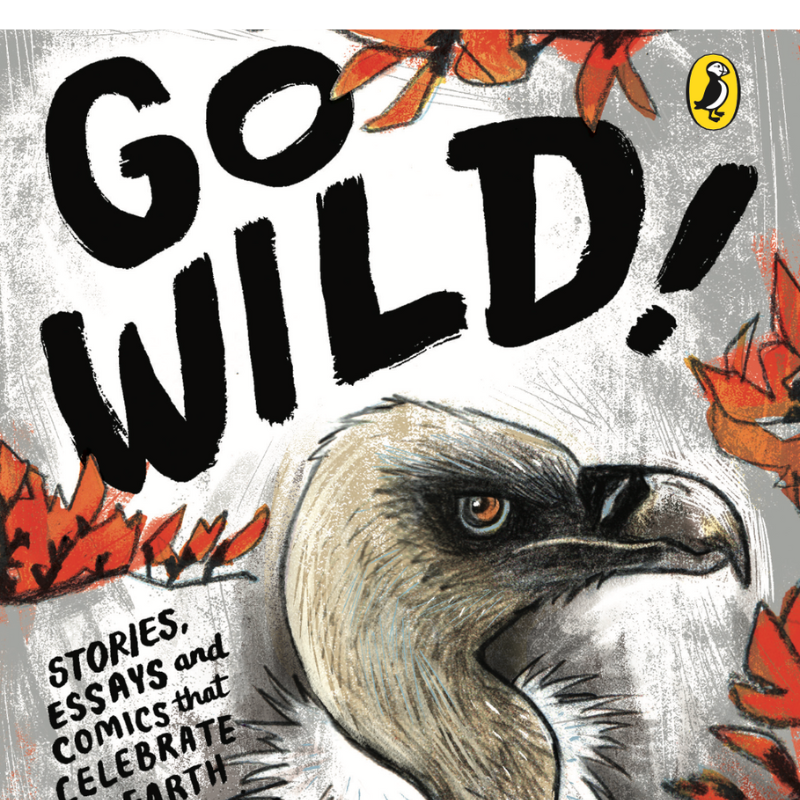
Over and above, under and below, Go Wild! is totally worth the recycled paper it is printed on and absolutely worth reading and lingering over. It brings together generations of the best naturalists writing and illustrating now. There are many jokes that land, glorious and witty illustrations, deep knowledge lightly expressed and profound wisdom too. The singular and memorable cover has a vividly rendered vulture from Anita Roy’s strange and wonderful story illustrated by Prabha Mallya. Her gorgeous rendering is so effective that sometimes I felt a presence in the room when the book was cover side up.
About the reviewer:
R Sivapriya is publisher of literary fiction and non-fiction at Bloomsbury India.