
Earth Song
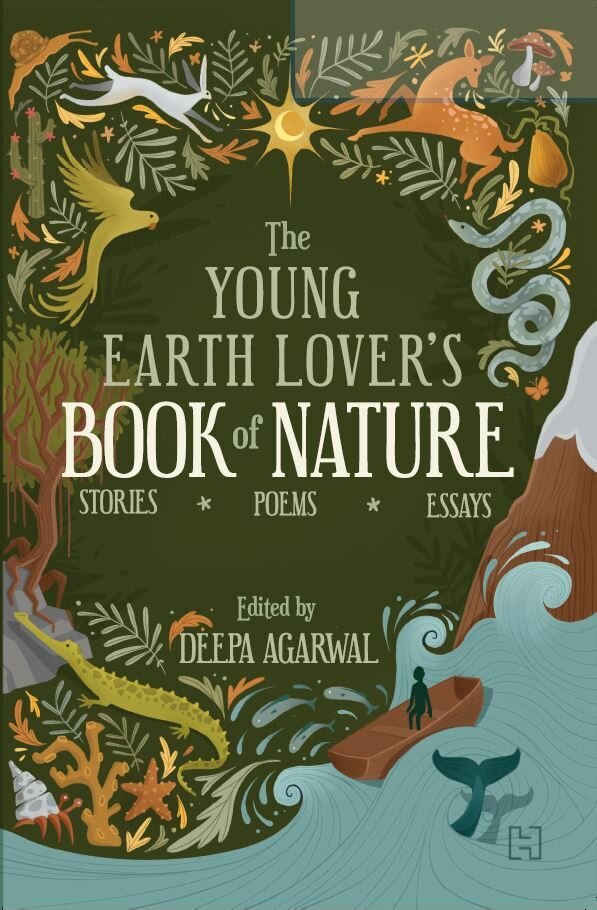
Book Title: The Young Earth Lover’s Book of Nature: Stories, Poems, Essays
Author: Various
Editor: Deepa Agarwal
Illustrator: Damini Gupta
Publisher: Hachette, 2024 (paperback, ₹499)
Reviewed by: Aditi Patil
Details
The Young Earth Lover’s Book of Nature: Stories, Poems, Essays is a unique and eclectic anthology that brings together an array of voices from the worlds of science, literature, poetry, and naturalism. Just a glance at the table of contents reveals a delightful remix of thinkers — classics like Alfred Tennyson, Dhan Gopal Mukerji, Christina Rosetti, Mark Twain, Rabindranath Tagore, and Charles Darwin share space with naturalists like George Schaller, Jim Corbett, Zai Whitaker, and Vivek Menon. For an interdisciplinary conservationist like me, who aspires to bridge different fields, this anthology feels like a masterstroke — a convergence of perspectives that together create a vibrant tapestry of nature writing.
I had the pleasure of reading this book while conducting fieldwork in Lahaul, Himachal Pradesh, and there couldn’t have been a better setting. As I witnessed the region’s unprecedented heatwave — where people were reportedly buying fans for the first time — this book’s urgency struck me deeply. The blend of stories, poems, and essays from forty-four nature lovers felt particularly relevant. In a world facing such rapid environmental change, children and young adults need writers like Ranjit Lal to interpret birdsong with humour and curiosity, and Christina Rossetti to make them wonder “who has seen the wind.”
One of the most poignant aspects of this anthology is how it balances the urgency of the environmental issues it raises with the delicate beauty of its illustrations. Damini Gupta’s charming depictions of bees, bats, butterflies, and snowflakes perfectly complement the stories, offering a visual reminder of what we stand to lose.
Zai Whitaker’s hard-hitting account of the plight of sea turtles, for instance, is a stark reminder of the challenges marine conservation, often sidelined and underfunded, faces. Manish Chandi’s account of navigating a rough storm in the Andaman Islands, where he vividly describes the experience as “being scrambled like six eggs on a cold blue turbulent flame,” is utterly gripping. Deepa Agarwal skilfully paces the anthology, allowing readers to catch their breath between Chandi’s two stories. She cleverly intersperses other narratives — like Sarojini Naidu’s Coromandel Fishers and Zai Whitaker’s tender account of Salim Ali’s ornithological discoveries — before leading back to Chandi’s second story. By doing so, she enriches the reading experience, adding layers of context and reflection. Chandi’s adventures in the Andamans, paired with Whitaker’s urgent call for turtle conservation, come at a critical time. The looming threat to Galathea Bay, a crucial mangrove habitat and one of the most significant nesting sites for the giant leatherback turtle in the Indian Ocean, underscores the importance of these stories. I’m particularly struck by Agarwal’s brilliance in including Jules Verne in this nature-focused anthology, a choice that subtly reminds us that science and nature are inseparable.
Jim Corbett, a childhood favourite of mine, continues to hold that place in this book with his The Law of the Jungles—a story as real as nature itself. Only in this anthology could Corbett’s raw storytelling be immediately followed by William Wordsworth’s reflective query, “What man has made of man?” This juxtaposition adds a layer of depth, inviting readers to ponder humanity’s complex relationship with nature.
Dhan Gopal Mukerji’s words, “Wherever I turned, I thought I saw eyes,” resonated with me deeply, especially after my own experiences in the Satpuda Tiger Reserve, where even the silence of the forest seems to tell a million stories. Mukerji’s mastery truly shines later in the book when he describes, with immense pride, the growth of a pigeon whose “throat glistens with iridescent beads.”
As I trekked in the Baralacha Range, I couldn’t help but recall Francis E. Younghusband’s descriptions of the Trans-Himalayan geography. His portrayal of glaciers, with their “delicate transparency” and “exquisite tinting of blues and greens,” perfectly captures the beauty and danger of these landscapes — scenes that I’ve witnessed firsthand. Tennyson’s words, “I slip, I slide, I gloom, I glance,” offer a sweet hope that lingers long after the pages are turned.
Meghaa Gupta’s essay underscores the vital importance of remembering our history of environmental movements, while Vivek Menon’s essay stands out as well, with his wealth of experience shining through as he concludes, “nature is at the core of everything we are — and will be.” And finally, Frost’s Desert Places is a personal favourite, echoing my own struggles with loneliness, while Bulbul Sharma’s vivid portrayal of alpine fruit orchards adds a touch of warmth and nostalgia to the collection.
In essence, The Young Earth Lover’s Book of Nature is more than just a book; it’s an urgent call to reconnect with the natural world and recognise our role in its preservation. For young readers, this anthology offers both inspiration and a call to action, blending beauty with a critical understanding of the environmental challenges we face.
About the reviewer:
Aditi holds an MPhil from Cambridge and has co-founded the research organisation ‘Conservation indica’. She has a decade of conservation research experience in India and is the author of Patriarchy and the Pangolin.