
Rethinking Student Voice in Education
By Arya Mishra and Asha S | May 22, 2025
By extending student participation beyond the school environment, Involve’s two pilot projects offered a rare opportunity for young people to influence decision-making processes in their communities.
Details
This year, we led two community-based exploratory research pilots at Involve. These focused on amplifying student participation and voice in spaces typically dominated by adults. Conducted in the Anekal educational block, Bangalore, across two Grama Panchayaths and two School Development and Management Committees (SDMCs), these pilots demonstrated that using the right platform, students can engage meaningfully and present their perspectives in traditionally adult-led forums like Grama Sabhas and SDMC meetings.
By extending student participation beyond the school environment, the initiative offered a rare opportunity for young people to influence decision-making processes in their communities. Designing and implementing these pilots yielded valuable insights into student voice and student-centric design, both theoretically and in practice. As this phase concludes and plans for the next begin, it is important to reflect on what it truly means to centre student voice in community interventions.
At the heart of this reflection are questions that guided the design and should shape the evaluation:
- Are students genuinely discovering the power of their voice, or are they simply fulfilling a task?
- Do these spaces amplify diverse student voices, or do they unintentionally spotlight only a select few?
These questions compel a deeper examination of how student voice is understood and enacted in educational settings.
What is Student Voice?
Fielding (2001) conceptualises ‘student voice’ as the capacity of students to influence decisions impacting their lives. This concept extends beyond mere participation, underscoring the necessity for students to actively shape their educational experiences and engage with broader community issues. Nonetheless, this ideal frequently encounters obstacles, ranging from tokenistic participation to the absence of systemic structures that empower students. If students are only permitted to speak in class to respond to teacher-posed questions, opportunities for authentic student voice remain constrained. Empowering students to express themselves necessitates offering them meaningful choices and establishing environments where they can actively contribute to their learning context.
Lundy’s (2007) model provides a framework to address these barriers through four essential components:
- Space: Providing students the opportunity to express their ideas.
- Voice: Helping students articulate their thoughts through capacity-building efforts, such as time, information, and skill-building.
- Audience: Ensuring that adults actively listen to and value students’ perspectives.
- Influence: Taking action based on students’ inputs or providing reasons when their suggestions cannot be implemented.
This framework aligns with the New South Wales (NSW) Department of Education’s four pillars for amplifying student voice:
- Having Voice
- Having Influence
- Having Choice
- Working Together
These pillars emphasise the creation of safe spaces for expression, the promotion of collaboration, and the assurance that students’ perspectives influence decision-making (NSW Department of Education, 2020). Failure to address these stages risks reducing student voice to tokenism, an act that undermines its transformative potential (Gillett-Swan & Baroutsis, 2024).
While these pillars provide a structural framework for student voice initiatives, it is essential to delve deeper into the core elements that enable students to effectively engage in decision-making processes.
While designing both pilots, we kept the four elements of Lundy’s model in mind. The spaces provided for student participation were the Grama Sabha and the SDMC meetings. Students were given guidance and support to articulate their ideas in a structured manner. Before the meetings, stakeholders were informed about the objective of the pilot and what the students would be doing in the space. An orientation session was provided for the stakeholders who would be interacting with the students to help them make the space safe and inclusive.
For the influence component, we aimed to understand whether stakeholders’ mindsets would shift regarding students’ participation in community spaces like the Gram Sabha, especially if students themselves led efforts to create change (in our case, students identified a problem in their community and solved it). To our surprise, stakeholders acted on the students’ problem identification and solutions. In one instance, the Bannerghatta Panchayat Development Officer (PDO) visited the community to address the issue of improper garbage disposal after one of the students addressed it in the Grama Sabha. In the Grama Sabha organised by the Shantipura Grama Panchayat, students were invited to partner with local leaders to raise awareness among parents about issues like attendance of parents in the Grama Sabha and regarding switching off the streetlights in the daytime by the community members.
These experiences demonstrated that embedding the four elements of Lundy’s framework into interventions can shift student voice from symbolic inclusion to genuine collaboration, resulting in a broader and lasting impact. Future implementations can further deepen this alignment by embedding ongoing feedback loops between students and decision-makers.
The foundation: Agency and decision-making skills
Student voice lies at the heart of student agency, that is, the ability to make choices and express them confidently. But agency requires more than just giving students the freedom to speak; it requires equipping them with the skills to make purposeful choices and calculated decisions. Agency depends greatly on an individual’s social and psychological assets. Social components include a sense of belonging, identity formation, and leadership capacity, while psychological components encompass self-esteem, self-confidence, and the ability to envision a better future.
Developing this skill involves teaching students how to make decisions, consider the impact of decisions they make on their lives and on others, and express their reasoning clearly. Managed choices, where students make decisions within an adult-designed framework, can be a stepping stone. However, the ultimate aim is to shift classroom power dynamics, enabling students to take ownership of their learning and choices.
The NSW Wellbeing Framework for Schools emphasises meaningful participation as a driver of belonging and active involvement. It connects agency to broader well-being goals, advocating for mechanisms such as participatory action research to prepare students for leadership roles (NSW Department of Education, 2020).
Through our community-based pilots this year, we worked to build key skills like self-esteem, self-confidence, a sense of belonging, and leadership capacity. We interviewed students who presented their solutions to Gram Sabha members, asking them to reflect on the process and how they felt.
A few students from Government Higher Primary School Bhovipalya and Government Higher Primary School Bannerghatta shared their insights after the intervention.
‘I felt happy discussing and contributing to solving a problem’. — Radha
‘I am feeling more confident now approaching Grama Panchayath members and know whom to contact if he faces an issue.’ — Krish
‘I initially felt scared, but after preparing, she gained the confidence to present my solution’. — Lakshmi
While building confidence was one aspect, students were also reflective post-presentation. They discussed what went well and what could have been improved. Since the whole pilot was rooted in their community, the sense of belonging among students was strengthened. For instance, Shilpa, one of the students who participated in the Gram Sabha, shared with joy, ‘Everyone in the community said I did a good job and blessed me.’
Opening environments for exploration
Giving students a choice in what and how they learn, for instance, allowing them to decide which subjects to explore, is an important starting point. It builds their confidence in a safe and supportive environment. However, the ultimate goal of fostering student voice extends far beyond the classroom.
The true test of student agency lies in how well students exercise their voice outside controlled environments. Schools must prepare students to navigate real-world situations where they may face resistance or indifference. By experiencing agency within schools, students develop the skills and mindset to make critical decisions, advocate for themselves, and consider the bigger picture as they transition into adulthood.
In our SDMC pilot, Dhawal, a student representative, introduced herself to the SDMC members with remarkable confidence. At the end of her introduction, she asked whether the members ever considered students’ perspectives while making decisions or took the time to speak with students to understand their concerns. These questions were spontaneous, not planned. Dhawal recognised a gap and chose to address it, demonstrating how these pilots’ helped students build the confidence to use their voices meaningfully in real-world scenarios.
Lansdown’s (2018) Modes of Participation categorise student participation into consultative, collaborative, and child-led participation. Each mode emphasises the importance of developing both decision-making and leadership skills, preparing students to transition from structured environments into real-world scenarios where they can advocate for themselves and others.
Research from the Centre for Children and Young People (2017) shows that collaborative initiatives, where students work alongside adults, foster meaningful engagement. Mechanisms like student-led governance or school improvement projects help bridge classroom learning with real-world applications (NSW Department of Education, 2020).
To understand how these moments influence systemic structures, we captured reflections from adult participants at both the baseline and endline stages. At the baseline, a Grama Panchayath member mentioned, ‘Students will know school-centric problems, but not community-related issues. Adding students to spaces like these will help them learn but won’t necessarily affect the workings of the Grama Panchayath.’ However, by the endline, a shift was evident. A Panchayath member shared, ‘Yes, we want students to help us raise awareness among their parents about community problems. For example, nobody switches off the streetlights in the morning. Students can make parents aware of such issues and act as intermediaries between us and the parents.’ These reflections highlight the early signs of the mindset shifts we aimed for, not only among students but also among adults. The shift from viewing students as passive learners to recognising their potential role in community engagement and problem-solving marks a significant transformation in how adults view student involvement in local governance.
Ensuring inclusivity: Every voice matters
One critical question remains: Is student voice a privilege reserved for the well-spoken or for those who participate in after-school activities? To truly embrace the student voice, we must ensure diversity and inclusivity. Every student, regardless of their background, abilities, or circumstances, deserves the opportunity to have their voice heard.
This inclusivity requires intentional design. Schools must create spaces where all students feel safe and supported to express themselves. Programmes should provide equal opportunities for participation, ensuring that no student is left behind. The goal is not just to amplify the loudest voices but to create a symphony of diverse perspectives.
Shier’s (2001) Pathways to Participation emphasises the importance of intentional structures that open opportunities, provide support, and fulfil obligations (opening, opportunities and obligations) to respect every child’s right to participate. Without such frameworks, efforts to foster inclusivity risk falling into tokenism, further alienating marginalised voices.
To ensure inclusivity in our pilot design, we established clear criteria for selecting the holiday projects that would be presented in the Gram Sabha. All students were given equal opportunities to participate and pitch their solutions. While a few students presented their problems and solutions in front of the Gram Panchayat members, every student had the opportunity to share the issues they were facing in the community.
A strategic approach: Age-appropriation
Achieving this goal requires a deliberate and strategic approach. The Continuum of Voice framework outlines seven stages of incorporating student voice, emphasising that skipping any stage undermines the process. The age-appropriate agency is a key consideration — what agency looks like for a first grader will differ significantly from what it looks like for an eighth grader. A well-designed roadmap ensures that students progressively build their capacity to exercise their voice as they grow.
Making students partners in their learning is central to this approach. This means involving them not just in making choices but in understanding the purpose behind their decisions and how those decisions contribute to their growth and the community. The NSW School Excellence Framework reinforces this by emphasising student involvement in setting learning goals and refining teaching practices through feedback (NSW Department of Education).
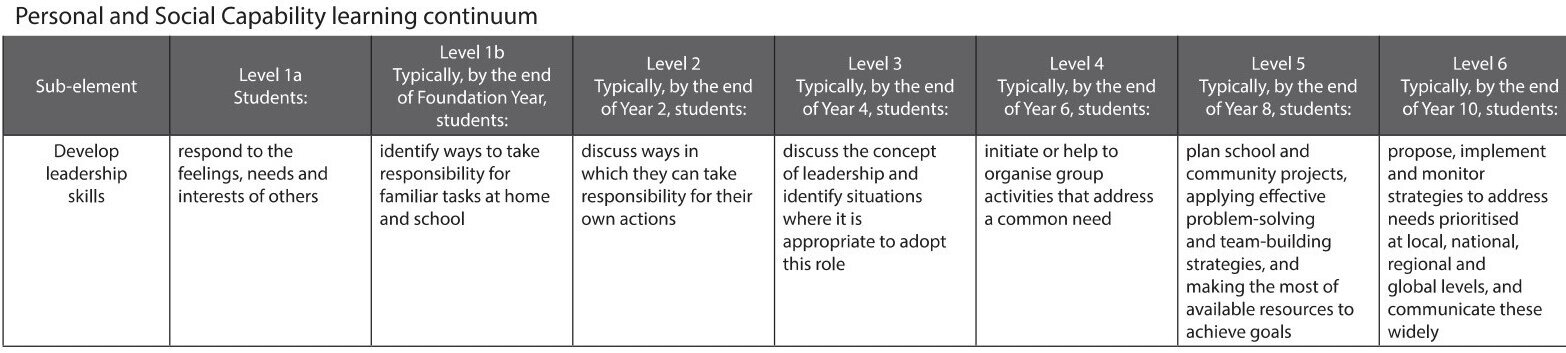
The Australian Curriculum, Assessment and Reporting Authority (ACARA) provides a Personal and Social Capability learning continuum that includes stages for developing leadership skills. This framework aligns with the Continuum of Voice and illustrates how leadership development progresses from responding to others’ feelings to proposing and implementing solutions for community needs. The table below from ACARA demonstrates this progression:
Source: Australian Curriculum, Assessment and Reporting Authority
This continuum highlights the importance of building leadership and decision-making skills as a foundation for amplifying student voices.
Since both pilots involved students engaging with unfamiliar stakeholders in uncontrolled environments, they were intentionally designed for middle and high school students to maintain appropriate cognitive and emotional rigour.
The way forward
Building student voice is a journey, not a destination. It requires a systemic commitment to creating opportunities for students to express themselves, mechanisms to help them refine their ideas, and structures to ensure their voices lead to meaningful action. By doing so, we prepare students to become active community participants, capable of navigating complex decisions and advocating for positive change.
As educators, policymakers, and community members, we must ask ourselves: Are we truly empowering students or simply ticking boxes? The answer lies in our willingness to go beyond token gestures and invest in sustainable, impactful, and inclusive practices that prioritise every student’s voice.
Grounding these efforts in robust frameworks, such as Lundy’s Model, Hart’s Ladder, and Fielding’s Patterns of Partnership, ensures that student voice becomes a transformative value rather than a procedural formality. Complementing these with strategies from the NSW Department of Education, such as integrating student voice into school excellence frameworks and wellbeing initiatives, provides a comprehensive roadmap to reimagine education through the power of student voice (NSW Department of Education, 2020).
As Maria Montessori wisely observed, ‘Follow the children. They will show you what they need to do, what they need to develop in themselves, and what area they need to be challenged in.’ These words remind us that true empowerment begins with listening and trusting children to lead the way.
AUTHORS
Arya Mishra, Solution Design, Involve Learning Solutions Foundation, TFI Fellow (2023−24)
Asha S, Program Manager, Involve Learning Solutions Foundation, MA Education, Azim Premji University (2017−19)
Featured photo by Yogendra Singh on Unsplash