Experience mathematics with puppets, theatre and storytelling
Three years after the release of his course ‘Geometry of Vision’ on NPTEL e‑learning platform in 2022, puppeteer-mathematician Vijay Ravikumar gears up to teach it to the undergraduates at the University for the first time.

Details
Imagine you are facing a corridor with square-tiled flooring. The fact that the tiles are square in shape is immediately apparent to you. Is that because of their equal sides and right angles? Before you say yes, look again… is that really what the tiles look like from your perspective?
Even though the tiles are actually squares and run parallel to each other, from your point of view, they seem less and less square-like as you look further ahead. And at some point, the supposedly parallel rows of squares seem to… intersect? “When you look out at the world in front of you,” says Vijay Ravikumar, “you are constantly taking two-dimensional snapshots of a three-dimensional world.” The result of this is that everytime we move, the object or view in front of us changes in some way. They may change size, shape, angle, and very often, parallel lines seem to converge. Despite all this, our eyes and brain are somehow able to interpret the shapes correctly.
It is on this provocative note that Vijay, a maths faculty member at Azim Premji University, introduces his online course ‘Geometry of Vision’. He plunges his audience into the world of the projective plane, a mathematical world whose origins lie intriguingly in Italian renaissance art (with the rise of the style of ‘perspective painting’). This is a world in which parallel lines intersect; in Vijay’s words, “a fascinating yet counterintuitive geometric space”.
An unusual math teacher
It’s his use of handmade props, animations and theatrics that makes Vijay’s maths online courses specially striking. One of the course videos, for example, begins with a cardboard train chugging along, finally entering the room in which an excited passenger awaits it. Wearing a cap, backpack and holding a cardboard camera, the passenger is none other than Vijay himself, playfully easing the viewer into the concept of projective geometry. How did he learn to teach maths this way?
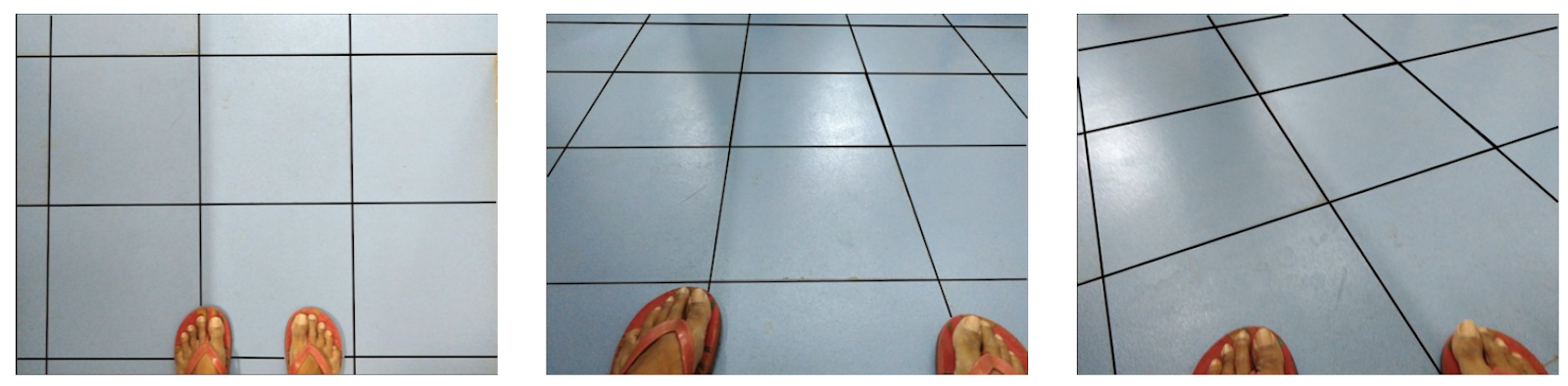
Square tiles look different based on your perspective, as seen here in these images.
Image Credit: Vijay Ravikumar
Long before he joined the university, Vijay worked as a puppet theatre artist in Chicago, where he is originally from. This was something he had to leave behind when he chose to start his graduate studies in mathematics. Maths consumed the next phase of his life and it was only when he took up a faculty position at Chennai Mathematical Institute (CMI) that he finally found himself with time to rediscover his artist roots. By then, Vijay was also growing restless with his research. “I had found a number of results in my area of algebraic geometry, known as Schubert Calculus, but it felt like I had already plucked the low hanging fruit in this small sub-branch,” he said.
That was when he started to get involved with the theatre scene in Chennai. He worked as a puppeteer, storyteller, playwright, performer and director, and was starting to feel so creatively fulfilled that he eventually decided to quit CMI and devote himself to theatre. With a bunch of shows planned and a grant in hand, the future was looking promising for Vijay. The only problem was that it was March 2020. “COVID happened literally five days after I quit,” he grimaced.
Two worlds collide
Interestingly, this bad timing shaped the course of the next part of Vijay’s career. Instead of wallowing in dismay, he chose to be practical and go back to mathematics. “Up until that point, there was a big separation between my artistic life and my mathematical life,” he remarked. For the first time, he began toying with the idea of mixing the two worlds. “I realised I was in a position to tell a mathematical story, and bring that story to life in a more traditional storytelling sense.”
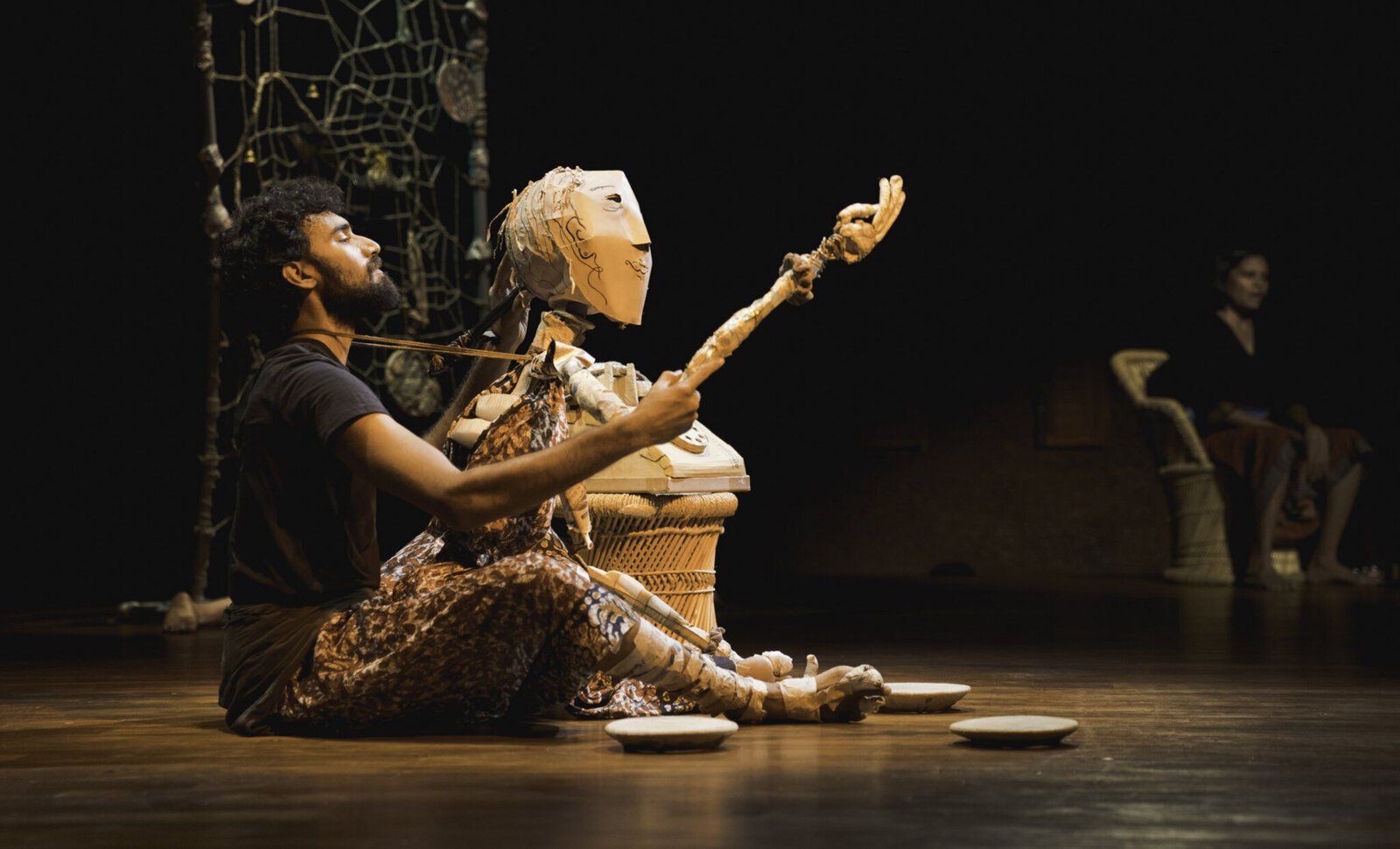
A performance of Vijay’s play ‘Lentils and Stones’.
Image Credit: Alessandra Silver
Vijay spent the rest of the pandemic working at the intersection of math education and art, and ‘Geometry of Vision’ was one of the results of this pursuit. Later, Vijay came up with a second course titled ‘Topology of Movement’ which explores spatial orientation, 3‑D rotations, and the quaternion numbers. A third course that is under development, called ‘Structure of Sound’, will round up this trilogy of courses into a bundle that he calls ‘Our Mathematical Senses’.
Learning maths via storytelling can be a great way for students to grasp concepts that otherwise seem highly esoteric. And according to Vijay, the practice can be immensely valuable even to experts. He takes the example of a concept called orientation entanglement. This is a property of space by which an object, suspended in space by strings attached to various points in the room, is tangled up if rotated by 360° but reverts to its original state if rotated once more in the same direction (720°). “This is a fact that we understand very well as geometers, and is also at the heart of physics (i.e., it’s the basis of ‘spin’ of fermions) though to anyone else it may feel really counterintuitive,” said Vijay. However, it turns out that this is a concept that’s remarkably simple to demonstrate. In his course ‘Topology of Movement’ he does just this, with the help of an anthropomorphic polystyrene ball named Bala.
A deeper way to engage
When he demonstrated this to his colleagues they too found value in this. “Mathematicians and physicists may know how to write equations for this property, but few think about what it’s like to actually experience it. Many come out of the workshops feeling they understand the concept much better than they did while just working with it abstractly.”
On his website, Vijay ventures, “Doing math through storytelling, theatre and animation can sometimes throw up surprising mathematics that’s not typically found in textbooks.” Could we go even further to say that these ways of engaging with mathematics can advance the field? “Okay, that’s a tall order,” he chuckles thoughtfully. “It’s definitely not just about explaining the concept — that much, I feel strongly about. It’s about understanding it in a different way, and potentially in a better way, in a deeper way.”
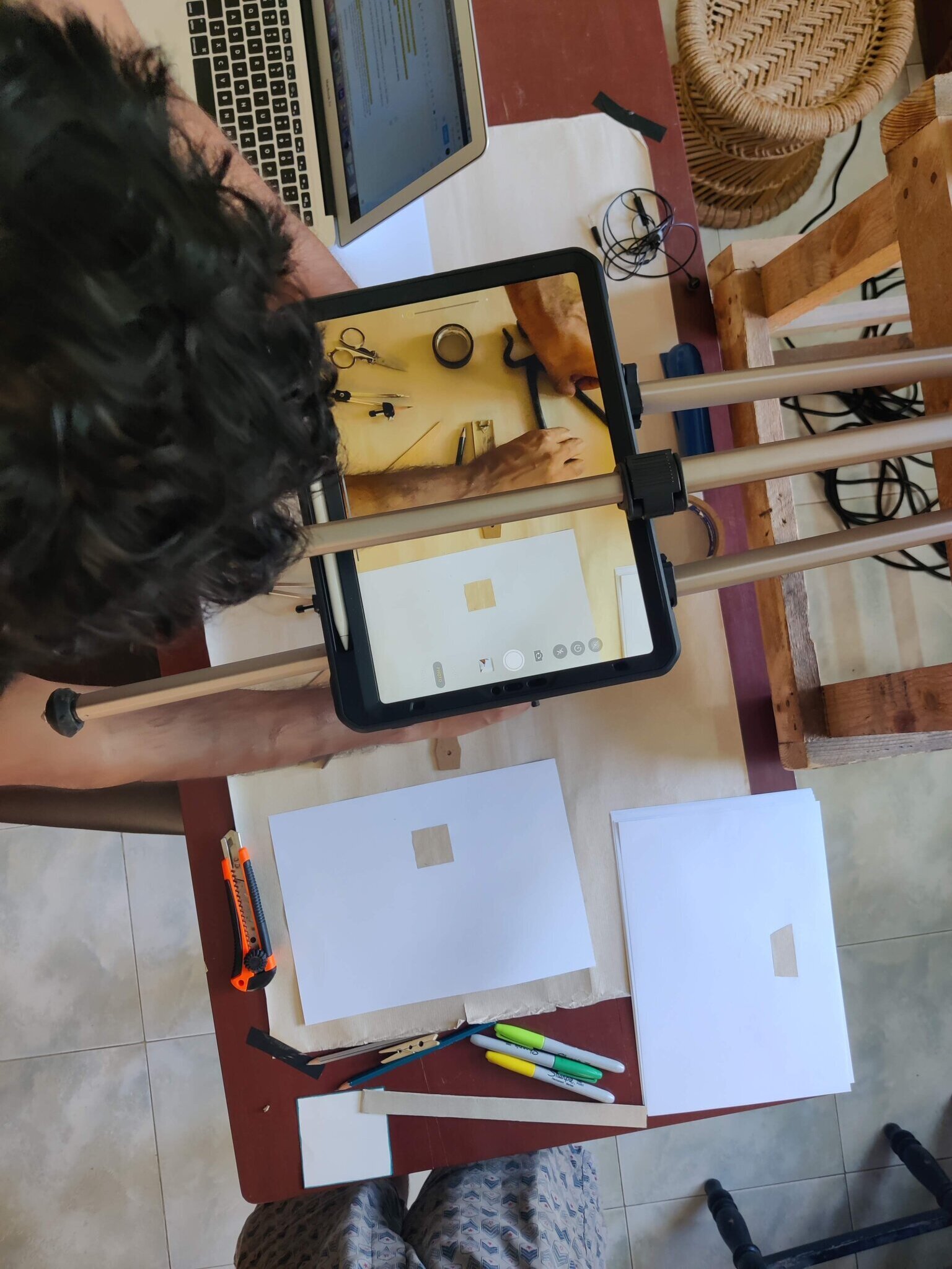
Behind the scenes — recording of the Geometry of Vision course.
Image Credit: Pranav Sreerag
Doing maths research typically involves building up a massive structure, he described. “It takes years to get to the framework through which you are able to understand the machinery and the technical mathematical entities well enough to actually start working on the question.” But when you finally do, the insights that follow, that enable you to solve the problem are often surprisingly simple, and based on something that anyone could understand. “So in that sense,” he mused, “I could certainly see this advancing mathematics. If some of these ideas are experienced by the right person working on the right problem, it could help them solve an unsolved problem. I do think that’s possible.”
Digital to analogue
Three years since Geometry of Vision was released on the government-funded e‑learning platform NPTEL in 2022, Vijay is gearing up to conduct it as a live class for undergraduates at the university this upcoming semester. “It is going to be an open elective, so it is for everyone [irrespective of major]. The nice thing about this course is that the mathematical structure is very deep and more than 2,000 years old, but it can be understood at many different levels. A philosophy, literature or humanities major who may have zero background in maths will get something out of it, and so will somebody very interested in maths. I’m hoping to run the course at multiple levels simultaneously and see how that goes.”
After spending a number of years immersed in the realm of online education, Vijay is pleased to have the opportunity to test his material in a real classroom. “Making these NPTEL videos and teaching online was really draining,” he admitted. “It takes a lot of energy to bring the content to life, but you don’t have that immediate response from students. Speaking to students here, in comparison, is such a breath of fresh air.”
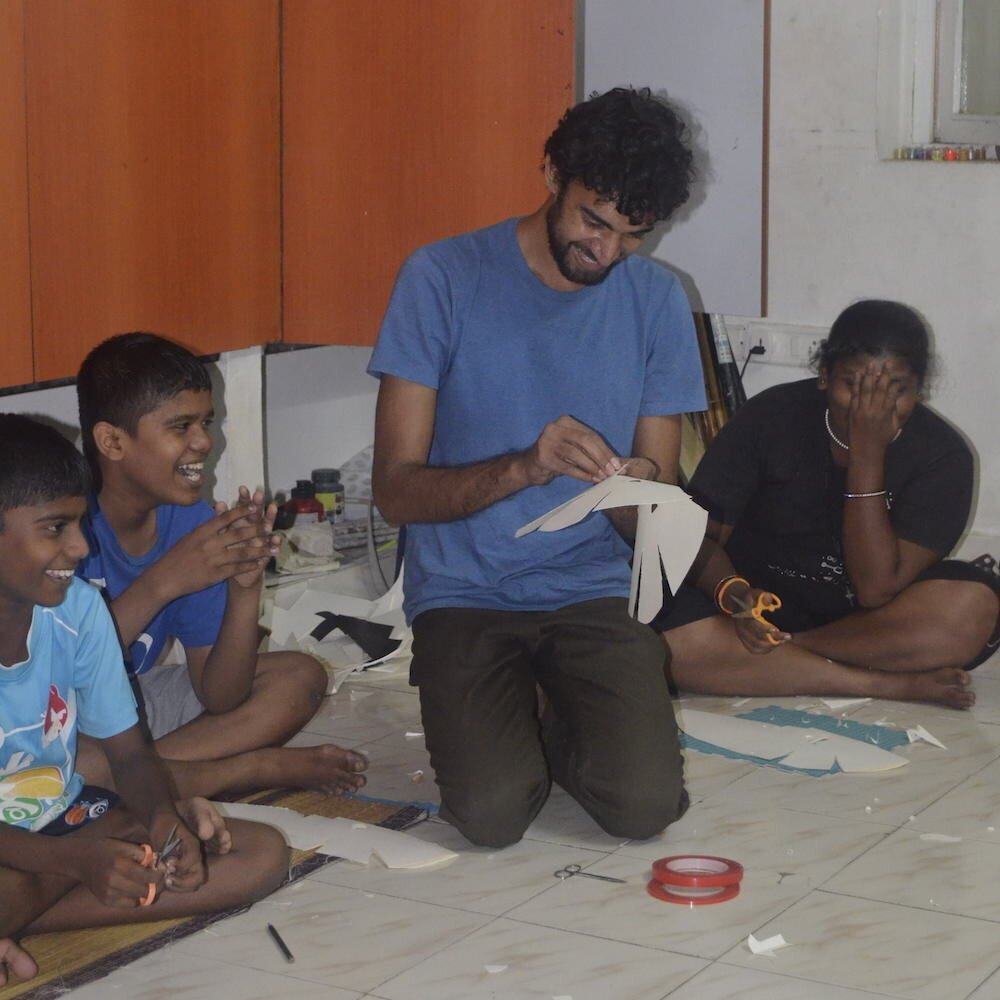
A mask-making workshop with children in Urur-Olcott Kuppam, a fishing village in Chennai.
Image Credit: Pranav Sreerag
Vijay does not hesitate to state that there is no comparison between face-to-face communication versus online teaching. That said, he isn’t ready to abandon online courses all-together. He envisions his ‘Structure of Sound’ course to be something of a hybrid. “I would like to really tailor the videos so that they can be used in a live classroom setting. I may not be part of the setting, but at least it would be used for something where people are physically gathering and connecting in some way. I think that’s really important,” he signed off.
About Vijay
Vijay Ravikumar is a faculty member at Azim Premji University. He grew up in the US and completed his undergraduate studies at Amherst College. After completing his PhD in 2013 from Rutgers University, he moved to India. Over the last decade, he has worked as a research mathematician, a teacher, and a freelance artist. He may be contacted at vijay.ravikumar@apu.edu.in
About the Author
Nandita Jayaraj is a science writer and communications consultant at Azim Premji University. She may be contacted at nandita.jayaraj@apu.edu.in