
The Art of Writing a Picture Book
Internationally acclaimed children’s author Uma Krishnaswami writes lyrically about how art and words meld together to form a heartful picture book that celebrates the natural world.
Details
For those of us writing for children, picture books are the beating heart of our field. They exist on the cusp of children’s literacy, inviting the youngest readers into worlds of story. They lay down the paths, neural and figurative, along which later reading will make sense. Ideally, they should be read together by an adult reader and a child listener. The picture book and its joint readership then combine to create what my former student and writing colleague Tamara Ellis Smith has called a “vibrant triangle.”
I am not a visual artist, so I don’t know how a picture book can emerge from a mind that is capable of both verbal and visual imagining. What I have learned over many years is that for a wordsmith, creating a picture book is an exercise in letting go. You write the story you think you are after, and then when you see the art as it takes shape, you realise your story has gathered dimensions you couldn’t begin to dream of.
Many of my picture books involve the natural world. In Out of the Way! Out of the Way! a boy and a tree grow over their respective lifetimes, along with the road and the community in which they are located. Time is part of the story. Artist Uma Krishnaswamy (yes, almost my namesake; no, she’s not me) had to base the start of her visual imagining on my opening words:
A dusty path ran through a village.
People and animals
walked up and down,
going from here to there
and back again.
Uma visualised these rather spare lines as a moving, shifting swirl of grass and trees, village houses, a temple spire, a chicken scratching on the ground, a squirrel darting by a couple of water-pots, a curious cat staring at the reader from the edge of the scene, a butterfly flapping its wings in the air, people going about their daily business, and the little path running through it all. The human world and the natural world both moving along in tandem, as they do. I hadn’t spent any time at all imagining the details of that village, of the people and animals, of the path. I hadn’t needed to. Why waste words on details that a picture is able to represent far more effectively? That’s the beauty of a picture book. I believe that to make the most of this marvellous form, we who ply a trade in words must learn how to use only the most essential.
By the time we turn the page and the boy has found “something small and green” in the middle of the path, we can see that the setting not only teems with life but is in constant motion. The words in the book lead readers to pore over the busy art, finding recurring motifs, looking for the bull and the cat and the birds while tracing the boy’s journey through his own life, with the tree as the still point in this turning world.
In both Out of the Way! Out of the Way! and its companion book, Look! Look!, children play a role in letting the natural world live and thrive. But these books were written thirteen years apart, and they were different stories. Just knowing how the books would contrast with one another (a boy protagonist in one, a girl in the other, a tree in one, water in the other) wasn’t enough to show me the way. But Uma’s art did. In a blog post about the challenge of writing a companion book, I wrote: “I thought I’d written a tidy picture book text, stayed true to my young character, followed, more or less, the shape of the previous story, while allowing this one to follow its own path — as water does, right?
Only when Uma started work on the art did I see the problems in my text. I had written three scenes in a row that made poetic sense, escalating a single action. But visually, they’d end up looking altogether too much like one another. The page turns wouldn’t work.”
When you write picture book text, you are really writing half a story. You can’t be too much in love with your own words. When the art shows up, I often find words dropping off the page in a text I might have thought was complete.
I used to worry that I’m not particularly endowed with a visual sensibility, even if I try to be, as the novelist and critic Henry James famously put it, “someone on whom nothing is lost.” I’ve come to realise that if I remember the sound of thunder, the taste of food, the scent of the sea, the touch of a boulder or of tree bark, I’m much more likely to remember that place for how it made me feel. The emotions that often drive the momentum of a picture book can be absorbed from a real place or event. Rain showers breaking out as I was landing at Delhi airport long ago became the seed of my very first picture book, Monsoon.
That said, do picture books, especially those with stories related to the natural world, have to be realistic? In both Out of the Way! Out of the Way! and Look! Look! the stories are completely realistic — but the art isn’t, not at all. It’s stylised with a strong folk art sensibility, with flattened perspectives and exaggerated gestures. And maybe even the text of each is a bit idealised, because if these stories were completely realistic, might the seedling get trampled and the rocks remain buried? So, in the end, I think there’s plenty of room for both realism and fantasy in picture books about the environment and nature. It really depends on the story you want to tell and why you want to tell it.
And in the end, it has to come together as a whole. The words and art, white space and design, should all feel of a piece, worthy of multiple readings, with something for children and grownups to carry away in the heart.
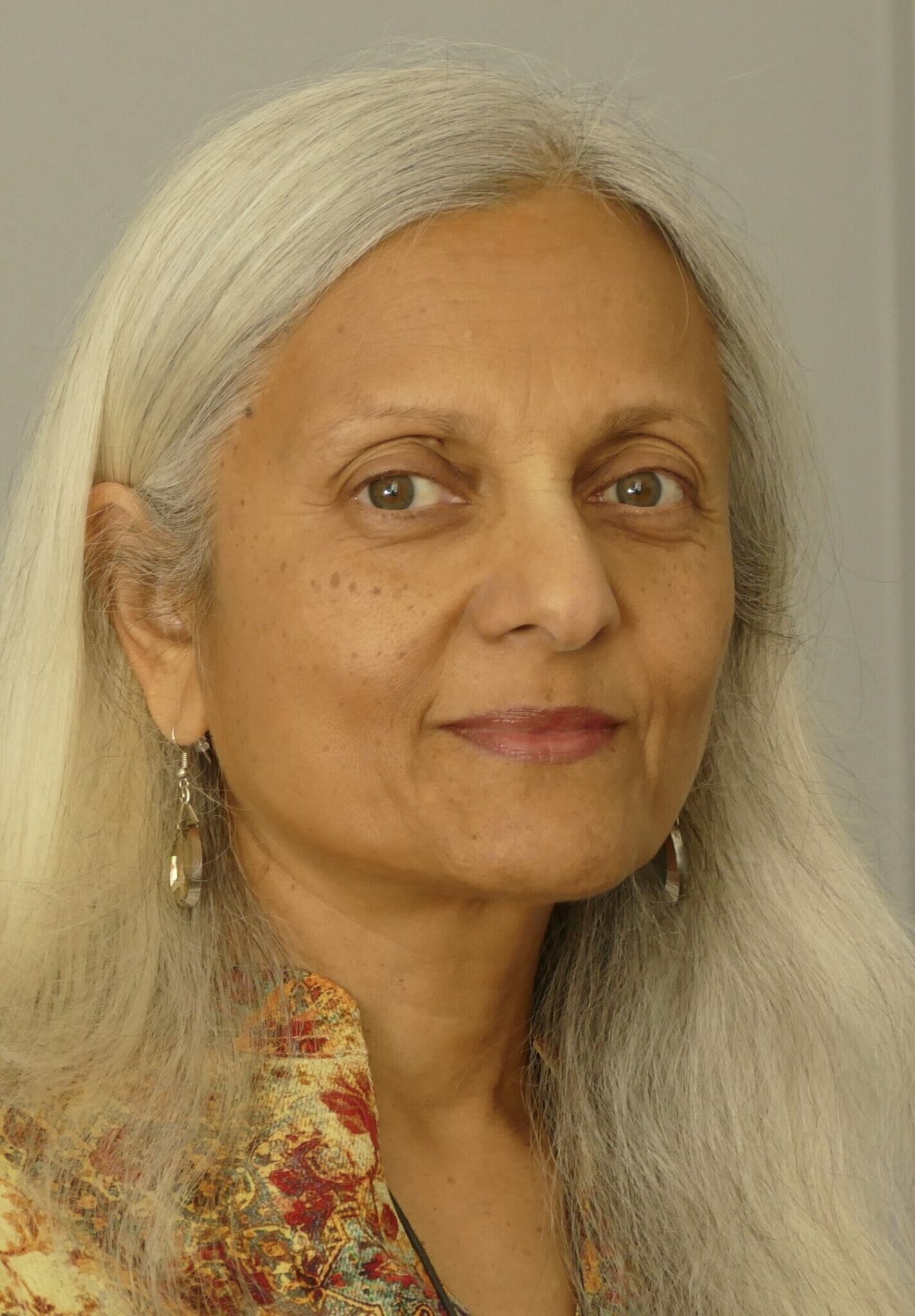
About the author:
Uma Krishnaswami has written books for young readers of various ages. She is faculty emerita, Writing for Children and Young Adults, Vermont College of Fine Arts.