
Tagore, education and nationalism: seeking the unfragmented world
Amman Madan on how Tagore saw India’s contribution to the moral development of humanity
Details
Like many other Indians I had had to memorize Rabindranath Tagore’s poem “Where the mind is without fear” in school. And like them I, too, began to understand it only when I came into my twenties. I say “began” for even today I find new meanings in it.
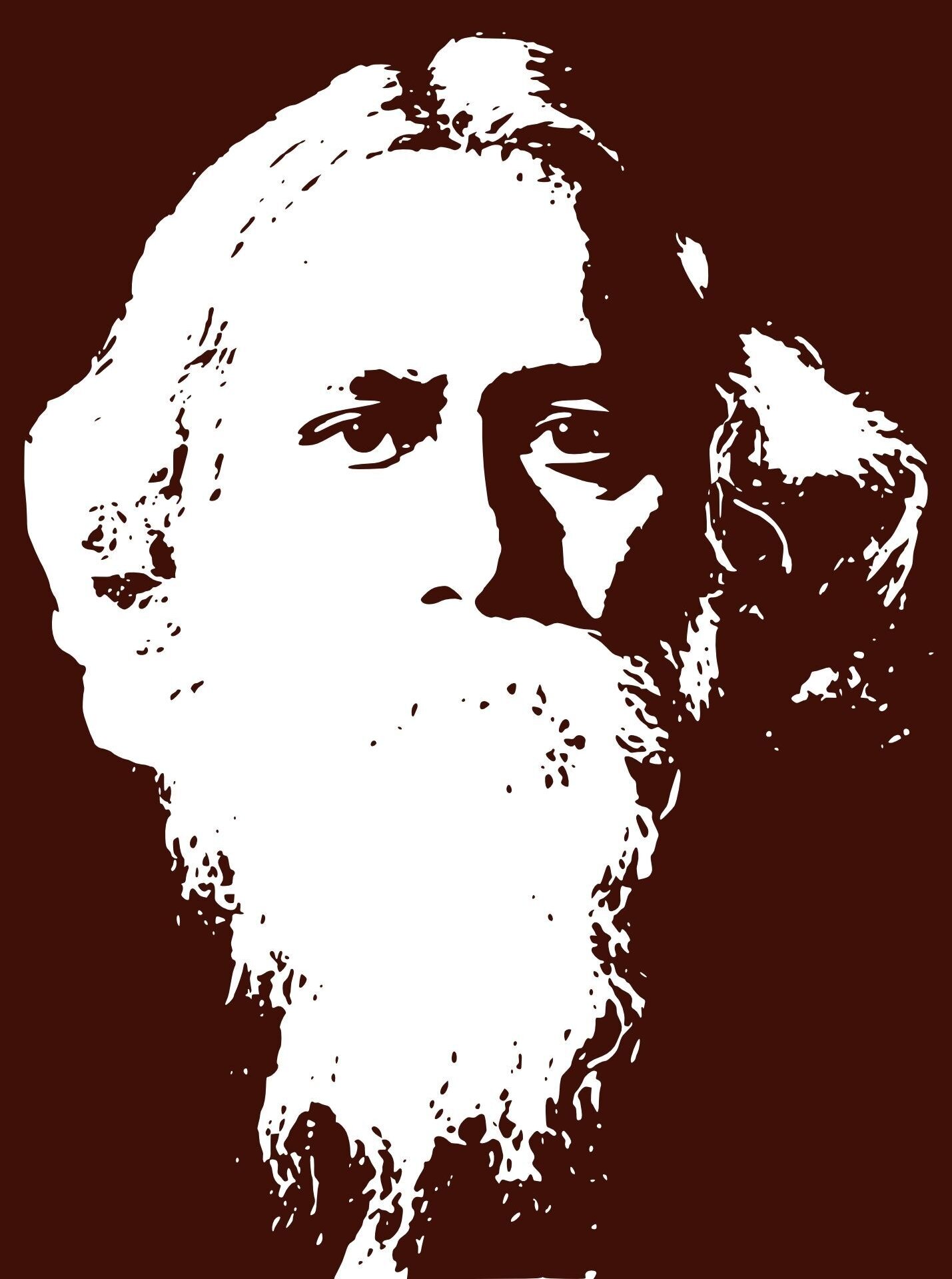
Tagore stands at the cross-roads of many questions with which we Indians struggle even today – How do children or grownups learn? What is the place of love or anger in our lives? What is the nation or, for that matter, what is the spiritual? What are the most important things worth learning? Tagore’s writings give much food for thought, even if I cannot always agree with him. I think this white-bearded man would not have minded my disagreements. He was after all the man who rejected our tradition of social ostracism for those who thought differently. He himself took traditions quite seriously and looked deep into them to search for the truth of India, not as a unique land by itself, but as its contribution to a larger truth of humanity. But he was vocal in his opposition to “the blind and lazy habit of relying upon the authority of traditions that are incongruous anachronisms in the present age” (Tagore 1921, p 114). Blind agreement was something he firmly opposed.
The search for “truth,” which was what he and Gandhi tended to call their search for the best cultural norms, could not be content with the most obvious answers. He wrote that people learned from their experiences and that deprivation might teach one to become a thief. This was the obvious answer and many accepted it. But humans did not stop at just that lesson. There was something within humans, which led them to higher ideals. They learned to overcome deprivation not by theft but by sharing and by love.
In a stark warning against immediate reactions and the habit of taking the easiest path Tagore pointed out that all civilization rested on love and care for others. If humans had just taken the easy path, they would have never achieved the greatness of art, culture and industry which we see today. My economist friends would join me in smiling at this early rejection of the rational economic actor, who once dominated their discipline. At one point of time more and more economists thought that individuals always tried to increase their benefits and minimize their costs. Tagore, however, said that being human was about being moral and about social cooperation. Of course, we had a political and an economic side to us, but the key to being human was our moral side.
Tagore gave a sharp warning to the world of his times, one which we will benefit from heeding even today. He said the West had had few resources and so learned to build strong groups which preyed on each other. They learned more effective ways of making war and so captured the lands of those who had not felt the need to become as predatory as them. The greed for more and more things motivated the improvement of industry and led to an outpouring of goods. This, he said, accelerated into modern times and came together in the form of the “Nation” which was present in many countries. The Nation was a pattern in humans to concentrate political and economic strengths into one organization and then push all the people to become mindless cogs in its machines. India did not have such a Nation and had come under the heel of the military and material power of the form it had taken in Britain.
Tagore was clear that such a concentration of power and materialism was not the same as Western civilization. He said that in its heart the West too understood, like Indians, that the most important principles for humanity had to be moral and not political or economic. But it was getting increasingly swamped by the latter. As the moral got more and more distant from politics and production, the problems of countries increased. They sought to overcome the problems by even more politics and more production.
Greater production was a wonderful thing, he agreed. It saved people from starvation and drudgery. The rise of the rule of law, too, was a great improvement which the West had wrought. This leap in politics suppressed the whimsical acts of kings and tyrants. Tagore insisted that he was a great admirer of Western civilization. That was why he urged them to not allow their higher selves to get drowned under the mindlessness of factory work and the ever-increasing control and surveillance of their citizens.
When I read Tagore after reading Critical Theory I feel a twinge of shame about our habit of reading only Western scholars and not Indians. Yes, there is much that Tagore misses. But there is also much that he says (see, for instance, Tagore 1921, 1961) that Critical Theory misses.
India was captivated by the razzle-dazzle of its conquerors, Tagore reminds me. It ignored its own true self to think that by copying the conquerors it would rise up and become like them. But this led only to becoming another mirror image of the same aggressive, selfish countries, with pretensions of ethics while always scheming to get the better of others. This could never take humans very far. They had to find ways of living in a more cooperative way with others, not in a more competitive way. They had to find ways of living with love for their neighbours, not hatred and jealousy.
India had historically paid attention more to the social rather than the political and economic. And this was actually the most important dimension of the three, Tagore felt. “The truth is that the spirit of conflict and conquest is at the origin and in the centre of Western nationalism; its basis is not social cooperation. It has evolved a perfect organization of power, but not spiritual idealism” (ibid. p 21). The most important challenge in the world then and now was what to do about different social groups (Tagore used the archaic and now rejected term “races”) who were increasingly coming into close contact with each other. He said that, unlike the West, India had paid more attention to the problem of social life and experimented upon it more extensively than others, even if it had not found a perfect solution. It was a sign of its advancement that all the different social groups which came into India down the years became its own. The British too would become India’s own (after all, which language are you reading this in?). This acceptance and re-arranging was India’s contribution to the moral development of the whole of humanity.
One of India’s attempted solutions to the problem of social relations which ultimately failed, Tagore said, was the caste system. It failed because it forced large numbers of people to live in humiliation and prevented them from following their talents and passions in work, holding them back instead into their ancestral occupations. Another of its attempted solutions was the poetry of Nanak, Kabir and Chaitanya, which taught people to love the same God, each in their different way.
Humanity faced many challenges in its search for the perfect harmony of elements, Tagore believed. India in its own way was carrying forward that common search of all humanity. But when it began to imitate its conquerors it became untrue to itself and fell downward into the path of hatred and never-ending strife between social groups.
Tagore thought to be lazy those who declared that India had found all its answers millenia ago and all we had to now do was to publicize them. The journey was yet unfinished. His trenchant critique of what later scholars called the state and modernity drew him to learning about and spreading a better harmony between humans and nature as well as harmony between the moral, the social, the political and the economic. The way forward for him was to build institutions where people created and learned this new harmony. Education for Tagore became as necessary as his writing.
Tagore’s views on education (see Jha 1994 for a short overview of his many writings and lectures on education) were closely linked to his views on western and Indian civilizations, harmony between humans and nature and the importance of cooperation between social groups for human progress. Like many educationists before him – Rousseau, Montessori, Froebel and so on – Tagore believed that the education of children had to be different from that of adults. Children were to be taught through directly experiencing life and nature. Playing with colours, words, objects they would gradually move to a more abstracted contemplation of their existence. It was important to teach how to work in offices and to have an ascetic immersion in learning. But that should come later, he believed.
The education of all – children as well as grownups – should include what was essentially human and also what was essential to an Indian voice in humanity. If we ignored this then the disharmony created would eventually come back to bite us. Pupils in schools as well as universities should learn that politics and industry were important, but being human they had to learn to give priority to the moral over all else. This was a sharp contrast with today’s fear-ridden rush towards coaching centres, where the terror of being left out of the market drives away all other life choices. This, Tagore would have felt, was our continued submission to the violence of the market over the moral. No wonder that there were so many tragic suicides or that the majority of young people were left scarred and angry by their school and college experiences.
Tagore believed that the greatest search and striving within Indian civilization was about how different social groups could live with each other in harmony and justice. Education had to play a big role in this, teaching children and adults how to cooperate with each other, rather than compete. Classrooms and assessments should be about learning to listen, reflect and create and especially about learning to collaborate with others. He would have been puzzled and horrified at how today’s schools teach students to enjoy getting two marks more than their friends. When we see organizations, political parties and countries teaching youth to spout hatred against others he would have said that this was the result of our copying the violent cultures of the exploitative, materialistic Nation rather than seeing what Indian culture was.
The education Tagore dreamt of and the institutions he set up always tried to do a critical selection from Indian culture and tried to integrate it with what was admirable in other countries. He began to cultivate vernacular languages in schools and universities, as a way to connect the lives and thoughts of ordinary people with the elites. He believed that the knowledge taught in universities should be of relevance to farmers and artisans, not just educated babus. Tagore searched far and wide for teachers who could teach such knowledges, for instance who could add the lessons of modern science to the best in traditional Indian agriculture while also giving due primacy to the spiritual, the moral and the aesthetic in agriculture. The beauty of rice fields at dawn could inspire learning to cooperate with each other and scientifically discover better cultivation methods. Young people began to understand that social relations were reinvented when they brought fragmented landholdings into cooperative farms. This movement away from relations between landlords and tenants was seen as a step towards a greater proximity with the divine. This broke in several ways with how other Indian and western universities were built.
Tagore was far from satisfied with the results of his experiments in education. After all his ambition was not a small one: it meant not only identifying the best from Indian traditions but learning from other sources, too, so as to make headway in the great challenges humanity faces – how can different communities live together in close proximity with peace and justice, how to produce in a sustainable way which meets needs but does not fuel greed and jealousy, how to govern ourselves so that justice and freedom prevails, amongst others. Indian educational institutions have a long way to go before we approach his vision.
I was in my late twenties when I read Tagore’s lecture “My school”. I was wondering at that time what to do with my life. It had to have something to do with education, I knew, since this was the path through which people had to pass if they were to get over hatred, injustice and oppression. It was electrifying then to read the opening lines of his lecture:
“I started a school in Bengal when I was nearing forty. Certainly this was never expected of me, who had spent the greater portion of my life in writing, chiefly verses. Therefore people naturally thought that as a school it might not be one of the best of its kind, but it was sure to be something outrageously new, being the product of daring inexperience.”
Here was a great poet who dared to think about education, that domain which the Indian middle classes held in silent contempt. And he was willing to change directions, make mistakes, by taking leaps into exciting new terrains.
I admire a lot in Tagore and I also note the many gaps in his thought. There are some things which I don’t understand, like his talk about the spiritual. There are some things which we now reject like his talk about races and the universal man and his teleological ethics. Nonetheless over the years I have shared that lecture of Tagore’s with hundreds of my students, it helped us to together imagine that other kinds of schools were indeed possible. There could be a school where climbing a tree was as important as reading a book. Where love was the central principle of learning, not competition or showing the others down. Education deserved to be thought about very seriously and never to be reduced to the cramming of dry words and paper, something which he raged against in his “The Parrot’s training”.
I see his ideals and that of many other scholars and realise that we have a long way to go yet. With him and the others, I see that cooperation and paying attention to our moral dimension is indeed the answer through which humanity can continue to improve upon itself. And if sometimes one has to break from the rest in order to nudge them forward, then ekla chalo re.
About the author
Amman Madan studied Anthropology and Sociology at Panjab University and Jawaharlal Nehru University and currently teaches at Azim Premji University, Bhopal. He works on promoting cultures of dialogue, justice and fraternity amongst children and youth.
References
Jha, Narmadeshwar. “Rabindranath Tagore.” Prospects: The Quarterly Review of Education 24, no. 3⁄4 (1994): 603 – 19.
Tagore, Rabindranath. Nationalism. London: Macmillan and Co, 1921.
Tagore, Rabindranath. Towards Universal Man. London: Asia Publishing House, 1961.