
Nature, People and Sustainability: Celebrating the Interconnectedness in Making of Cities
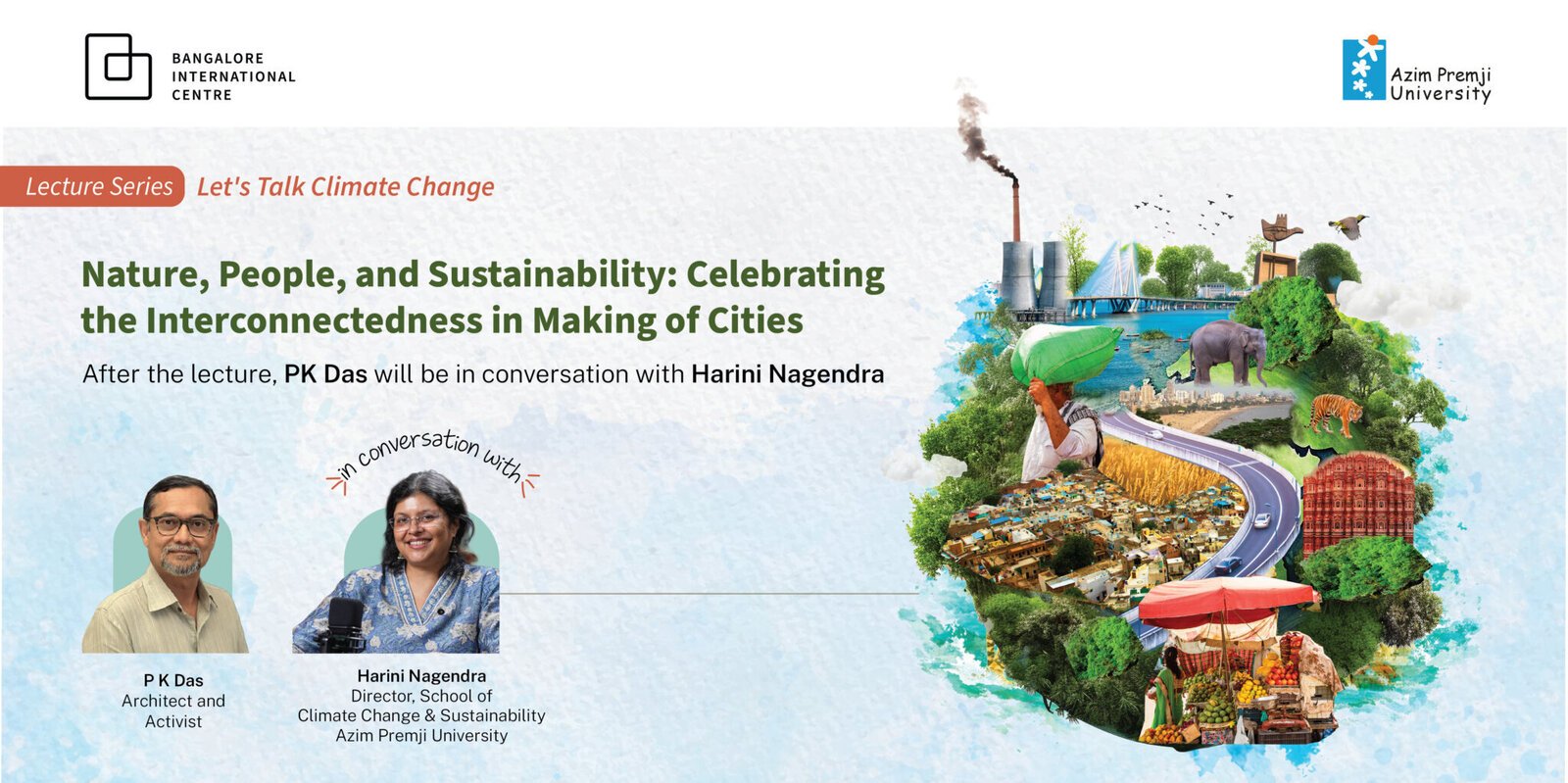
P K Das, architect and activist, connects nature, people and sustainability, with Harini Nagendra.
Details
Today, we the people are most affected by the breakdown of the interconnectedness of an inherently sustainable planetary order. The bitter impact of the brutal destruction of nature has consequences on the social and environmental aspects of life in our cities too — an increasing number of people pushed to the margins through the divided or territorialised spaces, and natural ecology trampled, destroyed and colonised for the private profit of a few.
The way forward is to recognise and celebrate the interconnectedness, to understand, revive, and reinvigorate the natural connections between different forms of life that constitute a sustainable planetary order. Public celebrations of the interconnectedness are a form of collective intervention beyond the boundaries of caste, religion, gender, class and cultures, to make cities equal and accessible to all. The interdependent relationships between people and between people and nature must be celebrated too.
To celebrate the interconnectedness in the making of a city, the speaker suggests the idea of Linear Parks as an effective democratic means towards equity and justice in social, spatial, and environmental terms. This approach challenges the prevailing order of centralisation, hierarchy, and control. The talk explores the implementation of Linear Parks, including their successes and shortcomings, with reference to a movement in Mumbai. The intent is to spark new imaginations and different ways to intervene and influence change towards building equal, just, and sustainable cities.
Speaker profile
P.K. Das is popularly known as an Architect – Activist. His priority has been to establish a very close relation between architecture and people by involving them in a participatory planning process, while critically responding to the question of sustainable ecology of cities.
His wide spectrum of work includes organising slum dwellers for better living and evolving affordable housing models, engaging in policy framework for housing and urban development, reclaiming public spaces including developing the waterfronts, protection and conservation of natural areas, re-envisioning the city of Mumbai, along with an architectural practice involving urban planning, urban design, architecture and interior design assignments across India.
He has authored several books and publications and has delivered talks and lectures across the world. In response to these larger questions, he founded and is publishing a fortnightly e‑journal ‘Question of Cities- A Forum for Nature, People and Sustainability’. His work in the development of Mumbai’s coastline and his slum rehabilitation projects has won him several national and international awards including the First Urban Age Award instituted by the London School of Economics and Deutsche Bank conferred to the Mumbai Waterfronts Centre of which Das is the Chairperson. He has also been conferred with the prestigious First International ‘Jane Jacobs Medal- 2016’, instituted by The Rockefeller Foundation.
He has been widely published and has also delivered talks and lectures across the world, at IFLA World Congress in 2016 at Torino, Italy; Smart City Expo World Congress held in 2014 at Barcelona, Urban Waterfronts conference in 2014 at Columbia University; 2013 MAS Summit, New York City, The Rockefeller Foundation Bellagio Centre in 2012 at Bellagio, Italy; Morgan Tomorrow Congress in 2009 at Amsterdam; Urban Age Conference South America, Sao Paulo, Brazil in 2008; XXIII UIA World Congress in 2008 at Torino, Italy; Global Talk at T.U. Delft University, New York University Abu Dhabi and others in India.
Interlocutor
Harini Nagendra, Director, School of Climate Change and Sustainability, Azim Premji University.
Harini Nagendra’s work focuses on forest conservation by communities, urban commons, and climate change amongst other themes. She is a well-known public speaker and writer. Her books include Nature in the City: Bengaluru in the Past, Present and Future; Cities and Canopies: Trees of Indian Cities; So Many Leaves, and Shades of Blue: Connecting the Drops in India’s Cities. She also writes the acclaimed Bangalore Detectives Club series; a set of historical mysteries set in 1920s Bangalore.