
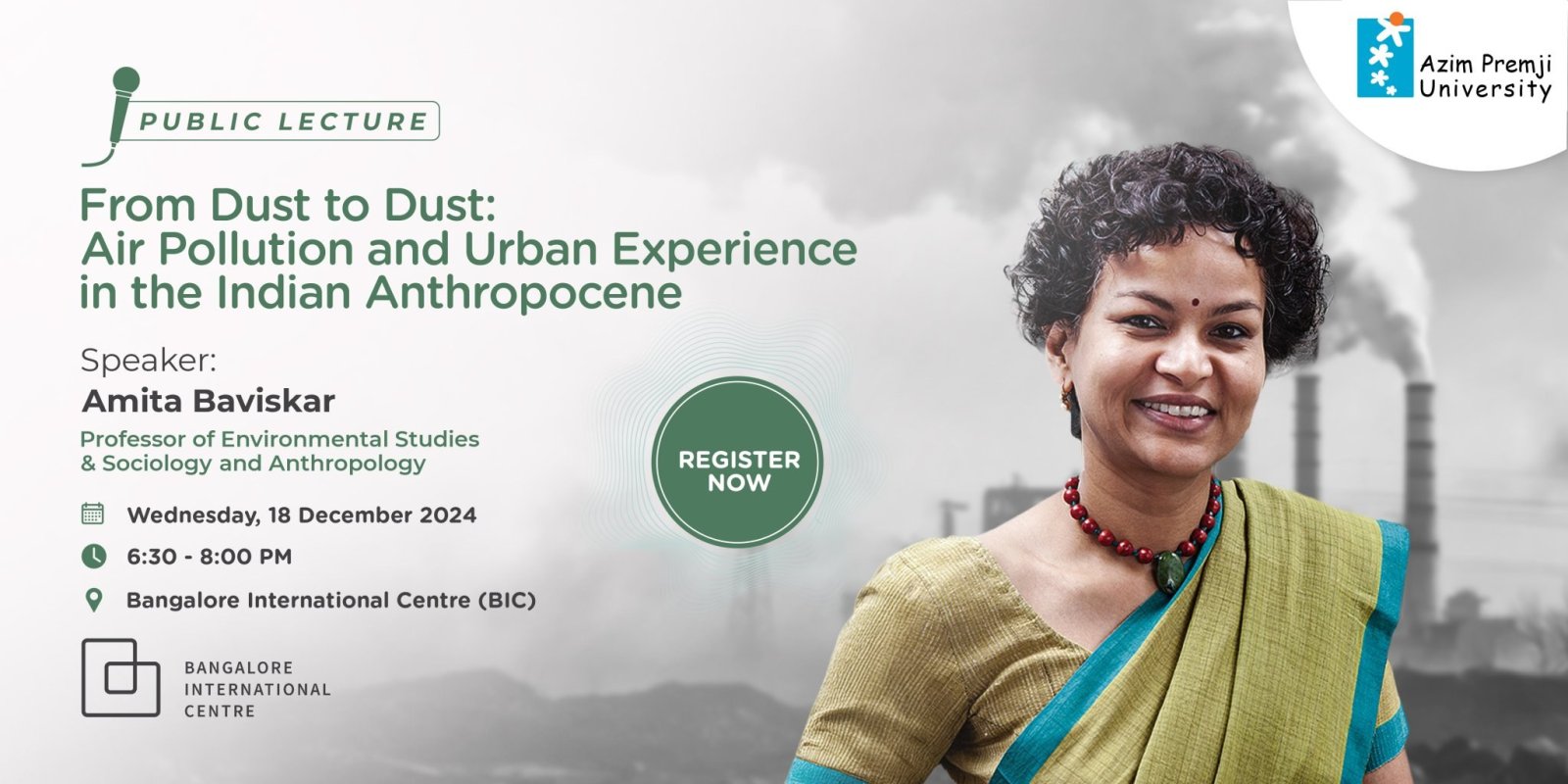
From Dust to Dust: Air pollution and urban experience in the Indian Anthropocene
Why does Delhi’s severe air pollution fail to spark urgent action? Join Amita Baviskar to explore its cultural and urban implications
Details
About the Lecture: Situated on the hot and dry north Indian plains, the city of Delhi has always lived with dust. But in the last three decades, dust has transformed into a problem: air pollution. In the world’s most polluted capital city, debates about dust rise and subside like seasonal storms, never quite becoming a public priority. Why? Despite its severe impacts on health, why does air pollution become yet another element in a deteriorating urban environment to be borne and lived with, rather than a public emergency that calls for urgent and drastic action? My talk will address these questions by situating them within the cultural politics of environment and development.
About the Speaker: Amita Baviskar, Professor of Environmental Studies and Sociology at Ashoka University, is renowned for her groundbreaking work on India’s cultural politics of environment and development. Her research spans resource rights, social resistance, and urban-rural ecological transformations. Currently, she studies food systems, agrarian change, and Delhi’s air pollution and heat experiences.
Author of In the Belly of the River and Uncivil City, Baviskar has also co-edited works on India’s middle classes and urban ecology. She holds a PhD in Development Sociology from Cornell University and is the recipient of several prestigious accolades like the Infosys Prize for Social Sciences (2010), the VKRV Rao Prize (2008), and the Malcolm Adiseshiah Award (2005). Baviskar has been instrumental in shaping environmental sociology and the study of social movements in India.