
Whispers from the Soil
On World Soil Day, library educator Sowmya Ravindranath explores how soil provides a fertile ground for ecological, social, ethical and political discourses in Indian children’s books.
Details
In the cultural memory of India, soil has always occupied a place of reverence. Alluded to as the divine and the feminine, remembered as Bhudevi and Dharini, soil is imagined as a mother, a guardian, a nourisher and a symbol of fertility. In the epic Ramayana, Sita is the daughter of mother earth — the baby who was found in the soil and the woman who returns to the soil in her finality. Mannina maga (son of the soil in Kannada) is often used to describe people who are deeply connected to the land and have an affinity for agriculture. However, ‘son of the soil’ in political thought today encodes the native versus migrant rights issue. As the top layer of the earth, soil is the force that feeds life above and below. Closely linked to many Sustainable Development Goals drafted by the UN, healthy soil plays a crucial role in mitigating risks of climate change and alleviating poverty, hunger and inequality. How are Indian children’s books engaging with these complex ideas surrounding the soil?
Traditional Tales and Lore
Tracing the depiction of soil in children’s books, it is easy to see that fiction dominates. Dilip M. Salwi’s Meet the Soil Fairy is one of the earliest books that revolves around the vital importance of soil. Personified as a fairy, soil convinces eight-year-old Bacchu that it is more than just dirt. He learns that if soil is degraded, lifeforms will die.
Devastation through soil erosion is the premise of Geeta Dharmarajan’s Ma Ganga and the Razai Box. Illustrated by Sonali Biswas, this is a mythological story of young Yasho who laments that the flood has carried away the precious topsoil. How will their trees grow, she demands. River Ganga responds with a challenge — she will return to the hill and nourish the soil only when they find Lord Shiva’s matted hair.
In Aditi Iyer’s Maati, young Bhuvi longs to understand the spirit of the soil. Her grandfather tells her of Maati, the earth that once gave their community a bountiful life. “When it caught sunlight, it shone like black gold,” he recalls, remembering a time before the village turned to “peculiar potions” to force the land to yield more. Greystroke and P.G. Dinesh’s The Magic Powder uses the folktale form to explore the relationship between soil, food and labour. In the story, Theingi sets out to turn dirt into gold, only to discover that the real treasure lies in the hard work that transforms soil into sustenance.
Sons and Daughters of the Soil
Stories of soil are rife with people who face adversities with resilience. Vinayak Varma’s Jadav and the Tree Place tells the real life story of Jadav Payeng, the ‘Forest Man of India’ who single-handedly transformed a barren sandbar on the Brahmaputra into a thriving forest. Chipko Takes Root by Jeyanthi Manokaran introduces young readers to the Chipko movement, where villagers, especially women, hugged trees to prevent deforestation and consequently protected soil, water and ecosystems. A neglected urban dump is the setting of Nandita da Cunha and Priya Kuriyan’s The Miracle on Sunderbaag Street. This book highlights how with small and persistent effort a degraded spot can be transformed into a beautiful thriving garden.
Meghaa Gupta’s Unearthed: An Environmental History of Independent India offers older readers a sweeping look at how soil, land and natural resources have shaped India’s post‑independence journey. From the green revolution and dam protests to saving seeds and the climate catastrophe, Gupta takes a critical look at the country’s complex environmental trajectory.
The Science of Soil
While the non-fiction space is mostly dominated by real-life stories, there is a small collection of books that introduce the science of soil. Sandhya Rao’s Sun, Seed, Soil offers an introduction to how seeds sprout, how sunlight fuels growth and how soil nurtures life. Know About Soil: The Precious Earth by Vijita Mukherjee takes a more informational approach, explaining soil layers, microorganisms and the role of insects and animals. Beeji’s Story follows the journey of a seed through different terrains, finally returning to soft soil to bloom and grow. Niveditha Reddy and Shubhshree Mathur’s Rain Perfume tells a gentle story of the relationship between a grandfather and granddaughter who bond over the smell of petrichor. The book makes an implicit connection between soil chemistry and water.
Mining Matters
Made of mineral, organic matter, water and air, soil holds the key to many life forms. For humans, soil is not just a source for growing food, but also a base for land development. If ‘development’ is on the agenda, can degradation and displacement be far behind? In the last few years, we’ve seen a clutch of children’s books that make the case for people and places affected by mining activities and bring to the forefront how soil becomes a site for struggle.
Rinchin and Sagar Kolwankar’s I Will Save My Land follows Mati, a young girl in Chhattisgarh who refuses to give up her family’s farmland to a mining company. Siddhartha Sarma’s Year of the Weeds offers a more complex narrative on the same theme for older readers. Korok, a young Gond boy, watches as a sacred hill is threatened by bauxite mining. The novel exposes the nexus between corporations and the state, and the violence inflicted on communities when soil becomes a commodity. In Nandita da Cunha’s Pedru and the Big Boom, a boy in Goa grapples with the environmental and social consequences of mining in his village. Devashish Makhija’s Oonga follows a young Adivasi boy caught between preserving his cultural heritage and making way for industrial development. These books depict how as a contested ground, soil shapes not only power and profit but also livelihood and childhood.
Connecting Craft and Caste
While soil is the ground from which life grows, it is also a raw material for several craft-based communities. A few children’s books highlight the role of clay in social hierarchies and cultural knowledge.
Vishakha Chanchani and Stephen P. Huyler’s The House that Sonabai Built is a photographic ode to the protagonist Sonabai Rajawar’s artistic journey from her first creations in clay to winning global acclaim for her creative work. Sheela Preuitt, Praba Ram and Debasmita Dasgupta’s The Doll That Bommakka Made tells the story of a clay ball shaped into a Thanjavur thalaiatti bommai crafted by the doll-maker Bommakka. Maheen Mirza’s The New Potter follows a young girl learning the craft of pottery. It highlights the skill, patience and intimacy involved in shaping earth, while acknowledging the challenges faced by traditional artisans. Kancha Illaiah and Durgabai Vyam’s Turning the Pot, Tilling the Land introduces young readers to caste‑based occupations tied to the soil — potters, farmers, labourers. It reveals how those who work most closely with the earth often face the harshest discrimination. The book becomes an entry point into understanding soil as social and ethical terrain.
Feast of Life
At its heart, the story of soil unfolds through food, insects, plants, seasons and the biodiversity that thrives in and around it. Niyatee Parikh Sharma and Vibha Surya’s The Tomato Thief, The Tomato Flood, Harvest Day and A Bounty of Chillies bring to the forefront families who enjoy gardening and growing their food. Anumeha Yadav’s Our Rice Tastes of Spring celebrates the diversity of native rice varieties, reminding readers that soil carries flavour, memory and culture.
Anisha Jayadevan, Ishika Ramakrishna, Jahnavi Rajan and Manini Bansal’s The Living Museum turns the spotlight on everyday surroundings and natural wonders, encouraging children to notice the life teeming in soil‑rich spaces. Suhel Qader, Vena Kapoor and Labonie Roy’s Be a Neighbourhood Naturalist urges young readers to observe insects, plants and micro‑habitats that reveal soil as a biodiversity hotspot.
Clearly, soil is more than just the dirt beneath our feet. It’s a keeper of myriad stories and a reminder that the richest ideas often come from the ground up.
Bibliography:
- Meet the Soil Fairy (Ratna Sagar)
- Ma Ganga and the Razai Box (Katha Books)
- Maati (Karadi Tales)
- The Magic Powder (Pratham Books)
- Jadav and the Tree Place (Pratham Books)
- Chipko Takes Root (Pratham Books)
- The Miracle on Sunderbaag Street (Kalpavriksh)
- Unearthed: An Environmental History of Independent India (Penguin)
- Sun, Seed, Soil (TERI)
- Know All About Soil: The Precious Earth (TERI)
- Beeji’s Story (Tulika)
- Rain Perfume (Kalpavriksh)
- I Will Save My Land (Tulika)
- Year of the Weeds (Duckbill)
- Pedru and the Big Boom (Kalpavriksh)
- Oonga (Tulika)
- The House that Sonabai Built (Tulika)
- The Doll that Bommakka Made (Pratham Books)
- The New Potter (Muskaan)
- Turning the Pot, Tilling the Land (Navayana)
- The Tomato Thief (Tota Books)
- The Tomato Flood (Tota Books)
- Harvest Day (Tota Books)
- A Bounty of Chillies (Tota Books)
- Our Rice Tastes of Spring (Red Panda)
- Shorewalk (Tulika)
- The Living Museum (FERAL)
- Be a Neighbourhood Naturalist (Juggernaut)
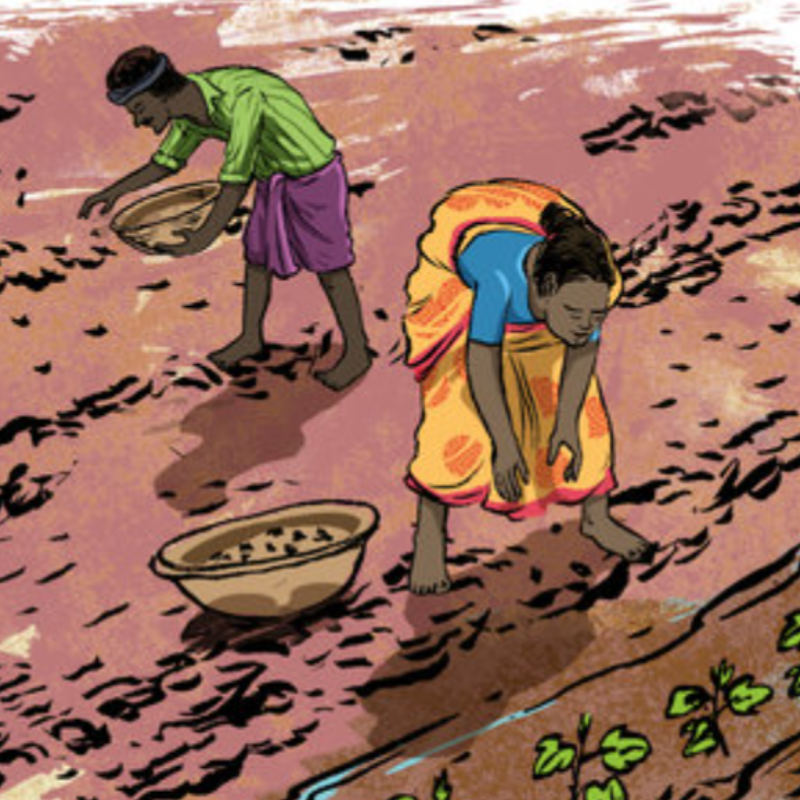
Image from The Seed Savers / Jayesh Sivan (Pratham Books)
About the author:
Sowmya Ravindranath is a library educator, who is deeply interested in making libraries safe spaces for children to explore their inner and outer worlds. She can be contacted on sowmya.ravindranath@gmail.com