
Trends in Green Kidlit: A 2024 Round-Up
Children’s literature increasingly explores environmental themes, with 2024 showcasing diverse works that inspire young readers toward sustainability and action.
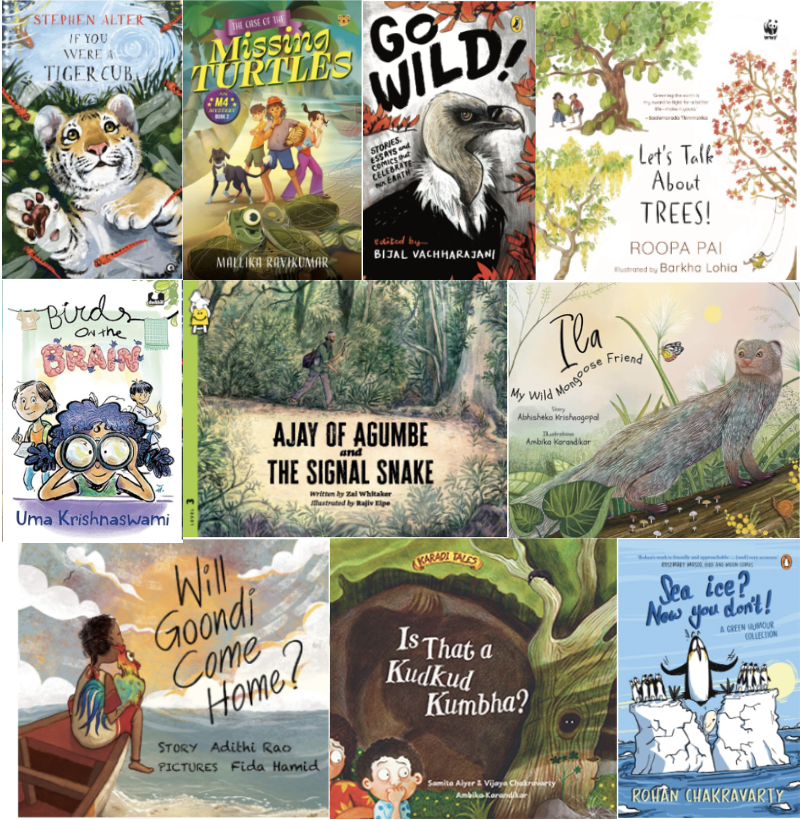
Details
It is often said that books reflect and represent the experiences, emotions and complexities of human life, allowing us to see ourselves and the world around us as if we are looking into a mirror. So it’s not surprising that at a time when the world is witnessing environmental crises of all kinds, there is a clear demand for children’s literature that helps make sense of issues like climate change, deforestation, pollution and biodiversity loss.
Today, we have publishers, book imprints, writing courses, literature festivals and more that are exclusively dedicated to children’s literature on the environment. Publishers like Kalpavriksh and TERI Press focus on children’s books that showcase nature and delve into the complex relationship between human beings and the environment. Other publishers like Penguin Random House, Hachette, HarperCollins, Tulika, Karadi Tales, Tara, Speaking Tiger and Pratham also have many green books in their lists. Such books have been highlighted in the catalogues of new children’s imprints as well: Indian Pitta, India’s first dedicated imprint for bird lovers, conservationists and policymakers, ventured into children’s books in 2024 with The Great Indian Nature Trail with Chunmun and Let’s Talk About Trees, published in association with WWF-India; while Perky Parrot, the children’s imprint of Niyogi Books, also brought out a clutch of environmental titles.
In 2020, Azim Premji University launched a Nature Writing for Children webinar series featuring curated conversations with creators of green books. The series garnered a high level of interest, inspiring many people to write on green themes for children. This prompted the university to begin a certificate course on nature writing for children in 2022.
Founded in 2021, the Green Literature Festival curates honour lists of environmental literature and promotes the reading, writing, teaching and publishing of this literature in India. Similarly, the Kumaon Literary Festival integrates sustainability and ecological concerns into its programming, with a focus on forest walks and heritage paths, to create a unique festival experience.
A catalyst for green publishing globally was the Swedish environmental activist Greta Thunberg’s Fridays for Future. Founded in 2018, it was a movement of students who protested climate change by skipping school on Fridays. A year after the movement, data from Nielsen Book Research showed that the number of new children’s books looking at the climate crisis, global warming and the natural world had more than doubled and sales too had gone up. Publishers around the world called this boom the ‘Greta Thunberg effect’. Although India already had a long tradition of writers such as Arup Kumar Dutta, Ruskin Bond, Zai Whitaker and Ranjit Lal writing books on nature, the years since 2018 have seen a spurt in green publishing. Creators like Bijal Vachharajani, Stephen Alter, Yuvan Aves, Rohan Chakravarty, Sangeetha Kadur, Maya Ramaswamy et al have been consistently bringing out books that draw young people into a deeper engagement with environmental issues that affect their lives.
Not only are more books being published, but in keeping with the current National Education Policy, which emphasises environmental responsibility and sustainability in the curriculum, schools too are asking for more green literature for their libraries and are interested in including green voices in their literature festivals.
With young people spending more and more time on their screens, ‘nature deficit disorder’ is a very real thing today. Although green books cannot be a substitute for time spent outdoors, they offer a good starting point to build the empathy needed to spur environmental action. Like in recent years, in 2024 too, publishers continued offering a diverse range of green books to meet this need.
While wildlife has long been one of the most popular themes in children’s books on the environment, there was an extraordinary focus on avian life in the year gone by. From koels to kudkud kumbhas, Karadi Tales had birds of different feathers flocking nicely together, while Adithi Rao and Fida Hamid’s Will Goondi Come Home? had a rooster kukdukooing its way into our hearts. Meanwhile, Birds on the Brain by Uma Krishnaswami was a masterclass on how to keep fiction factually accurate without losing emotional appeal.
It was also a rich year for anthologies. Back in 1998, Penguin India had given us The Rumbling Island: True Stories from the Forests of India, which featured pieces by some of the finest naturalists of the time. This year, they repeated the feat with the eclectic and gorgeously produced Go Wild: Stories, Essays and Comics that Celebrate the Earth, featuring original writings and illustrations by some of the finest contemporary voices on the environment. For those seeking more classical fare, Hachette India brought out The Young Earth Lover’s Book of Nature where William Wordsworth, Jim Corbett and Robert Frost sat alongside Rabindranath Tagore, Dhan Gopal Mukerji and Sarojini Naidu. Both the anthologies had beautiful covers and some common contributors. We were also delighted to see a brand-new reprint of Zai Whitaker’s Cobra in My Kitchen and Other Adventures with Wildlife: Stories, Poems, Essays from Hachette.
Books in series — most notably from Duckbill — have become ubiquitous over the past few years. Many of these books cover environmental themes. In 2024, for instance, we had Lavanya Karthik’s The Boy Who Built a Secret Garden: Nek Chand, yet another title in her well-liked Dreamers series. Meanwhile, HarperCollins brought out The Rain Harvesters by Sylvia Sikundar and Stephen Aitken, as part of a new series on important environmental issues such as water pollution, biodiversity conservation, the pet trade and poaching.
For a niche theme, the environment also found itself at the heart of many debuts such as Vardhini Amin’s The Forestborns, Samita Aiyer and Vijaya Chakravarty’s Is that a Kudkud Kumbha? and Sharanya Kunnath’s Lakshmi’s Little Bird.
Even though there was a surfeit of books, not many pushed the boundaries to tap into new research on the environment. From fungi and trees to rivers and animals, today we know a lot more about the inner lives of non-human beings. Yet, baldly projecting human characteristics on these life forms remains common. Environmental fiction with non-human protagonists needs to work harder to break out of this convenient mould. A good example to follow is Nilanjana Roy’s The Wildings. Published in 2012, it tells a thrilling story about the stray cats of Nizamuddin without ever compromising on the intricacies of feline behaviour.
The diversity in non-fiction has been consistently expanding over the years. This year too, there were books like Anu Kumar’s Flying Horses, Secret Rivers, Magical Cities: Incredible Adventures in India and Beyond that contained unusual histories of the natural world, and Roopa Pai’s Let’s Talk About Trees, a stunningly produced book on Indian trees. We also loved Muriel Zurcher and Sua Balak’s Bio-Inspired! The Living World Shows the Way published by Eklavya. Translated from French, it explores human inventions inspired by nature’s genius. Cartoonist Rohan Chakravarty continued to entertain and educate with his 2024 Green Humour collection Sea Ice? Now You Don’t! But is there a need to create more literature connected immediately to the environmental issues of our time? We definitely believe so.
When we sat down to pick our favourite nature books of 2024 (for children), we were delighted to find an eclectic mix to choose from. While there were many good ideas, here’s our list of recommended reads from the year gone by (in no particular order):
- Is that a Kudkud Kumbha? by Samita Aiyer, Vijaya Chakravarty and Ambika Karandikar, published by Karadi Tales
- Birds on the Brain by Uma Krishnaswami, published by Duckbill
- Ajay of Agumbe and the Signal Snake by Zai Whitaker and Rajiv Eipe, published by Pratham
- Will Goondi Come Home? by Adithi Rao and Fida Hamid, published by Tulika
- Let’s Talk About Trees by Roopa Pai and Barkha Lohia, published by WWF/Juggernaut
- If You were a Tiger Cub by Stephen Alter, published by Aleph
- Go Wild: Stories, Essays and Comics that Celebrate the Earth, edited by Bijal Vachharajani, published by Puffin
- Ila, My Wild Mongoose Friend by Abhisheka Krishnagopal and Ambika Karandikar, published by Kalpavriksh
- Sea Ice? Now You Don’t! by Rohan Chakravarty, published by Penguin
- The Case of the Missing Turtles: An M4 Mystery: Book 2 by Mallika Ravikumar, published by Talking Cub
It’s a privilege to be part of someone’s childhood and an astonishing achievement to be able to shape their ideas about the world, and we’re grateful for an opportunity to do this with our newsletter. We would like to thank all our readers and supporters, and wish everyone a green year ahead!
About the authors:
Meghaa Gupta and Vidya Mani are the editors of the Nature Writing for Children Newsletter published by Azim Premji University.