
Stories on the Move
On World Sustainable Transport Day, educator Simrita Kaur takes a trip through Indian children’s literature to uncover the many ways in which it spotlights eco-friendly travel.
Details
When Swedish climate activist and founder of Fridays For Future Greta Thunberg spoke at the United Nations summit in 2019, she emphasised the need for opting for greener modes of travel. Her message about sustainable travel takes on a different kind ofrelevance when we consider the ground realities in a country like India, where it is considered extremely normal for roads to erupt into holes under the sheer volume of vehicles.
To what extent is children’s literature in India making a case for greener modes of travel? Is it actively presenting public or low emission transport as a conscious green choice? Is it in any way shaping children’s perceptions of transport and environmental responsibility?
Vehicles, Vehicles Everywhere
Autorickshaws, cycle rickshaws, buses, tongas and bicycles are everyday fixtures in children’s literature. They mirror the real-life rhythm of Indian streets. Even when the stories are not specifically about travel, it is normal to have double-page spreads that encapsulate this daily business of our streets.
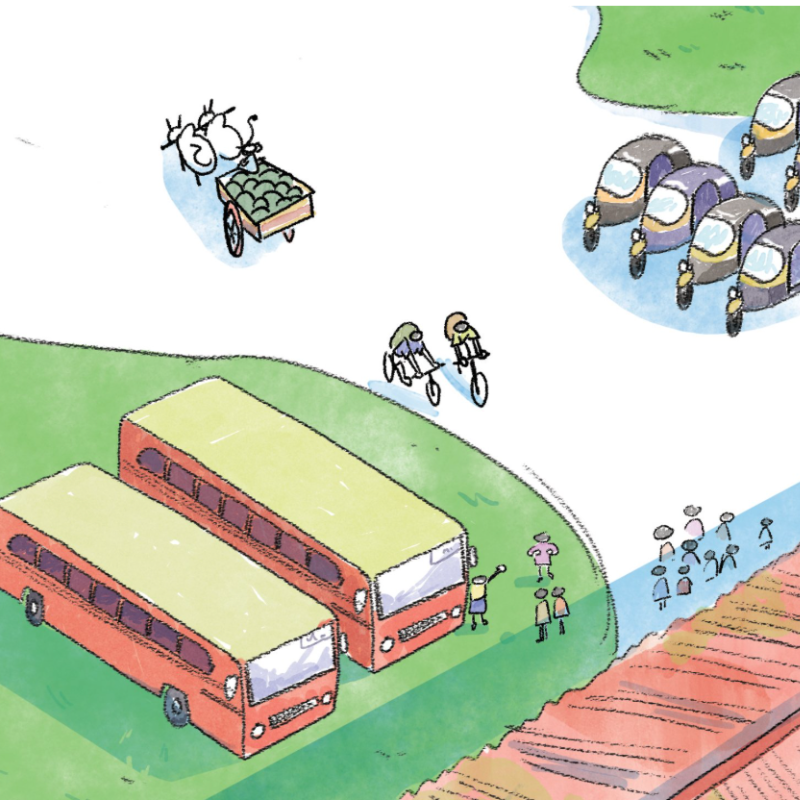
Think French artist Joëlle Jolivet’s An Indian Beach or Deepa Balsavar’s Nani’s Walk to the Park. Even though the central theme of these books has little to do with mobility or making environmentally-conscious choices, their colourful, busy spreads immersed in everyday Indian life capture the chaos of our roads, presenting and putting on display the wide array of transportation. In Menaka Raman and Sushant Ahire’s Nanammal and Kamalathal Travel by Road, two old women bitten by the travel-bug dash to catch a train to Goa, hopping on all conceivable forms of road transport on their way to the station. Their travel adventures continue in Nanammal and Kamalathal Travel by Sea.
The ubiquitous and humble autorickshaw makes for an unusual protagonist in B. Vinayan’s Beyond the Blue River. Through lucid prose and magic realism, he transforms the life of a perfectly mechanical creature — GRACE City Auto for Hire No. SD 013422 — into a metaphor for human existence. A similar personification plays out in Ken Spillman and Ajanta Guhathakurta’s The Auto that Flew. Meanwhile in Aruna Shekar and Sandhya Prabhat’s Asha the Auto-Driver a woman auto-driver smashes gender stereotypes as she picks up and drops off passengers at the railway station, the beach, the cricket stadium… stringing and selling jasmine all the way.
In many books transport becomes an indirect reflection of class, aspiration and access. In the Farmer Falgu series, for example, the ever-resourceful farmer is shown travelling on his trusty tonga. In Meghaa Gupta and Habib Ali’s A Home of Our Own, an abandoned car becomes a site for playing ghar-ghar (house-house) — an object discarded by one group of people becomes a symbol of safety and aspiration for another.
Train Tales
Trains in India have a distinct cultural significance. Both local and long-distance, they connect villages, towns and mega cities in ways few other transport systems can. On the Metro by Neha Singh and Rai captures the experience of Zeba and her Abbu as they ride on the Delhi metro to visit the Qutub Minar — a journey with an interesting twist at the end. The Mumbai local is the city’s undisputed lifeline and has been embraced by its denizens as the most reliable, convenient and democratic way of moving across the megapolis. Goplu’s Train Ride by Timira Gupta and Parmita Mukherjee captures the vibrant everyday theatre on display in these trains. From women knitting, chopping vegetables, chatting or simply catching up on their sleep, the book shows us how the working Indian travels — collectively, efficiently and sustainably — without shouting ‘green’.
When the eponymous Bela misses her train in Neha Singh and Sonal Gupta’s aptly titled Bela Misses her Train, she chases it in true Bollywood style — on a bicycle, a tractor and even a camel cart! Similarly, in Asha Nehemiah and Barkha Lohia’s Amma’s Journey, the scene of Amma rushing to catch her train represents how the Indian middle class moves — hurried and through shared spaces.
Mrinal Mitra’s My First Railway Journey captures the thrill of a first train journey through the excited eyes of a young boy. Meanwhile, in Bharati Jagannathan and Preeti Krishnamurthy’s The Timid Train, the train itself takes centre stage. Shy and hesitant at first, the young train must find its wheels on the track and learn to weave around the occasional cow or dog who it must share space with.
Poetry in Motion
Transport often finds joyful expression in poetry and rhymes, many of which have been passed down through the years. Generations of Indian children have grown up on the late actor Ashok Kumar rapping Railgaddi, Railgaddi, Chhuk-Chhuk with gay abandon in a crumpled white dhoti and vest. And while it may be tempting to call it India’s answer to ‘The Wheels on a Bus’ rhyme, that would be doing a great disservice to our traditional rhymes and poems that capture the chaos of travel with flair, rhythm and oodles of humour.
Oluguti Toluguti, a wonderful collection of regional rhymes, presents verses in their original scripts, Roman transliteration and English translation, showcasing how rhythm and travel often go hand in hand. From the aforementioned Railgaddi, Railgaddi, Chhuk-Chhuk that echoes the excitement of a speeding train, to Nanabhai Nanabhai Kahan Gaye? where a curious boy jumps aboard a train to follow the sound of drums, and the Marathi rhyme about a zural or cockroach who cleverly hitches a free ride on a bus, the book brims with life and laughter. In the same collection is the Abbu Laya Motor Car, where a little boy proudly sings of the toy car his father has brought home.
Indu Harikumar’s embroidered illustrations breathe life into Palanquin Bearers, Sarojini Naidu’s poem (originally written in Hindi) about palanquin bearers who are carrying a bride to her new house. Sadhana Ramchander and Ragini Siruguri’s Autorickshaw Blues and Other Colours is a delightful celebration of the small, noisy, bumpy autorickshaw that can fit in more people than is humanly possible!
Green Travel, not Greenwashing
Going by representations in a large number of children’s books, most Indians appear to choose sustainable modes of transport when travelling from one place to another. However, is this sustainable travel a choice or a necessity? And is simply depicting public transportation enough? Should children’s books also address the discomfort related to public travel, the lack of dignity and the unequal access that makes it unfairly reserved for some?
In Neha Singh, Meenal Singh and Erik Egerup’s I Need to Pee, young Rahi is on her way to Meghalaya — a long trip that involves a ride to the railway station, an overnight train journey and a bus ride from Guwahati to Shillong. What begins as a simple travel story soon turns into an adventure of another kind — Rahi’s determined quest to find a clean public toilet. Using humour and urgency, the story brings into sharp focus the everyday challenges of travelling in India, especially for women, and the infrastructural gaps that often go unnoticed. Here is a book that doesn’t just celebrate public transport. Instead, it interrogates the experience of using it, asking whether travel can truly be sustainable if it continues to lack dignity and safety for all.
Sustainable travel is not simply advocating for conscious choices relating to modes of transport. It is a movement which must acknowledge larger systemic changes that make travelling sustainably an obvious, safe and inclusive choice. Apart from Rani Iyer’s Green Transport: Exploring Eco-friendly Travel for a Better Tomorrow, one is hard-pressed to find Indian children’s literature on this subject, even as we appear to have a deluge of green books.
Bibliography
- An Indian Beach: By Day and Night (Tara Books)
- Nani’s Walk to the Park (Pratham Books)
- Nanammal and Kamalathal Travel by Road (Pratham Books)
- Nanammal and Kamalathal Travel by Sea (Pratham Books)
- Beyond the Blue River (Tulika Publishers)
- The Auto that Flew (Pratham Books)
- Asha the Auto-Driver (Tulika Publishers)
- Farmer Falgu series (Karadi Tales)
- A Home of Our Own (Tulika Publishers)
- On the Metro (Pratham Books)
- Goplu’s Train Ride (Pratham Books)
- Bela Misses her Train (Karadi Tales)
- Amma’s Journey (Eklavya)
- My First Railway Journey (Children’s Book Trust)
- The Timid Train (Pratham Books)
- Oluguti Toluguti: Indian Rhymes to Read and Recite (Tulika Books)
- Palanquin Bearers (Katha Books)
- Autorickshaw Blues and Other Colours (Katha Books)
- I Need to Pee (Penguin)
- Green Transport: Exploring Eco-friendly Travel for a Better Tomorrow (Teri Press)
- Just a Train Ride Away (Tulika Publishers)
- The Adventures of Toto the Auto series (Fun OK Please)
- The Story of Transport (Teri Press)
- The Happiness Train (Hachette)
Image from Nanammal and Kamalathal Travel by Road / Sushant Ahire (Pratham Books)
About the author:
Simrita has 15 years’ experience as an educator and consultant across education systems and has worked with the tiniest humans to adult learners aspiring to be development practitioners. She aspires to zero-waste living, fosters cats, reads children’s literature and ponders the epistemological foundations of learning.